
Africa's data centre market is growing faster than any other continent, but it is not growing uniformly. The pace and pattern of investment is shaped by regulatory frameworks that vary enormously from country to country, from South Africa's mature, complex regime to the near-absence of specific regulation in several smaller markets. For investors and operators comparing opportunities across the continent, understanding these regulatory differences is not an academic exercise, it directly affects project costs, timelines, risk profiles, and ultimately the return on investment.
The short answer: South Africa has the most mature but most complex regime; Egypt's rules are the clearest but state-led; Nigeria pairs very large demand with very high power costs and an evolving framework; Rwanda runs the lightest-touch licensing with aggressive ICT incentives; and Kenya is converging on clarity, with a defined licence class, a GDPR-grade data protection act, and SEZ corporate tax rates as low as 10%.
This analysis compares the regulatory environments for data centres in five key African markets: Kenya, South Africa, Nigeria, Egypt, and Rwanda. These five countries represent the most significant data centre markets or the most interesting emerging opportunities, and their regulatory approaches offer lessons for the entire continent.
Kenya: Clarity Emerging
Kenya's regulatory framework for data centres has become significantly clearer since the Communications Authority's decision to bring data centres under the licensing framework. The requirement for data centre operators to hold an NFP-T2 licence (Non-Facility Based Type 2, costing KES 15 million for a 15-year term) established formal regulatory oversight for the first time. The Policy Intelligence hub tracks licence classes, tariffs, and compliance obligations as they are gazetted.
The Data Protection Act of 2019, modelled on the EU's GDPR, provides a comprehensive data protection framework that gives international customers confidence that their data will be handled according to globally recognised standards. The Office of the Data Protection Commissioner (ODPC) is still building its capacity, but the legislative foundation is solid.
Kenya's renewable energy policy (over 90% grid power from geothermal, hydro, wind, and solar) provides a structural advantage that no regulatory incentive can match. The country's corporate tax rate of 30% applies to data centres, though the Special Economic Zone programme (applicable to Konza Technopolis and other SEZ-designated areas) offers a reduced rate of 10% for the first 10 years and 15% for the next 10 years.
Import duties on data centre equipment (servers, UPS systems, networking gear) are a challenge. Kenya applies the East African Community Common External Tariff, which ranges from 0% to 25% depending on the equipment category. Some ICT equipment qualifies for VAT exemption under the EAC protocol, but the application is inconsistent and the customs classification process can be slow. Harmonising import duty treatment for data centre equipment across the EAC would significantly reduce deployment costs.
South Africa: Mature but Complex
South Africa has Africa's most developed data centre market, with over 200 megawatts of IT load capacity across dozens of facilities. Its regulatory framework is correspondingly the most comprehensive on the continent, though complexity is a defining characteristic.
Licensing and Regulation
The Independent Communications Authority of South Africa (ICASA) regulates electronic communications, including data centres. Colocation facilities that provide connectivity to multiple networks may require an Electronic Communications Service (ECS) licence. Facilities that primarily provide space, power, and cooling without offering network services may fall outside ICASA's direct jurisdiction, though the boundary is not always clear. This regulatory ambiguity has been a source of frustration for operators.
Data Protection
South Africa's Protection of Personal Information Act (POPIA), fully effective since July 2021, is closely modelled on the GDPR and is widely regarded as Africa's most comprehensive data protection law. The Information Regulator, established under POPIA, has been slower to enforce than some expected, but the law's requirements are clear and well-understood by the business community. International companies operating in South Africa typically apply POPIA compliance as a baseline.
Power Challenges as a Regulatory Issue
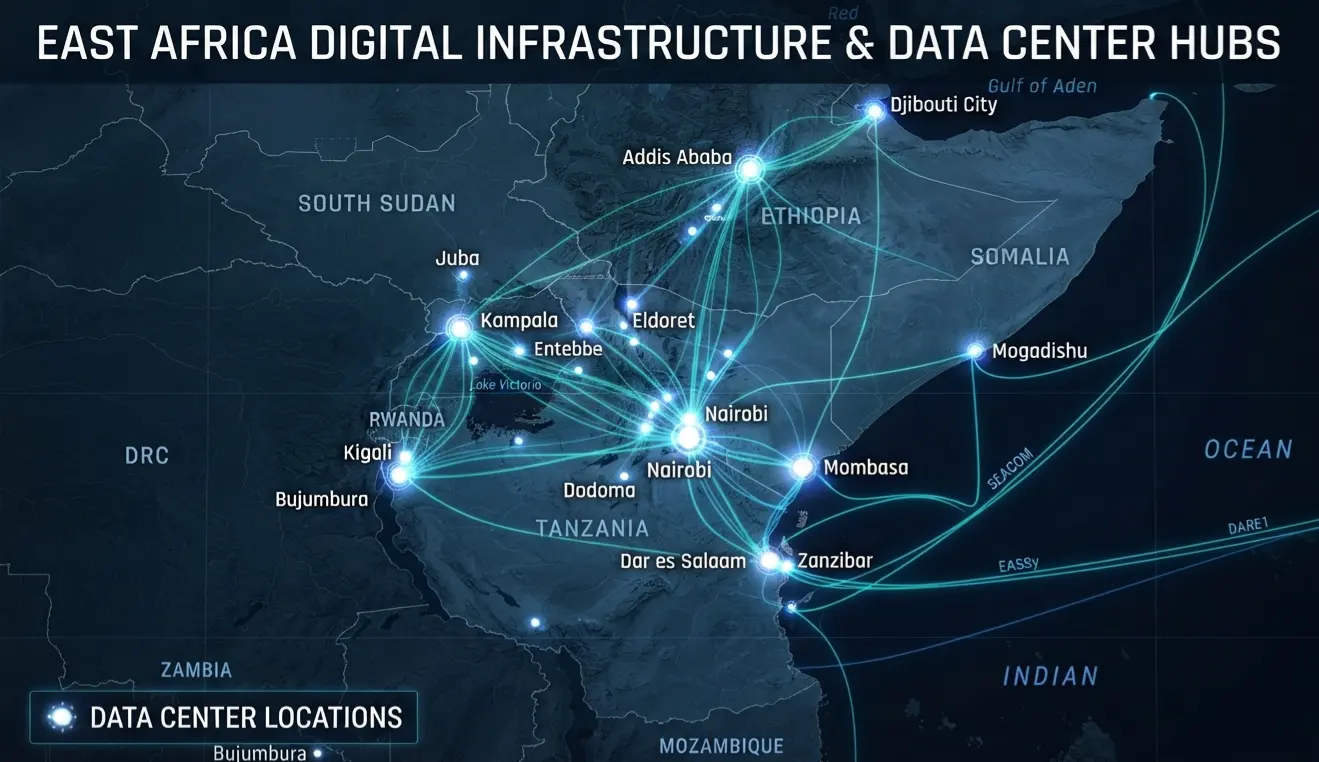
South Africa's ongoing load shedding crisis (scheduled power outages implemented by Eskom to manage supply shortages) has become, in effect, a regulatory issue for data centres. While not a regulation per se, the unreliable grid forces data centres to depend heavily on diesel generators, increasing operating costs, emissions, and maintenance requirements. The South African government has introduced tax incentives for self-generation (including solar and battery storage), but these are partial remedies for a systemic problem.
Tax Incentives
South Africa offers several incentives relevant to data centre investment. The Investment Tax Allowance allows companies to deduct 100% of the cost of qualifying assets in the year of expenditure, significantly reducing the effective cost of data centre equipment. Special Economic Zones offer reduced corporate tax rates and customs duty benefits. The Section 12B tax incentive for renewable energy generation allows data centres to deduct the cost of solar installations from taxable income.
Nigeria: High Potential, High Complexity
Nigeria is Africa's largest economy and most populous country (220 million people), making it a natural data centre market. However, the regulatory and infrastructure challenges are significant.
Licensing
The Nigerian Communications Commission (NCC) requires data centre operators to hold appropriate licences. The specific licence category depends on the services offered, facilities providing connectivity require an ISP or carrier licence, while pure colocation may fall under a different category. The NCC has been modernising its licensing framework, moving toward a technology-neutral approach that is more flexible for data centre operators.
Data Protection
Nigeria's Data Protection Regulation (NDPR), issued by the National Information Technology Development Agency (NITDA) in 2019 and updated as the Nigeria Data Protection Act (NDPA) in 2023, establishes data protection requirements including restrictions on cross-border data transfers. The NDPA is less comprehensive than POPIA or Kenya's DPA, but it is evolving. NITDA has been active in issuing guidance and enforcement notices.
The Power Problem
Nigeria's unreliable power grid is the single biggest regulatory and operational challenge for data centres. Grid power is available for only a fraction of the day in many areas, forcing data centres to run on diesel generators for the majority of their operating hours. This dramatically increases operating costs, diesel-powered electricity can cost $0.25–0.40 per kWh, compared to $0.08–0.12 from Kenya's grid. There is no regulatory solution to this problem in the near term; it requires investment in power generation and grid infrastructure that will take years.
Tax and Investment Climate
Nigeria offers the Pioneer Status Incentive, which provides a tax holiday of 3–5 years for companies in qualifying industries. Data centres have been discussed as a potential qualifying industry, though the incentive has not been consistently applied to the sector. The Nigerian Investment Promotion Commission offers facilitation services for foreign investors, and the country's large market size provides a natural demand base.
Egypt: Government-Led, Subsidised
Egypt's data centre market is driven significantly by government investment and policy direction. The country's New Administrative Capital, east of Cairo, is being developed as a technology hub with data centre infrastructure as a core component.
Licensing
The National Telecommunications Regulatory Authority (NTRA) regulates data centres in Egypt. The licensing framework is relatively straightforward, with clear categories for facility-based and non-facility-based operators. The Egyptian government has been proactive in attracting data centre investment, offering regulatory support and streamlined licensing processes for qualifying projects.
Data Protection
Egypt's Personal Data Protection Law (PDPL), enacted in 2020 and progressively implemented, establishes data protection requirements including data localisation for certain categories of government data. The law restricts cross-border transfers and requires data controllers to obtain consent or demonstrate adequate protection in the recipient country. For international operators, Egypt's data localisation requirements for government data create a clear demand driver for domestic data centre capacity.
Energy Subsidies

Egypt's data centre industry benefits from subsidised natural gas for power generation, which keeps electricity costs among the lowest in Africa at approximately $0.05–0.07 per kWh for industrial consumers. This subsidy is a significant competitive advantage, though it is contingent on government policy that could change. The government has also invested heavily in renewable energy, particularly solar, as part of its energy strategy.
Rwanda: Small but Strategic
Rwanda is Africa's smallest data centre market by physical capacity, but its regulatory environment is among the most progressive on the continent.
Licensing
Rwanda has minimal specific data centre licensing requirements. The Rwanda Utilities Regulatory Authority (RURA) regulates telecommunications, but data centres that do not provide telecommunications services may not require a specific licence. This regulatory light-touch approach is intentional, Rwanda's government has made digital transformation a national priority and has deliberately removed regulatory barriers to digital infrastructure investment.
Data Protection
Rwanda enacted its Law No. 058/2021 Relating to the Protection of Personal Data and Privacy in 2021. The law establishes data protection principles similar to GDPR and creates an data protection authority. While enforcement capacity is limited by the country's size, the legislative framework is modern and investor-friendly.
Investment Incentives
Rwanda offers some of the most aggressive investment incentives in Africa for technology companies. The Kigali Innovation City project provides tax holidays, duty-free import of equipment, and streamlined business registration. The Rwanda Development Board offers fast-track business registration (often completed within 24 hours) and dedicated support for technology investors. Corporate tax for qualifying ICT investments can be reduced to as low as 0% for an initial period.
Rwanda's challenge is market size. With a population of 14 million and a smaller economy than Kenya, Nigeria, or South Africa, the domestic demand for data centre services is limited. However, Rwanda's strategic positioning as a hub for East and Central Africa, its excellent fibre connectivity, and its government's commitment to digital transformation make it an interesting market for operators with a regional strategy.
Comparative Summary
| Factor | Kenya | South Africa | Nigeria | Egypt | Rwanda |
|---|---|---|---|---|---|
| Licensing clarity | Improving | Complex | Evolving | Clear | Minimal |
| Data protection law | Strong (DPA 2019) | Strong (POPIA) | Moderate (NDPA) | Moderate (PDPL) | Strong (2021) |
| Grid power cost | Low | Medium | Very high | Very low | Medium |
| Grid reliability | Good | Poor | Poor | Good | Good |
| Tax incentives | SEZ available | IAA, SEZ | Pioneer status | Gas subsidies | Aggressive ICT incentives |
| Market size | Large | Very large | Very large | Large | Small |
| Data localisation | Restricted transfers | Restricted transfers | Partial requirements | Government data | Discussed, not enacted |

What Kenya Can Learn
Kenya's regulatory framework is competitive and improving, but there are lessons from other African markets. From South Africa, Kenya can learn the value of tax incentives that directly target data centre investment, the Investment Tax Allowance that allows 100% upfront deduction of equipment costs would significantly reduce the capital barrier for new facilities. From Rwanda, Kenya can learn the value of regulatory simplicity, a fast-track licensing process for data centre operators, with clear timelines and transparent criteria, would reduce the uncertainty that deters investment.
From Egypt, Kenya can observe the strategic value of deliberate government direction, the New Administrative Capital project demonstrates how government commitment to a specific location can catalyse private investment. And from all markets, Kenya can observe that the trend toward stricter data protection and data transfer restrictions is accelerating, which structurally benefits domestic data centre capacity.
For investors evaluating African data centre opportunities, the regulatory framework is one of several factors (alongside market size, connectivity, power, and skills) that determine where to invest. Kenya's combination of improving regulation, competitive energy costs, and strategic connectivity positions it well, but continued regulatory refinement is essential to maintain this advantage as other markets improve their own frameworks.