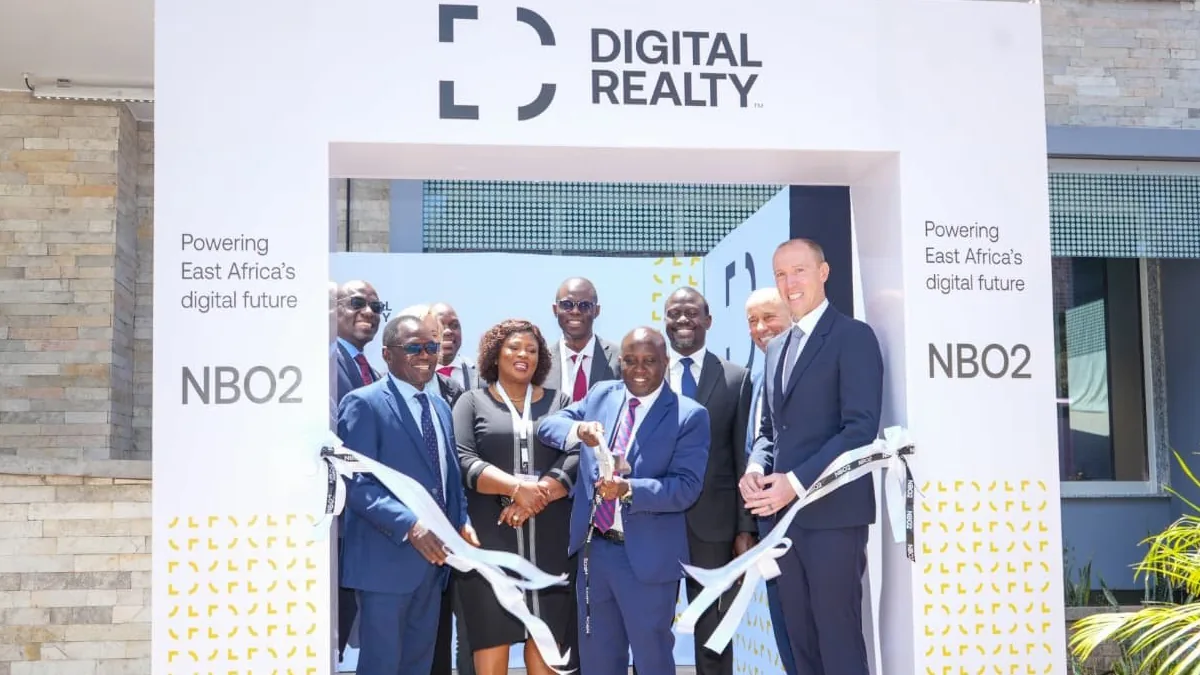
On 7 September 2026, Digital Realty formally launched NBO2, the second facility of the iColo campus it inherited when it acquired the Kenyan carrier-neutral operator. The event drew the state's digital establishment: ICT and Digital Economy Principal Secretary John Tanui framed the launch as part of the government's push to make Kenya the region's digital hub, and Digital Realty's own announcement carried the year's most borrowed phrase, Nairobi as East Africa's "digital gateway".
The launch matters. Our directory has carried NBO2 since our September re-verification, and it fills a genuine gap: Kenya's carrier-neutral capacity has been concentrated in a handful of buildings, and a second large neutral site in Karen adds real supply to a market growing at roughly 30% a year. But a launch press release is a starting point for verification, not the end of it, so here is what the evidence supports today, and what the "gateway" language still has to earn.
What actually launched
The physical facts first. NBO2 sits on Bogani East Road in Karen, near its sibling NBO1, the facility iColo launched in September 2019 as "the first truly carrier-neutral data centre in Nairobi". The building is specified at 3,600 m² with 2N power, N+2 cooling, ISO 27001 and PCI-DSS claims per the Digital Realty listing. Developing Telecoms reported in August 2024 that NBO2 carries a 6.5 MW design IT load, expected online in Q3 2025, within a master plan of three data centres plus a captive substation consuming over 20 MW at full build. That master plan (three buildings, 18,000 m² on the Karen side, 13 MW and 1,800 racks at the Mombasa campus) is the strategic story Digital Realty is buying into: iColo already runs the largest facility count in Kenya, with four buildings across Nairobi and Mombasa.

What was not published at launch, and what we flagged on NBO2's directory entry: the commissioned (as opposed to design) IT load, the number of halls fitted out, and the commercial live date for general colocation. None of this is criticism, it is the standard gap between a ribbon-cutting and a ramp. The discipline is to price the facility on what is commissioned, not on the master plan.
Days after the ribbon-cutting, follow-on coverage filled in the government's side of the ledger. Powers of Africa reports that Principal Secretary Tanui used the inauguration to encourage Digital Realty to keep expanding toward a 20 MW campus (a target that lines up with the master plan's captive substation, already sized for more than 20 MW at full build) and pledged that "work will continue on the policy front to position Kenya as an attractive investment destination." The launch coverage also spells out the campus-level pitch: access to more than 100 networks, two internet exchange points and a satellite teleport, with customers able to distribute workloads between NBO1 and NBO2 as a built-in business-continuity pair. Read that framing carefully, though, those connectivity figures describe what the wider campus and its ecosystem offer, not NBO2's own building-level register, which is the number that has to climb for the gateway claim to cash out.
The gateway claim, and the one number that decides it
"Digital gateway" is a claim about traffic, not buildings. The single best public proxy for whether a building is becoming a gateway is its registered interconnection (the number of networks present) and this is where NBO2's evidence is thinnest. The PeeringDB record for NBO2 (last updated September 2025) showed two networks and a single internet exchange, against NBO1's 62 networks and four exchanges. Our own data methodology treats PeeringDB as a cross-check rather than ground truth, and the register is community-maintained, new buildings are often under-registered. But the direction is unambiguous: NBO2 is a real, formally launched, still-ramping building.
For the gateway claim to cash out, three things have to happen, and each is observable:
- Networks move in. NBO1 took years to accumulate its density, and it is interconnection and peering, not floor space, that turns a building into a gateway. Watch whether NBO2's registered count climbs from two toward double digits within its first year, and whether the exchanges on site grow beyond one.
- Content and cloud land. The 27 January 2026 announcement that iXAfrica will host Oracle Cloud Infrastructure's Nairobi region shows what a gateway transaction looks like: a hyperscaler committing to local capacity. If Digital Realty lands a comparable cloud on-ramp at NBO2, the claim strengthens materially.
- Cable economics show up in pricing. A gateway is supposed to lower the cost of reaching the world. If cross-connect and IP transit pricing at Karen converges toward (or beats) the Mombasa Road corridor, that is the market voting.
Why Digital Realty bought iColo in the first place
The launch is also a window into the consolidation logic reshaping African digital infrastructure. Digital Realty (one of the world's largest data centre companies) did not need another building; it needed the carrier-neutral franchise in East Africa's best-connected market, and iColo was exactly that: four facilities, the densest interconnection point on the Kenyan coast (MBA1 in Miritini, 94 networks), and a decade of neutrality credentials. NBO1 and NBO2 gave it the Nairobi footprint; MBA1 and MBA2 gave it the cable-landing play.
For Kenyan buyers, the consolidation cuts both ways. The upside: capital depth, global standards playbooks, and the kind of master-plan patience (captive substations, three-building campuses) that local capital struggles to fund. The caveat: every Kenyan carrier-neutral market now has a Digital Realty price-maker in it. Buyers negotiating colocation in Karen should do what our buyer's guide always recommends, benchmark against ADC NBO1, iXAfrica and PAIX, and ask for as-built capacity in the specific hall, not the campus brochure figure.
What it means for the market this quarter
Three practical takeaways. First, Kenya's operating map now has 27 verified entries in our directory, but only eight genuinely carrier-neutral buildings, so every new neutral rack is absorbed quickly; NBO2's ramp is worth watching monthly. Second, the competitive response is already in the market: iXAfrica's 22.5 MW Mombasa Road campus expansion, the Tilisi land commitment, and Africa Data Centres' Sameer expansion are all racing the same demand curve, which means pricing power is shifting to buyers in the near term, whatever the press releases imply. Third, for the government's hub ambitions, the binding constraint remains power delivery and interconnection density, not concrete. Our market-in-numbers reference tracks all three, and the NBO2 entry will be re-verified the moment its interconnection record moves.