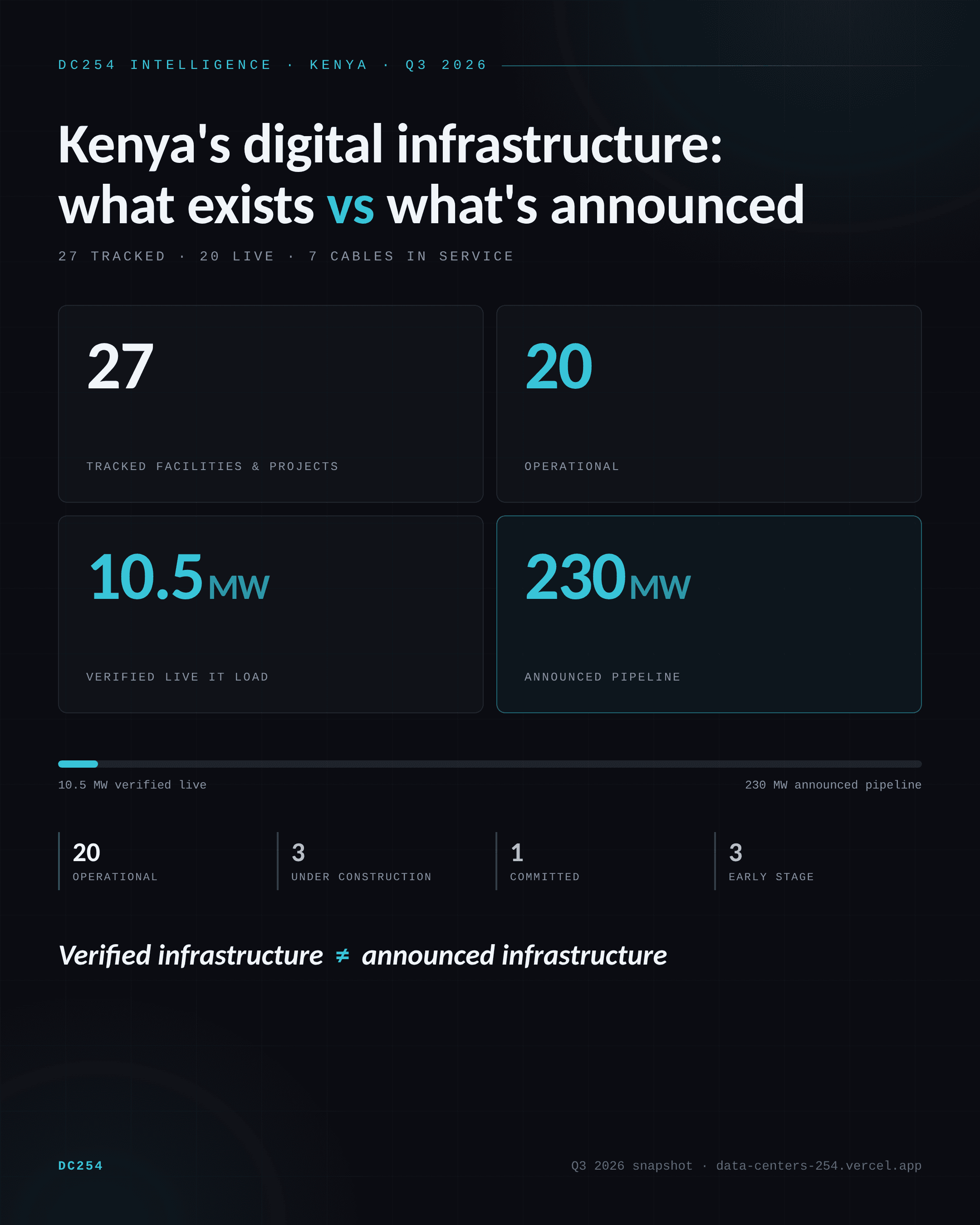
Kenya's digital infrastructure is bigger than the headlines suggest, but smaller than the announcements. The DC254 Q3 2026 snapshot tracks 27 facilities and projects in Kenya, and not all of them are real today. 20 are operational. The other 7 are under construction, committed or early-stage. On capacity, 10.5 MW of IT load is verified as live, against a 230 MW announced pipeline. On connectivity, 7 submarine cable systems are in service at Mombasa. That gap between what exists and what is announced is not a contradiction. It is the single most useful thing to understand about Kenya's digital economy right now.
What do the 27 tracked records actually contain?
Every DC254 directory record carries a status, and the four statuses mean very different things.
| Stage | Kenya records | Announced MW | What it means |
|---|---|---|---|
| Operational | 20 | 42.9 designed | Built and running; 10.5 MW published as live IT load |
| Under construction | 3 | 77 | Capital committed, structures going up |
| Committed | 1 | 53 | Developer has committed to build, site prep or design underway |
| Early stage | 3 | 100 stated, 2 unquantified | Announced intent only; nothing is guaranteed |
Under construction covers iXAfrica NBOX1.2 (18 MW), Africa Data Centres Nairobi 2 (15 MW) and Nxtra by Airtel at Tatu City (44 MW). The one committed record is iXAfrica NBOX2 at Tilisi (53 MW). In early stage, the Microsoft and G42 AI data centre carries a stated 100 MW, while Raxio Nairobi and the Kenya Data Centres SME Facility have no verified MW figure yet. Read the ladder from bottom to top and the pattern is clear: the further a record sits from operational, the less certain its numbers become.
Where does Kenya's digital infrastructure actually sit?
Nairobi holds 19 of the 27 tracked records, about 70 percent. Mombasa holds 4, and all four are operational. Konza, Limuru and Thika each have one operational facility, and Ruiru has the Nxtra project at Tatu City. Two facts follow from this split. First, the live base is more distributed than people assume: operators run facilities along the coast, in the capital and in satellite towns. Second, the entire announced pipeline is a Nairobi-metro story. Every one of the 7 non-operational records sits in Nairobi or its metropolitan fringe, which means the next 230 MW, if it gets built, lands where the demand, fibre and staff already are.
How big is the gap between 10.5 MW live and 230 MW announced?
The announced pipeline is roughly 22 times the verified live base. That ratio is striking, but the honest reading is more careful. The 10.5 MW is a floor, not a ceiling: only 8 of the 20 operational facilities publish a verified live IT load figure, so Kenya's real running load is certainly higher and unmeasured in public data. The 230 MW, meanwhile, is not a forecast. It spans very different confidence levels: 77 MW is physically under construction, 53 MW is committed, and 100 MW rests on a single early-stage announcement. If the Microsoft and G42 project alone were delivered, it would multiply Kenya's live capacity nearly tenfold. If it slipped, the pipeline would shrink by 43 percent overnight. That is why DC254 reports the two numbers side by side and never adds them into one figure.
Why do cables in Mombasa not equal compute in Nairobi?
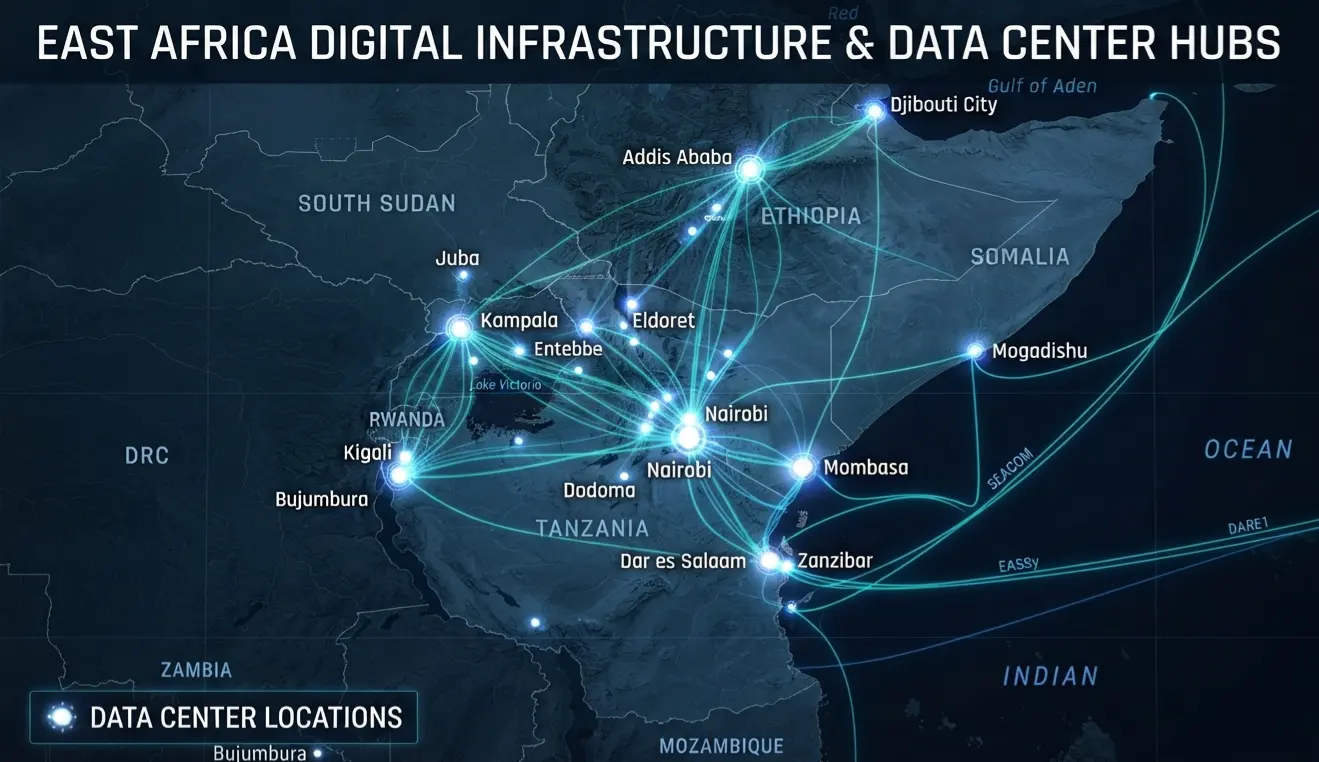
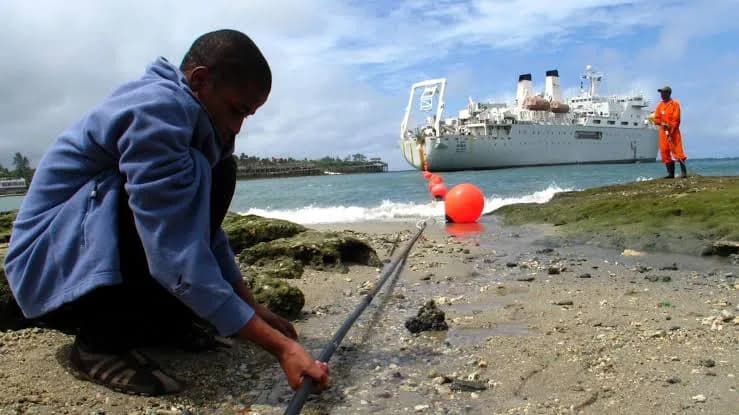
Connectivity is Kenya's most mature layer. TEAMS and SEACOM arrived in 2009, EASSy in 2010, LION2 in 2012, DARE1 in 2021, PEACE in 2022 and 2Africa in 2024. Africa-1 has already come ashore but has not announced readiness for service, so DC254 does not count it as live. Daraja is announced and LuLu is planned. Seven systems in service over fifteen years is genuine maturity.
But a cable is not a data centre. International capacity lands at Mombasa, then travels over terrestrial fibre to internet exchange points in Nairobi, and only then reaches the facilities where compute actually runs. Operators cite Kenya's grid, more than 75 percent renewable, as the power draw. Each link in that chain, cable, landing station, fibre, IXP, data centre, power, has its own live-versus-announced split. Connectivity into the country is not the same thing as capacity inside it.
How should you read infrastructure announcements?
The discipline DC254 applies is simple. A facility can be operational, under construction, committed or early stage, and each label is a different kind of fact. A cable can be in service, landed with readiness pending, or still a drawing. Capacity can be verified live, built and designed, or announced pipeline. Wednesday's Inside the Map piece showed how we decide whether a cable is truly live. The same method separates Kenya's 20 live facilities from its 230 MW of announcements. When a headline says Kenya is building a hyperscaler market, check which rung of the ladder the project actually sits on. What exists is real infrastructure. What is announced is intention. DC254 tracks both, and never lets them blur.