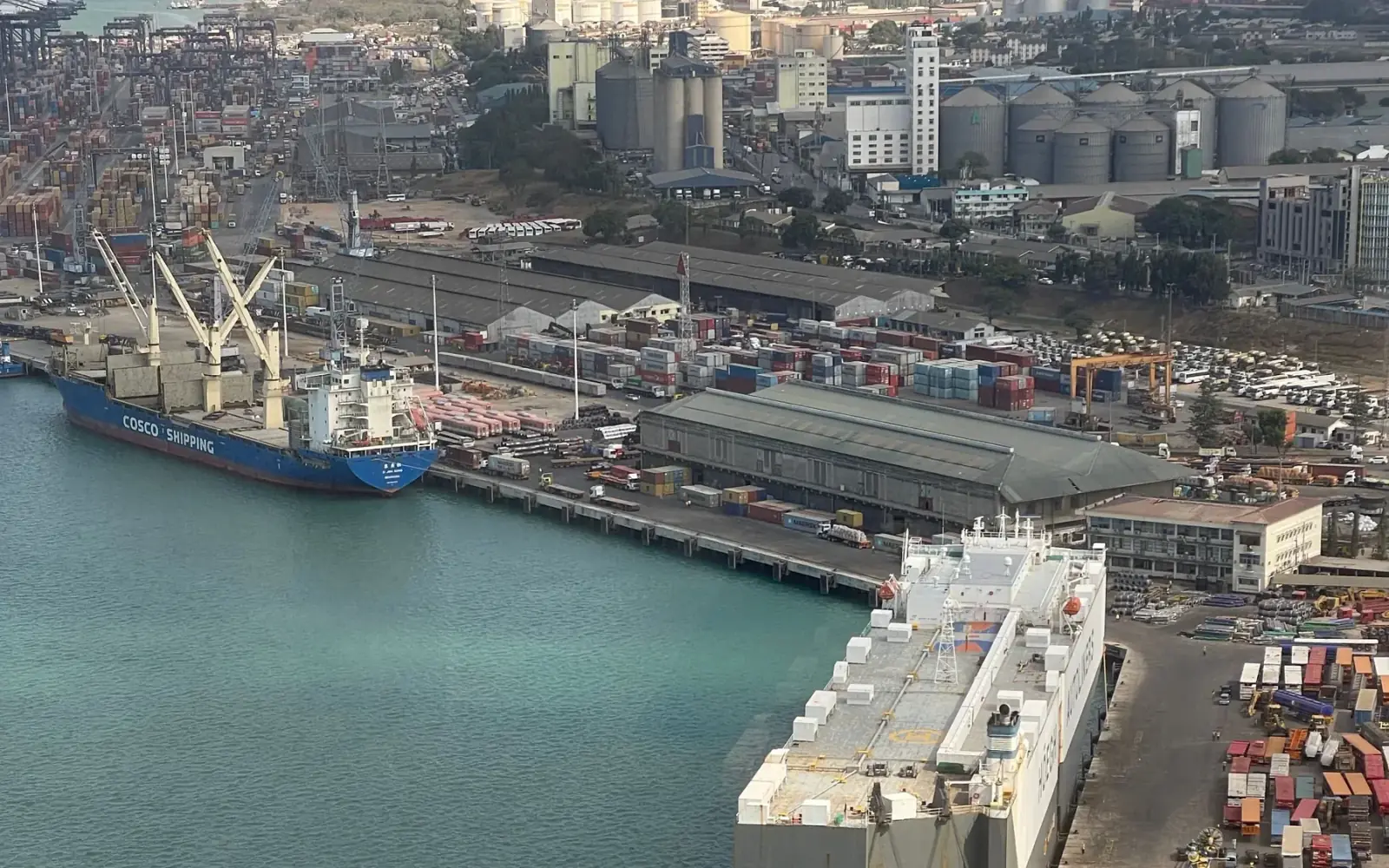
Mombasa sits at the eastern edge of Kenya's coastline, and beneath its waters run the fibre optic cables that connect over 300 million people in East and Central Africa to the global internet. Seven live submarine cable systems land at stations along the Mombasa coast, with two more landed or in development, making this city the single most important internet gateway in the region. Every WhatsApp message sent from Nairobi, every M-Pesa transaction processed, and every Netflix stream watched in Kenya begins or ends its oceanic journey here.
Submarine cables are the physical backbone of the internet. Despite the proliferation of satellite services like Starlink, more than 99% of intercontinental data traffic travels through these undersea fibre lines. For Kenya and its landlocked neighbours (Uganda, Rwanda, Burundi, South Sudan, and eastern DRC) Mombasa is the doorway to the digital world.
The Cables That Land in Mombasa
Kenya's first submarine cable, TEAMS (The East African Marine System), landed in 2009. Before TEAMS, Kenya's international internet traffic was routed through satellite links or through neighbouring countries' cables, resulting in high latency and prohibitive costs. TEAMS was a game-changer: it reduced international bandwidth costs by over 90% and catalysed Kenya's tech boom.
The cables currently landing in Mombasa include:
-
TEAMS (2009), Owned by Telkom Kenya on behalf of the Kenyan government. Initial capacity 1.28 Tbps, subsequently upgraded. Connects Kenya to the United Arab Emirates and onwards to Europe and Asia.
-
SEACOM (2009), Privately owned, connects South Africa, Mozambique, Tanzania, and Kenya to Europe and India. Played a crucial role in breaking the bandwidth monopoly in East Africa.
-
EASSy (2010), The Eastern Africa Submarine System, a 21-member consortium cable running from South Africa to Sudan, with a branch landing in Mombasa. Connects to Europe via multiple landing points.
-
LION2 (2012), The Lower Indian Ocean Network 2, an Orange-led cable linking Mombasa to Madagascar and Réunion. Ready for service since April 2012.
-
DARE1 (2021), The Djibouti Africa Regional Express, in service since February 2021 and connecting Djibouti, Mogadishu and Mombasa. Designed to provide diversity and redundancy for landlocked East African nations.
-
2Africa (2024), One of the largest subsea cable projects globally, built by a consortium led by Meta. Its Kenya segment went live in June 2024, it lands at Mombasa and Mtwapa, and it delivers 180 Tbps of design capacity, dwarfing all previous cables.
-
Africa-1 (landed 2024), A Telecom Egypt-led consortium cable connecting Africa to Asia via the Indian Ocean, with landings in Mombasa, Karachi and Egypt. The cable has come ashore at Mombasa but its ready-for-service date has not been announced, so DC254 does not count it among the live systems yet.
-
PEACE (2022), Pakistan and East Africa Connecting Europe, with a branch to Mombasa. Provides a new route to Europe via Pakistan and the Middle East.
The cumulative design capacity of the live systems approaches 300 Tbps, an almost incomprehensible amount of bandwidth that positions Mombasa as one of the most connected coastal cities on the African continent.
One more system is on the way. Daraja, a Meta-backed cable hosted by Safaricom, was announced in October 2025 to run from Salalah in Oman to Mombasa with 24 fibre pairs. It is in development and does not change the live count yet. Meta's subsea ambitions extend beyond African landings: its Petal system, announced in September 2026, will be the first petabit-class transoceanic cable, a signal of where the trunk capacity above Mombasa's routes is heading, even though Petal itself does not land in Africa.
One development changes the geography without changing that count. At ITW Africa 2026 (September 2026), a consortium led by INDOI Ltd. (IOX) and Blue Trade Investments announced LuLu, a planned ~500km coastal cable system running from Mombasa to Lamu with landing points at Vipingo Special Economic Zone, Kilifi and Malindi in between. LuLu is not a tenth international system, it is Kenya's first dedicated coastal diversity route, pairing a subsea span (144 fibre pairs, up to 60 Tbps per pair) with a protected terrestrial path along the whole corridor. Its readiness-for-service target is Q2 2028, subject to contract execution; as of the announcement, no supplier was named and construction had not started. Full status check: the LuLu coastal cable system.
From Ocean Floor to Nairobi: How the Connection Works
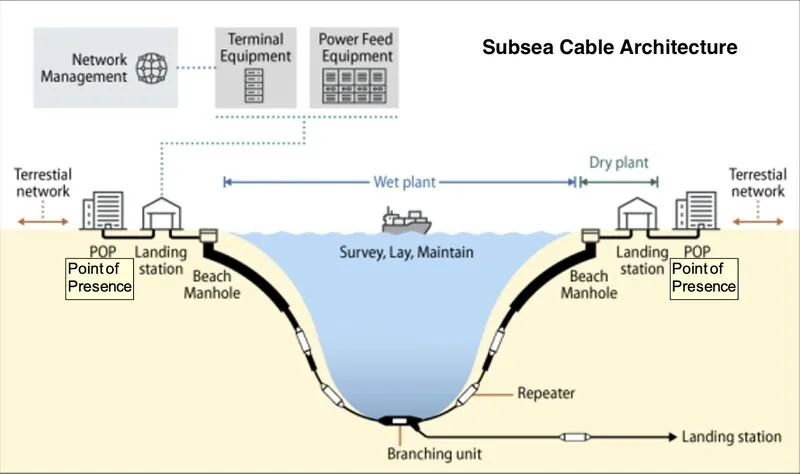
A submarine cable does not plug directly into your phone. The journey from ocean floor to data centre involves several stages, each with its own infrastructure.
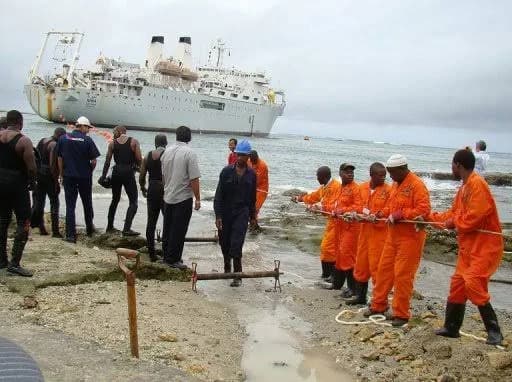
When a submarine cable reaches shore, it terminates at a cable landing station, a purpose-built facility typically located in a secure, nondescript building near the coast. Inside, the cable's fibres are connected to terminal equipment that amplifies and splits the optical signals. From the landing station, the connection travels overland via terrestrial fibre (typically along railway lines, road reserves, or power line easements) to data centres in Nairobi, a distance of approximately 500 kilometres.
In Nairobi, the cables connect to facilities like the Kenya Internet Exchange Point (KIXP), where local traffic is handed off between ISPs, and to international carrier-neutral data centres like iXAfrica and Africa Data Centres, where global content providers and cloud platforms maintain their presence.
The architecture means that traffic from a user in Nairobi to a Google server in Europe travels: user device → local ISP → terrestrial fibre → Mombasa landing station → submarine cable → European landing station → terrestrial fibre → Google data centre. The round trip takes roughly 100-150 milliseconds, which is fast enough for real-time applications like video calls and online gaming.
Why Mombasa and Not Elsewhere?
Mombasa's dominance as a cable landing point is not accidental. Several factors make it the natural choice:
Geography. Mombasa is Kenya's principal deep-water port, with a natural harbour and proximity to the open Indian Ocean shipping lanes where cables are laid. The ocean floor topology off the Mombasa coast is also suitable for cable deployment.
Proximity to Nairobi. The 500 km terrestrial fibre route from Mombasa to Nairobi is one of the shortest in the region. Nairobi, as East Africa's largest economy and the location of most data centres, is the natural destination for international bandwidth.
Existing infrastructure. Once the first cable (TEAMS) established landing station infrastructure in Mombasa, subsequent cables could share or co-locate at the same facilities, reducing the cost and complexity of new landings.
Market size. Kenya's large and growing economy, combined with its role as a gateway for landlocked neighbours, creates sufficient demand to justify multiple cable landings. No other Kenyan coastal city offers the same combination of market access and infrastructure.
What Happens When a Cable Is Cut?
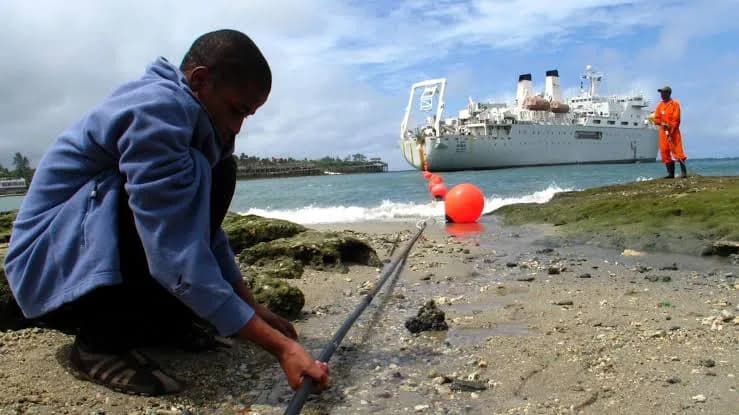
Submarine cables are vulnerable to damage from ship anchors, fishing trawlers, underwater landslides, and occasionally deliberate sabotage. Cable cuts are more common than most people realise, the Submarine Cable Almanac records dozens of outages globally each year.
Kenya's multi-cable architecture provides natural redundancy. If TEAMS is cut, traffic can reroute through SEACOM, EASSy, or 2Africa. The data centre licensing framework also requires operators to maintain diverse connectivity paths, which further protects against single points of failure.
The real risk is not a single cable cut but a simultaneous outage affecting multiple cables. This can happen if cables share a common geographic hazard, for example, if several cables pass through the same narrow strait and a single event damages all of them. The Indian Ocean has experienced such events, but Kenya's cable diversity (landing at geographically separated stations where possible) mitigates this risk.
Repair times vary. Shallow-water repairs near shore can be completed in days. Deep-water repairs in the open ocean typically take two to six weeks, depending on the availability of repair ships and weather conditions.
The Satellite Question: Is Mombasa Still Relevant?
Low Earth orbit (LEO) satellite constellations like Starlink, OneWeb, and Amazon's Project Kuiper are often presented as alternatives to submarine cables. For some use cases (particularly in remote areas far from fibre infrastructure) they are transformative. But for Kenya's international connectivity, satellites complement rather than replace submarine cables.
Submarine cables still offer orders of magnitude more bandwidth at lower cost per bit than any satellite system. A single modern cable like 2Africa (180 Tbps) carries more capacity than all LEO satellites combined. Cables also have lower and more consistent latency, which matters for financial trading, real-time collaboration, and cloud computing workloads.
Where satellites excel is in providing connectivity to areas where terrestrial fibre is not available or economically viable. In Kenya, this means remote northern and north-eastern regions, and potentially as backup for critical government services. But the backbone of Kenya's digital economy remains the submarine cables landing in Mombasa.
What This Means for Data Centres
The density of submarine cable connectivity in Mombasa is a significant competitive advantage for Kenya's data centre industry. International content providers and cloud platforms (Google, Microsoft, AWS, Netflix) need to be close to their users to deliver low-latency, high-quality experiences. Kenya's cable connectivity, combined with the data centre capacity in Nairobi, makes the country a natural hub for serving the East African market of over 300 million people.
This is why companies like iXAfrica and Africa Data Centres are investing heavily in Nairobi, not just for the Kenyan market, but to serve as a regional hub for East and Central Africa. The submarine cables that land in Mombasa are the fundamental reason this strategy works.