When a Kenyan bank decides to move its core banking platform to the cloud, when a startup chooses where to host its application, or when a government agency evaluates options for its digital services, the same question arises: which cloud provider is right for us? The answer is rarely straightforward. It depends on latency requirements, data residency regulations, budget constraints, technical requirements, and the organisation's long-term strategy.
Kenya's cloud market in 2025 is served by a mix of global hyperscale providers operating remotely, local telecom operators offering cloud services from Kenyan data centres, and a growing number of managed service providers that help enterprises navigate the complexity. Understanding the landscape (who offers what, where the actual servers are, and what the trade-offs are) is essential for making informed decisions.
The Global Hyperscalers in Kenya
The three global cloud providers, Amazon Web Services (AWS), Microsoft Azure, and Google Cloud Platform (GCP), all serve Kenyan customers, but none of them operates a cloud region within Kenya's borders. This single fact shapes the entire competitive landscape.
Amazon Web Services (AWS)
AWS is the dominant cloud provider in Africa by market share, and Kenya is no exception. AWS launched its Africa (Cape Town) region in April 2020, becoming the first hyperscaler to have a physical presence on the African continent. The Cape Town region has three availability zones, providing the redundancy that enterprise customers require.
From Nairobi, accessing AWS Cape Town involves traversing approximately 4,000 kilometres of submarine and terrestrial fibre, with typical round-trip latency of 50–80 milliseconds. For most business applications (web applications, APIs, databases serving internal users) this latency is acceptable and often imperceptible. For real-time applications like high-frequency trading, multiplayer gaming, or interactive video, it can be noticeable.
AWS has been proactive in building its Kenyan ecosystem. The company operates AWS Direct Connect partnerships with data centre operators in Nairobi, allowing dedicated, private network connections between customer equipment in Nairobi and AWS Cape Town. These Direct Connect connections bypass the public internet, providing more consistent latency and bandwidth. AWS also runs active training and partner programmes in Kenya, working with local universities and technology companies to build cloud skills.
AWS's strength is breadth: with over 200 fully featured services spanning compute, storage, databases, machine learning, analytics, Internet of Things, and serverless computing, AWS offers the most comprehensive cloud platform available. For organisations with complex or diverse cloud needs, this breadth is a significant advantage. The ecosystem of third-party tools, consulting partners, and pre-built solutions that has developed around AWS is also the largest of any cloud provider.
Microsoft Azure
Microsoft Azure has been the most aggressive of the three hyperscalers in building a local presence in Kenya, not through a cloud region, but through partnerships and programmes that give it an on-the-ground advantage. Microsoft operates Azure regions in Johannesburg and Cape Town in South Africa, and in Bahrain for the Middle East. Latency from Nairobi to Johannesburg is comparable to AWS Cape Town, at 50–80 milliseconds.

Azure's unique advantage in Kenya is Microsoft's deep enterprise relationships. Microsoft products (Windows Server, Active Directory, Microsoft 365, SQL Server, Dynamics) are already deeply embedded in Kenyan banks, government agencies, and enterprises. Azure's integration with these existing systems makes it the path of least resistance for organisations that are already in the Microsoft ecosystem. A bank running SQL Server on-premises can migrate to Azure SQL Database with minimal application changes. A government agency using Microsoft 365 can extend its identity management to Azure Active Directory (now Microsoft Entra ID) for cloud workloads.
Azure also benefits from Microsoft's investment in the Kenyan developer ecosystem. The Microsoft Africa Development Centre (ADC) in Nairobi employs hundreds of engineers working on global Microsoft products, and the company's partnership programmes with Kenyan universities, its AI Centre of Excellence, and its engagement with the Kenyan government's digitalisation agenda give it visibility and relationships that AWS and Google Cloud cannot easily match.
Google Cloud Platform (GCP)
Google Cloud is the third hyperscaler and, in Kenya, the smallest of the three by market share. Google Cloud's nearest region to Kenya is also in Johannesburg (launched 2023), with additional regions in Europe and the Middle East. Google Cloud's strength is in data analytics, machine learning, and open-source technologies, areas where Google's internal expertise, built through running its own global services (Search, YouTube, Gmail), translates into superior cloud offerings.
For Kenyan organisations, Google Cloud's appeal is primarily in specific use cases: organisations running Kubernetes (Google created and open-sourced Kubernetes), companies building data lakes and analytics pipelines (BigQuery is widely regarded as the best cloud data warehouse), and startups building AI/ML applications (Vertex AI, TensorFlow, and Google's pre-trained models). Google Cloud often has the most aggressive pricing for compute-intensive workloads, which can make it attractive for cost-sensitive startups and research institutions.
The Local Players
While the hyperscalers dominate the conversation, local cloud providers play an important role in Kenya's market, particularly for organisations with strict data residency requirements or those that prefer local support and relationship management.
Safaricom Cloud
Safaricom, Kenya's largest telecom operator, offers cloud services from its own data centres in Nairobi. Safaricom Cloud provides virtual machines, storage, backup, networking, and some managed services, positioning itself as the local alternative to global providers. Its primary value propositions are data residency (data stays in Kenya, on Kenyan soil), low latency (sub-5ms for Kenyan users), local support in English and Swahili, and the ability to bundle cloud with connectivity (fibre and mobile) in a single contract.

Safaricom Cloud's limitations are real. Its service catalogue is much narrower than the hyperscalers, it lacks the breadth of managed services, AI/ML platforms, serverless computing, and advanced analytics that AWS and Azure offer. Its ecosystem of third-party tools and consulting partners is smaller. And its global reach is, by definition, limited to Kenya. For a Kenyan bank that needs to serve customers across East Africa, or a startup that plans to expand to Nigeria, Safaricom Cloud cannot provide the multi-region deployment that hyperscalers offer.
Despite these limitations, Safaricom Cloud has a genuine market. Government agencies subject to data sovereignty requirements, banks that want their core systems in Kenya, and SMEs that value the simplicity of a single local provider all find value in Safaricom's offering.
Africa Data Centres as a Cloud Enabler
Africa Data Centres (ADC), the largest colocation provider in Africa, plays an indirect but important role in the cloud market. By providing carrier-neutral data centre facilities in Nairobi, ADC enables global cloud providers and their partners to establish a physical presence in Kenya without building their own data centres. AWS Direct Connect, Azure ExpressRoute, and Google Cloud Interconnect can all be delivered through ADC facilities, providing Kenyan customers with dedicated, lower-latency connections to cloud regions in South Africa and beyond.
Managed Service Providers
A growing ecosystem of Kenyan managed service providers (MSPs) helps enterprises navigate cloud adoption. Companies like Phase2, Internet Solutions, and various local IT firms offer cloud consulting, migration, and managed services that sit on top of the hyperscaler platforms. These MSPs provide the local expertise and ongoing support that hyperscalers cannot deliver directly, bridging the gap between global cloud platforms and Kenyan enterprise needs.
Comparing the Options: Key Decision Factors
Latency
Latency is often the first factor organisations consider, and it is where the gap between local and global providers is most tangible. Hosting in a Nairobi data centre provides sub-5ms latency for users in Nairobi, and sub-20ms for users anywhere in Kenya. Accessing cloud services in South Africa adds 50–80ms. For most business applications, this is acceptable. For real-time applications, it matters.
Data Residency and Sovereignty
Kenya's Data Protection Act (2019) places requirements on how personal data is processed and where it can be transferred. While the Act does not absolutely prohibit cross-border data transfer, it requires that transfers be to jurisdictions with adequate data protection standards. For government agencies handling citizen data, for banks regulated by the Central Bank of Kenya, and for healthcare providers handling patient records, the safest approach is to keep data in Kenya. This is a clear advantage for local providers like Safaricom Cloud and for colocation in Kenyan data centres.
Pricing
Cloud pricing is notoriously complex, and direct comparisons between providers are difficult because each offers different services, different pricing models, and different discount structures. As a general guide, compute pricing (virtual machines with equivalent specifications) is broadly similar across AWS, Azure, and GCP for on-demand instances, with the main differentiator being reserved instance and committed-use discounts. Local providers like Safaricom Cloud are competitive for basic virtual machines but may be more expensive for specialised services where hyperscalers achieve economies of scale.
Ecosystem and Services
AWS leads in service breadth (200+ services), Azure leads in enterprise integration and Microsoft ecosystem compatibility, and Google Cloud leads in data, AI/ML, and open-source tooling. Local providers offer a narrower catalogue but may excel in specific local needs (local compliance, local support, integration with local connectivity).
The Emerging Trend: Hybrid and Multi-Cloud
The most significant trend in Kenya's cloud market is the adoption of hybrid and multi-cloud strategies. Rather than choosing a single provider, many organisations are using a combination: keeping latency-sensitive and data-sensitive workloads in local data centres while running batch processing, development, and disaster recovery in global cloud regions. This approach maximises the strengths of each platform while mitigating the weaknesses of any single provider.
For Kenyan organisations, the hybrid model is particularly practical. It allows banks to keep core banking systems in Nairobi for low latency and regulatory compliance, while using AWS or Azure for development, testing, data analytics, and disaster recovery. It allows government agencies to keep citizen data onshore while leveraging global cloud capabilities for non-sensitive workloads. And it reduces vendor lock-in by distributing workloads across multiple providers.
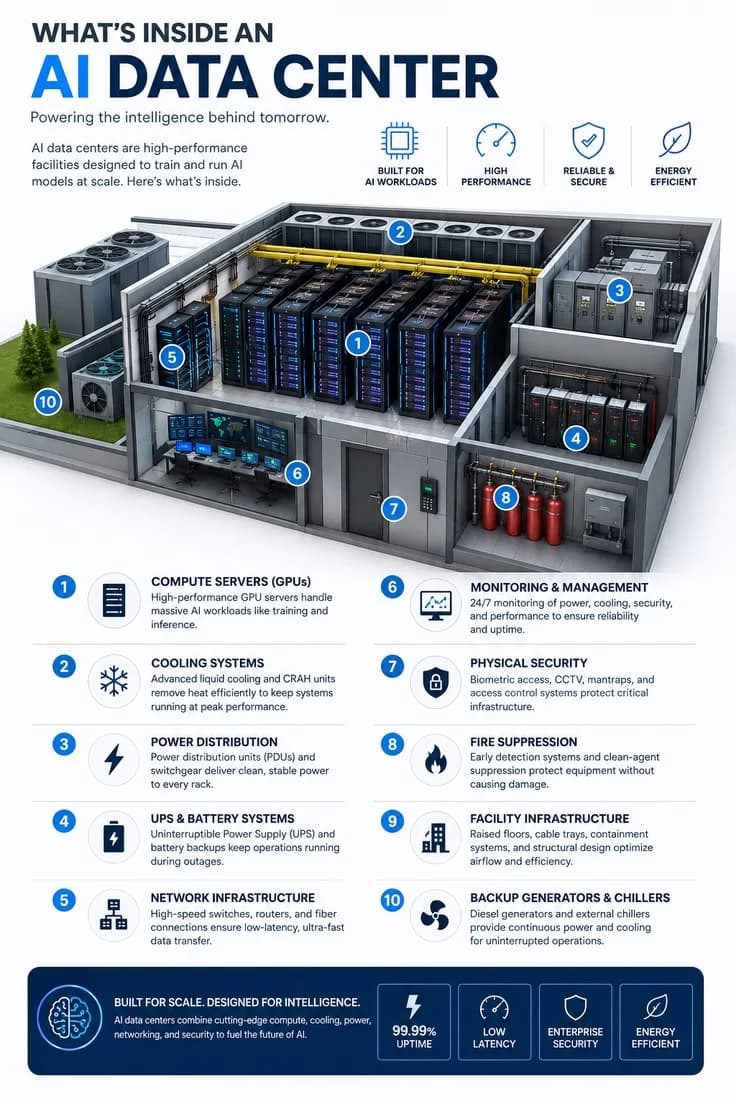
The data centre infrastructure being built in Kenya, carrier-neutral facilities with Direct Connect capabilities, interconnection to multiple cloud providers, and high-speed fibre connectivity, is the physical foundation that makes these hybrid strategies possible. As the cloud market matures, the quality of local data centre connectivity will increasingly determine how effectively Kenyan organisations can leverage global cloud services while meeting local requirements.