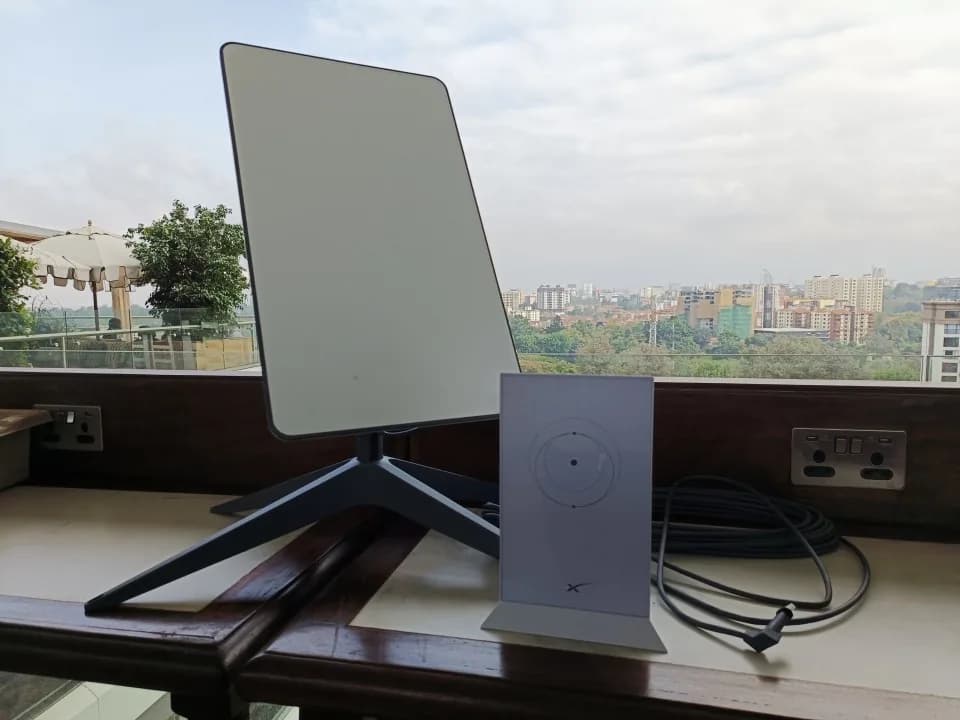
When Starlink switched on in Kenya in July 2023, the conversation was about homes: rural families, remote workers, the places fibre had never reached. Three years later the more interesting story is enterprise. Kenya has 25,000 Starlink dishes as of March 2026 (Communications Authority data via Tech-ish, 19 June 2026), a licensing regime that just made satellites considerably more expensive to operate (Techlabari, 8 April 2026), a network that hit capacity limits in July 2026 (TechCabal, 7 July 2026), and a growing number of businesses asking the question this article answers: what is satellite actually for, in a country whose data centres run on fibre and undersea cables?
The numbers: fast growth, small share, real limits
Start with the facts. Starlink launched in Kenya in July 2023 (The Kenya Times, 23 September 2025) and recorded nearly 2,000 percent subscriber growth in its first year, with aggressive pricing that put a mini kit at KSh 27,000 and promotional monthly service around KSh 1,300 by October 2024 (Space in Africa, 14 October 2024). Growth then moderated: 7,933 net additions in the year to March 2026, against 12,562 the year before (Space in Africa, 21 June 2026). The base stood at 24,999 subscribers in March 2026, about 0.9 percent of fixed internet (Tech-ish, 19 June 2026), and in July 2026 the company limited new signups as the Kenyan network reached capacity (TechCabal, 7 July 2026).
Read those numbers like a data centre operator would. A 0.9 percent share is not a fibre competitor; Kenya's fixed market is fibre-first and the big providers kept their customers by cutting prices and improving packages. But 25,000 diverse, independent, non-terrestrial links is a meaningful resilience layer for the enterprises that bought them, and the July 2026 capacity clamp is the reminder that satellite capacity is a shared, finite resource in a way a fibre pair is not.

What Starlink is actually good for in enterprise Kenya
The honest use cases fall into three groups.
Backup and out-of-band management. A business whose primary link rides one fibre route has a single point of failure the provider's marketing will not fix. A satellite terminal on the roof is a physically separate path: different medium, different provider, different failure modes. Network engineers value it even more as an out-of-band management connection, the path you use to reach equipment when the main network is exactly what is broken. After Kenya's 2024 undersea cable cuts forced businesses to activate business continuity plans for weeks at a time (Citizen Digital, 14 May 2024; Internet Society, 23 July 2024), the case for diverse links stopped being theoretical.
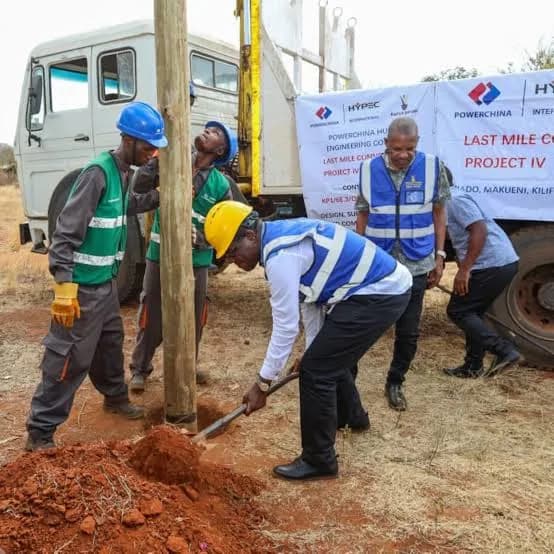
Sites fibre will never reach economically. Kenya's wind farms, mining operations, conservancies, border posts and rural bank branches sit far from any trench. The economics that make a Makueni fibre pole line viable for a trading centre make it absurd for a single remote site, which is why satellite terminals are becoming standard kit for remote industrial and public-sector locations (Mawingu, 27 February 2026). The February 2026 announcement that Mawingu would lead a Microsoft-Starlink rural connectivity initiative in Kenya signals exactly this: satellite plus local fixed wireless, reaching where trenching cannot.
Rapid deployment. A branch that opens Monday, an election centre, a disaster response camp, a construction site office: satellite delivers a working link in hours, not the months a wayleave and trench require. For Kenyan organisations that operate where infrastructure is seasonal or unstable, that speed is the product.
Where fibre and data centres keep winning
The comparison matters most at the top of the market. A data centre's product is dense interconnection: dozens of carriers, cross-connects between tenants, peering at the Kenya Internet Exchange Point, and capacity measured in gigabits per second delivered over diverse physical routes. Satellite serves none of that. Its capacity per link is modest, it is shared with every other terminal in the beam, weather degrades it, and its latency, while far better than old satellite, still sits above metro fibre's single-digit milliseconds.
The right mental model is complementary layers, not substitutes. Fibre carries the workload; satellite carries the lifeline. A Kenyan enterprise running its systems in a Nairobi colocation facility, with diverse fibre entries and a satellite terminal for management and emergency access, has a network posture most banks would call healthy. The same enterprise with only a satellite link has a consumer product with a business invoice.
The regulatory picture sharpens that divide. The Communications Authority's April 2026 licensing overhaul lifted satellite licence fees to as much as KES 45 million, roughly 28 times the previous level (Techlabari, 8 April 2026; ITWeb Africa, 9 April 2026), a signal that Kenya intends to treat satellite as one input among many in a competitive market, not a bypass around it.

What to watch next
Three threads are worth following. First, capacity: the July 2026 signup limits will ease or they will not, and either outcome tells enterprise buyers how dependable satellite is as a lifeline at scale. Second, price: every Starlink price cut in Kenya was answered by fibre providers, and the discipline runs both ways. Third, the hybrid model: the Microsoft-backed rural deployments with local partners like Mawingu suggest the future Kenyan network is a braid, fibre for density, fixed wireless for the middle mile, satellite for the margins.
For the data centre industry, the takeaway is short. Starlink does not move a single rack into or out of a Kenyan facility. It does make every facility and every enterprise network more survivable, and in a country that has watched cable cuts and national DDoS attacks disrupt the internet within living memory, survivable is a feature worth paying for.