
Africa's largest mobile network operator is putting serious capital behind the continent's AI infrastructure gap. MTN Group, which operates across 16 African markets, has agreed with Dubai-based investor Tarek Al Ashram to develop AI-focused data centres through a new venture called Africa Data Hub Holding Ltd, according to Bloomberg reporting published on 27 August 2026 and formally confirmed by MTN in an announcement on 31 August 2026. The announcement is one of the most significant commitments yet to building AI-ready compute capacity on the continent, and it arrives at a moment when Africa accounts for less than 1% of the world's AI data centre capacity despite having its fastest-growing and youngest population.
For Kenya's data centre community, the story matters even though the first facilities will not be built here. It signals that pan-African operators and Gulf capital now view AI infrastructure as an investable, revenue-generating asset class on the continent, and it adds competitive pressure to the race that Kenya's own flagship projects, including the planned one-gigawatt Microsoft and G42 facility, have been running. This article was first published on 29 August 2026 and updated on 31 August 2026 after MTN formally confirmed the partnership structure.
The Venture: Africa Data Hub Holding Ltd
The new company sits at the intersection of two complementary strengths. On one side is MTN Group, the continent's largest mobile operator by scale, with network infrastructure, enterprise relationships, and land and power positions across its footprint. On the other is Tarek Al Ashram, a Dubai-based investor who co-founded Gulf Data Hub, a large-scale data centre platform backed by American private equity giant KKR & Co. Al Ashram is backing the African venture through his own investment firm.
"We see significant potential to bring our experience in developing and operating large-scale data centre platforms to African markets," Al Ashram said in a response to queries, adding that Africa Data Hub will "help shape that growth" of the continent's digital economy. In his framing, Africa now presents a "similarly compelling opportunity, driven by strong underlying demand, rapidly expanding digital economies and an increasing need for resilient and scalable infrastructure" to what the Middle East experienced during its own data centre boom.
That comparison is instructive. The Gulf states transformed themselves from data centre bystanders into a regional hub by pairing sovereign-backed capital with experienced operators and guaranteed anchor tenants. Africa Data Hub is an attempt to replicate that playbook with MTN as the anchor, and with an operator who has already done it once in the UAE leading delivery.
Confirmed on 31 August: MTN Digital Infrastructure, Bayobab, and the Platform Structure
The formal announcement, published by IT News Africa on 31 August 2026, added useful structural detail to the original reporting. The agreement was signed by MTN Digital Infrastructure, the group subsidiary that houses MTN's towers, fibre, and data centre assets, and the venture will operate through Africa Data Hub Holding Limited as the platform through which future digital infrastructure opportunities are developed and scaled, with an initial focus on South Africa and Nigeria.
Two details stand out for infrastructure watchers. First, Bayobab, MTN's digital connectivity business, is not just a supplier but a shareholder in the partnership, and will provide open-access connectivity and go-to-market support across its pan-African network. Bundling wholesale fibre with data centre capacity into one platform mirrors the integrated land-and-power-and-fibre model that successful data centre platforms use to shorten time-to-revenue. Second, the announcement framed the venture explicitly as part of MTN's Ambition 2030 strategy, with group digital infrastructure CEO Mazen Mroué describing a platform "capable of supporting hyperscalers, cloud providers, enterprises and technology innovators across Africa", language that positions Africa Data Hub as wholesale infrastructure rather than an MTN-internal cloud play.
Mroué's framing also clarified the demand thesis: "Africa's digital economy is entering a new era, driven by rapid advances in artificial intelligence, cloud adoption and digital innovation. Realising this opportunity requires more than connectivity. It requires the infrastructure platforms that will power the next generation of digital services, businesses and innovation." For Al Ashram, the pitch is experience transfer: having watched data centre platforms accelerate cloud and AI growth in the Middle East, he described Africa as presenting "a similarly compelling opportunity" driven by demand, expanding digital economies, and the need for resilient, scalable infrastructure.
Inside the Buildout: 150MW, Nigeria and South Africa First
The venture is starting deliberately narrow. MTN chief executive Ralph Mupita said the company is taking a phased approach and will begin by building out 150 megawatts of AI data centre capacity, with facilities planned in Nigeria and South Africa. Those two markets are logical first moves: Nigeria offers West Africa's largest economy and a fast-growing cloud and content market, while South Africa hosts the continent's deepest data centre ecosystem and grid-adjacent industrial land.
The sites will serve a dual purpose. First, they will process MTN's own AI workflows, from network optimisation to customer analytics, giving the venture a guaranteed internal workload from day one. Second, they will rent capacity to hyperscalers, other enterprise businesses, and governments, a customer segment Mupita noted is "increasingly asking for more sovereignty over their data sets." That sovereignty demand is a recurring theme across African markets, where regulators and public institutions want data resident in-country but have historically had limited local options.
MTN has also been doing unglamorous groundwork that experienced developers will recognise: purchasing land and negotiating power agreements to support a multi-phased buildout across the continent. Securing grid capacity and land banks ahead of demand is exactly how mature data centre platforms position themselves to move quickly when customers commit, and it suggests the 150MW figure is an opening position rather than a ceiling.
Why MTN Is Getting Into Data Centres
MTN's motivation is straightforward: telcos globally are watching AI shift value toward compute infrastructure, and they want a share of the income stream that hyperscalers are chasing. Connectivity alone captures a thin slice of AI-driven revenue. The physical facilities that house AI training and inference clusters, however, are generating some of the strongest returns in digital infrastructure, with occupancy and pricing holding up across major markets.
Building also fits MTN's balance sheet strategy. The operator has spent years monetising non-core assets and repositioning around infrastructure, and data centres complement its fibre, towers, and mobile network assets. Partnering with an experienced external developer rather than building alone, as Mupita explained ("the entity that we are partnering with has built data centres in the UAE"), reduces execution risk and brings in capital and operational know-how that African telecom groups have often lacked in-house.
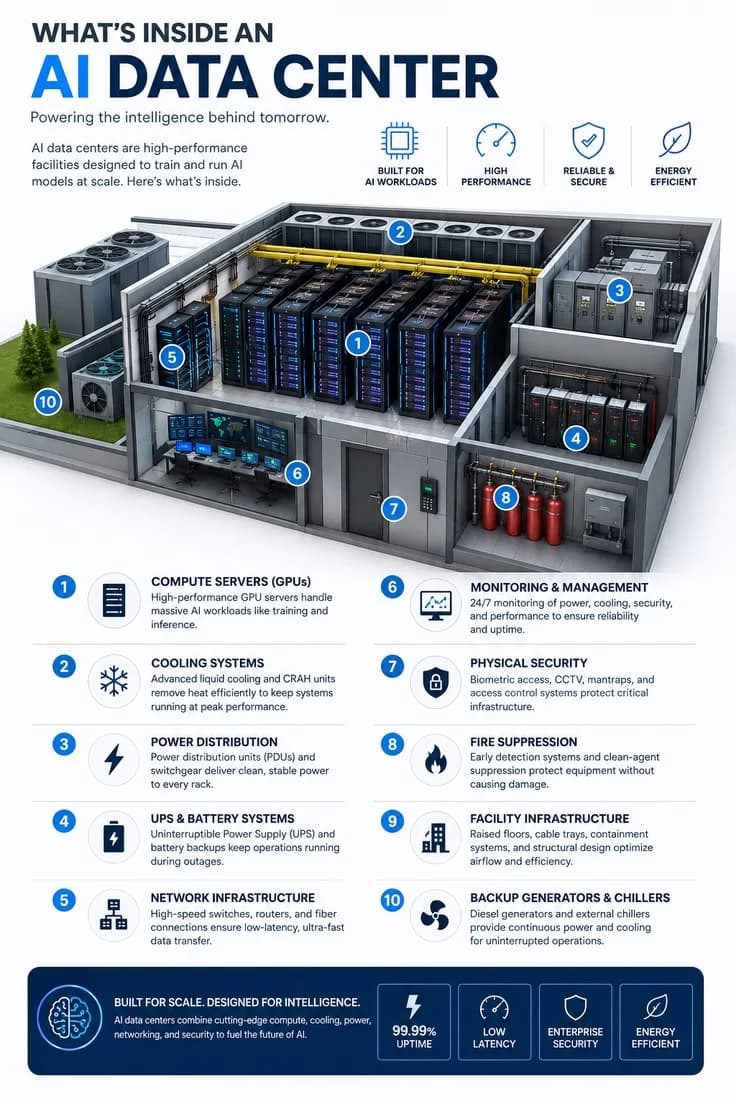
AI workloads also change the engineering requirements dramatically. Training clusters demand power densities per rack that far exceed traditional enterprise colocation, along with advanced liquid cooling, high-capacity interconnects, and hardened power chains. Operators who can deliver AI-ready halls today are effectively selling scarce capacity into unmet demand, which is precisely the opportunity Africa Data Hub is chasing.
Africa's AI Capacity Problem in Numbers
The context behind this deal is a stark imbalance. According to World Economic Forum data cited in the Bloomberg report, Africa houses less than 1% of the world's AI data centre capacity even as it holds the world's fastest-growing and youngest population. Hyperscalers including Microsoft, Alibaba, and Amazon offer cloud services on the continent, but the large-scale AI training facilities that have reshaped other regions have largely not materialised here yet.
That gap has consequences. African enterprises building AI products often train or host models overseas, exporting both spend and latency penalties. Governments crafting data localisation rules find limited in-country compute to localise into. And the continent's much-discussed AI talent pipeline lands in an environment with few large-scale facilities to work in, reinforcing the shortfall.
Kenya illustrates both the ambition and the gap. The planned one-gigawatt Microsoft and G42 facility, announced with fanfare as part of a wider Kenya-UAE technology partnership, "has so far not materialised", as the Bloomberg report notes. Projects of that scale depend on patient capital, firm power supply, and anchor tenants aligning simultaneously, and the continent's track record of converting headline announcements into energised data halls remains thin.
What This Means for Kenya
MTN does not operate a mobile network in Kenya, and the first Africa Data Hub sites are earmarked for Nigeria and South Africa. So why should Kenyan readers care? Three reasons stand out.
First, the deal validates the demand thesis that Kenya's own projects rest on. When Africa's largest operator commits capital to AI data centres, it signals that the underlying demand signals, sovereignty requirements, cloud growth, and enterprise AI adoption, are strong enough to underwrite multi-phase industrial buildouts. That is the same demand case that iXAfrica, Africa Data Centres, and other Kenyan operators make when expanding Nairobi capacity.
Second, it sharpens competition for the hyperscaler investments Kenya has been courting. If Africa Data Hub delivers AI-ready capacity in Nigeria and South Africa ahead of Kenya's flagship projects, regional hyperscaler and enterprise workloads could consolidate in those markets first. Nairobi's counterweights remain real, including dense subsea connectivity, a strong talent base, and a policy environment actively courting digital investment, but timelines now matter more.
Third, it creates a template Kenya's market could follow: a large anchor tenant pairing with a proven international operator and specialist capital. A similar structure around a Kenyan anchor, whether a bank, a telco-adjacent enterprise group, or a government workload, is exactly what would convert the country's pipeline of announced projects into steel, concrete, and energised capacity. Readers exploring the local landscape can compare operators in our data centre directory and our analysis of AI data centres in East Africa.
From Announcement to Energised Halls: The Execution Question
African infrastructure history counsels measured optimism. The continent has seen repeated cycles of ambitious digital infrastructure announcements, some transformative and some still on paper years later. The gap between a signed agreement and an operating AI data centre runs through land title, grid connections that can take years to secure, cooling and power engineering for high-density racks, anchor tenant contracts, and construction capacity, each a point where timelines slip.
What differentiates credible projects is visible progress: land actually acquired, power agreements actually signed, and phases sized to match realistic demand. On those measures, MTN's groundwork, purchasing land and negotiating power agreements before the venture was announced, and the choice to start with 150MW rather than promising gigawatts, are encouraging signs of discipline. The involvement of an operator with Gulf Data Hub's delivery record adds further weight.
The financing environment will matter too. AI infrastructure is capital-hungry, and African projects compete globally for it. A venture backed by an operator of MTN's scale and an investor with KKR-linked credentials is better positioned than most to attract institutional capital, but execution milestones, not press releases, will decide whether that capital follows.
What to Watch Next
Three markers will tell us whether Africa Data Hub becomes real. Watch for site-specific announcements in Nigeria and South Africa, including locations, grid arrangements, and cooling designs that reveal the density ambitions. Watch for anchor tenant disclosures beyond MTN's own workflows, particularly hyperscaler or government commitments that de-risk the first phase. And watch whether the venture's roadmap extends beyond its first two markets, with East Africa and Kenya a natural consideration in later phases given the region's connectivity and demand growth.
For Kenya's data centre sector, the announcement is best read as both validation and a starting gun. The AI infrastructure race on the continent now has another well-funded runner, and the markets that move first on power, land, and anchor tenants will collect the workloads that follow.