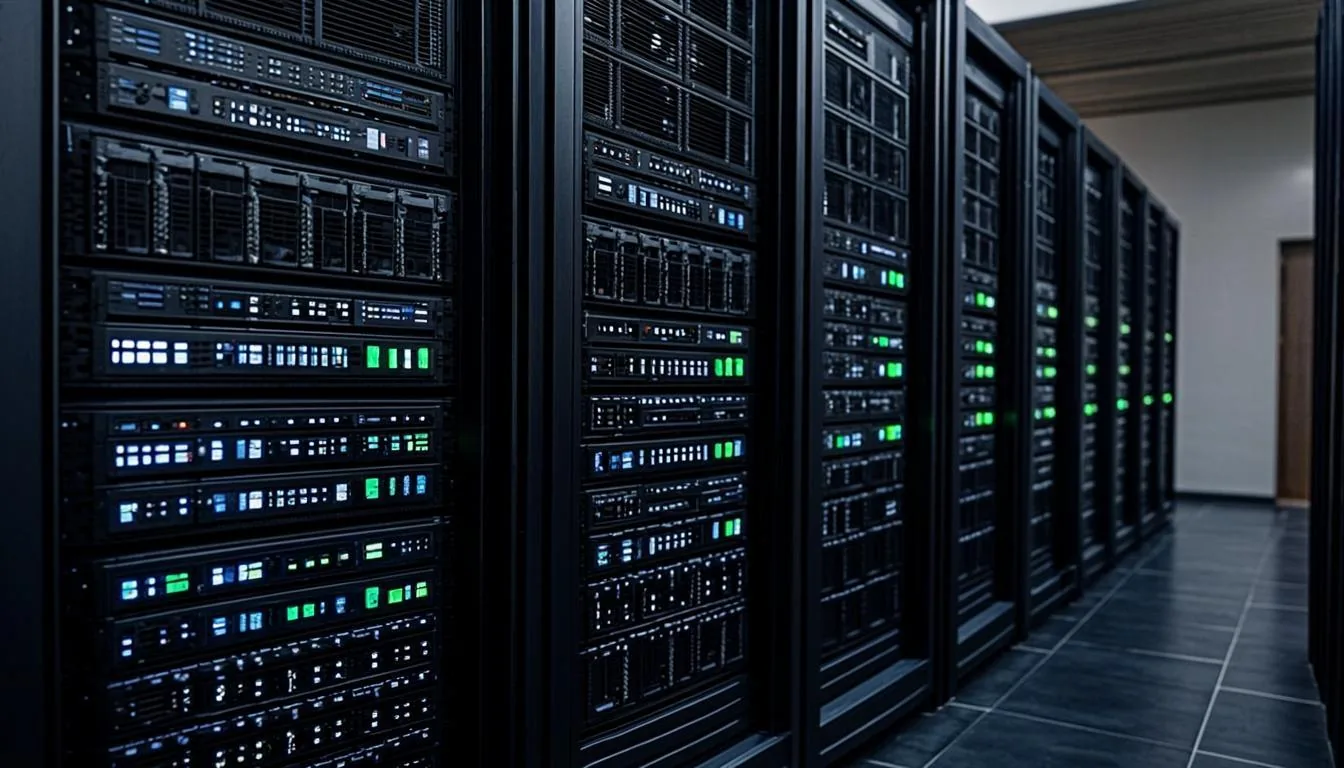
A line in DigitalOcean's second-quarter report deserves more attention in Nairobi than it will probably get there: the company locked in another 20 megawatts of data centre capacity for 2027 and 2028, bringing total committed capacity to about 155 MW. DigitalOcean is not a hyperscaler, it is the cloud African startups actually start on, the $6-a-month droplet provider, the company whose brand equity in Lagos, Nairobi and Kampala was built on being small and simple. When a company like that starts transacting in megawatts, the unit of account for the whole hosting industry has changed.
The quarter's numbers (reported 4 August, analysed by Yahoo Finance on 7 September) tell a clean story. Revenue climbed 29% year over year to $281 million. Remaining performance obligations (contracted revenue not yet recognised) swelled from $71 million a year ago to $894 million, which is the financial signature of customers signing multi-year deals instead of monthly ones. AI customer ARR grew 212% to $234 million, and 85% of that AI revenue now comes from inference and core cloud workloads rather than raw bare metal. The company added a record $93 million of incremental ARR, signed its first nine-figure annual commitments, and stretched its weighted average contract life from 1.6 years to more than 3.
The inference shift, explained plainly
The strategically interesting number is not the 212%, it is the 85% from inference and core cloud. Training an AI model is a concentrated industrial event: a few giant sites with grid-scale power, mostly in the US and China. Inference is the opposite: every user query, every API call, every embedded AI feature in an app needs a server close enough to answer quickly. Inference demand therefore spreads, across regions, across cities, across whatever power-secure real estate exists.
That is why the megawatt commitments matter. DigitalOcean is contracting 155 MW of future capacity precisely because inference customers sign three-year commitments and expect the capacity to exist when they arrive. Multiply this pattern across every mid-size cloud (and the large ones are committing ten times more) and you get the infrastructure reality underneath the AI hype: the world's AI build-out is, physically, a global race for power-secured data centre capacity. Kenya is part of that race whether or not the hyperscalers have noticed yet; iXAfrica's Oracle Cloud Infrastructure Nairobi region announcement in January 2026 was the first local transaction of this exact type.
What it means for Kenya, in three layers
For developers and startups, the direct read: pricing and capacity on the global clouds stays competitive for now. DigitalOcean's margin pressure (operating income fell 18% even as revenue accelerated) is the market's way of saying AI capacity is being bought ahead of demand. That is good for buyers this year. The risk sits further out: if AI-driven demand keeps compounding, the entry prices that made DO the startup default will creep upward, and the free-credit economics that seeded the African developer ecosystem will get tighter.
For Kenyan hosting businesses, the harder truth: none of DigitalOcean's 155 MW is coming to Nairobi on current evidence. Its capacity hunt plays out in US and European markets with proven grid supply. Kenya's cloud-on-ramp story is being written by others, iXAfrica with OCI, the PAIX and ADC interconnection layers, Digital Realty's NBO2 launch. The local opportunity is not to out-cloud DigitalOcean; it is to be the inference edge the global clouds need: cache the models, serve the users, keep latency local and shillings-denominated. That is a colocation and interconnection business, which is why our directory tracks carrier neutrality and network counts more closely than marketing claims.
For policymakers, the uncomfortable arithmetic. A single mid-size AI cloud commits more megawatts in one quarter (20 MW) than Kenya's entire verified operating data centre capacity (~28 MW across 27 verified facilities). The global AI build-out is a power-allocation contest, and the Microsoft–G42 project's well-documented stall on grid delivery shows what happens when a 100 MW-class request meets a 3,192 MW grid serving a 2,316 MW peak. If Kenya wants a seat in the inference economy, the binding policy question is not "how do we attract AI companies", it is how fast dispatchable generation and transmission can be built behind the geothermal belt.
The watch-list from here
Three things worth tracking this year. One: whether DigitalOcean's AI ARR growth survives the margin squeeze, the bulls' case is that nine-figure inference contracts mature into profitability; the bears' case is that it is renting GPUs at negative margin to buy growth. Two: whether inference capacity starts being committed on the continent, any announcement of a hyperscaler or mid-size cloud region in East Africa is a signal our AI infrastructure coverage will chase. Three: the price of entry-level cloud. The moment African startups' default droplet gets more expensive without getting better, the local-hosting value proposition (data residency, M-Pesa billing, shilling pricing, local support) becomes the strongest it has ever been. The megawatt race is global. The customer is local.