Ask what powers artificial intelligence and most people picture code, or maybe robots. The honest answer is more industrial: AI is powered by electricity pushed through a very particular kind of chip, in buildings engineered to keep those chips cool, in quantities Kenya has only recently begun to host at home. This guide explains what GPU cloud infrastructure is, why it is suddenly a Kenyan topic (the law and the market both moved), and what actually exists on the ground as of September 2026.
We are writing this for the newcomer. If you have ever wondered what people mean when they say a facility is AI-ready, or why anyone would train a model in Nairobi instead of on some American cloud, the next few sections are for you.
First, the chip: why GPUs and not ordinary servers
A normal computer processor, a CPU, is like a brilliant chef: superb at cooking one complicated dish at a time, in strict order. A GPU is more like a stadium kitchen with a thousand cooks: not each one brilliant, but all working at once, which is exactly the right shape for AI's maths. Training an AI model (teaching it patterns from examples) boils down to billions of small calculations that can all run in parallel, and GPUs, chips originally built to draw video game graphics, happen to be built for parallel work.
This is the core of our earlier explainer on what GPU computing is and why AI needs it, and the phrase to remember is GPU cloud infrastructure: computing capacity rented from facilities that can feed, cool and connect these machines. A single GPU machine is unremarkable. The infrastructure part matters when you need tens or hundreds of them together, because then the building itself, power, cooling, and the wiring between machines, becomes the hard engineering problem.
Why train in Kenya at all? The law moved first
The strongest argument for local GPU infrastructure in Kenya is not speed or pride. It is written down. Kenya's Data Protection Act came into force on 25 November 2019 and remains the primary law on data protection (DLA Piper's Kenya briefing, updated March 2026). The regulator, the Office of the Data Protection Commissioner (ODPC), publishes practical guidance, and its handbook says something every Kenyan AI builder should memorise: organisations can meet localisation requirements by processing personal data through a data centre located in Kenya, or by storing a serving copy of the data in Kenya (ODPC handbook, fetched 16 September 2026).
In plain terms, if your AI project touches Kenyan personal data (medical records, mobile money histories, student results, ID numbers), the law expects that data to have a Kenyan home. Sending it abroad for training on a foreign cloud is exactly the pattern the rules push against, and registration with the ODPC is required before processing personal data at all (Manwa Advocates, 3 July 2026). The government's own cloud policy pushes the same direction for public-sector data.
This is the concept engineers call data gravity: data is heavy, in a legal and practical sense, and the computing that touches it gets pulled to wherever the data must live. Kenyan personal data now has strong gravity. The pull points at Kenyan facilities.
What actually exists on the ground
So where would a Kenyan team actually rent GPU power today? The honest map, as of September 2026, is short but real, and it starts with one name.
iXAfrica NBOX1, in Nairobi, is the flagship. The operator announced it as East Africa's first hyperscale, carrier-neutral, AI-ready data centre (February 2025), and trade coverage highlights its high-density GPU hosting capability (Marcopolis, July 2025). The campus's overall design capacity, what it is built to reach, is 22.5MW per the operator (fetched 16 September 2026), with a second campus, NBOX2, planned at Tilisi. Design capacity is a plan, not a switch-on date, so buyers should always ask what is live today. We unpack what hyperscale means in a separate guide.
The full stack is already running, not just the shells. In November 2025, Atlancis Technologies, Everse Technology and iXAfrica jointly unveiled what the partners describe as East and Central Africa's first GPU-powered AI infrastructure, hosted at iXAfrica's Nairobi campus and built on NVIDIA GPUs (announcement dated 10 November 2025). The distinction matters: a facility that could host GPUs is a shell, while a facility where GPU clusters are installed, powered and cooled is a working AI factory, and Nairobi now has one. Kenyan teams can engage local providers for GPU capacity instead of importing every training run.
Beyond iXAfrica, the pattern to know is this: Kenya's operational colocation market (NBO1 on Mombasa Road, the new NBO2, iColo, PAIX, all covered in our Nairobi colocation buyer's guide) provides the shells, and AI-ready capability is arriving as those shells upgrade their power and cooling. The loudest sign of where this is heading is the Amaco HERCULES proposal: a $1.5 billion AI data centre plan for Mombasa that would generate its own electricity on a floating power barge, precisely because AI at scale is a power story before it is a software story.
The power problem, in one paragraph
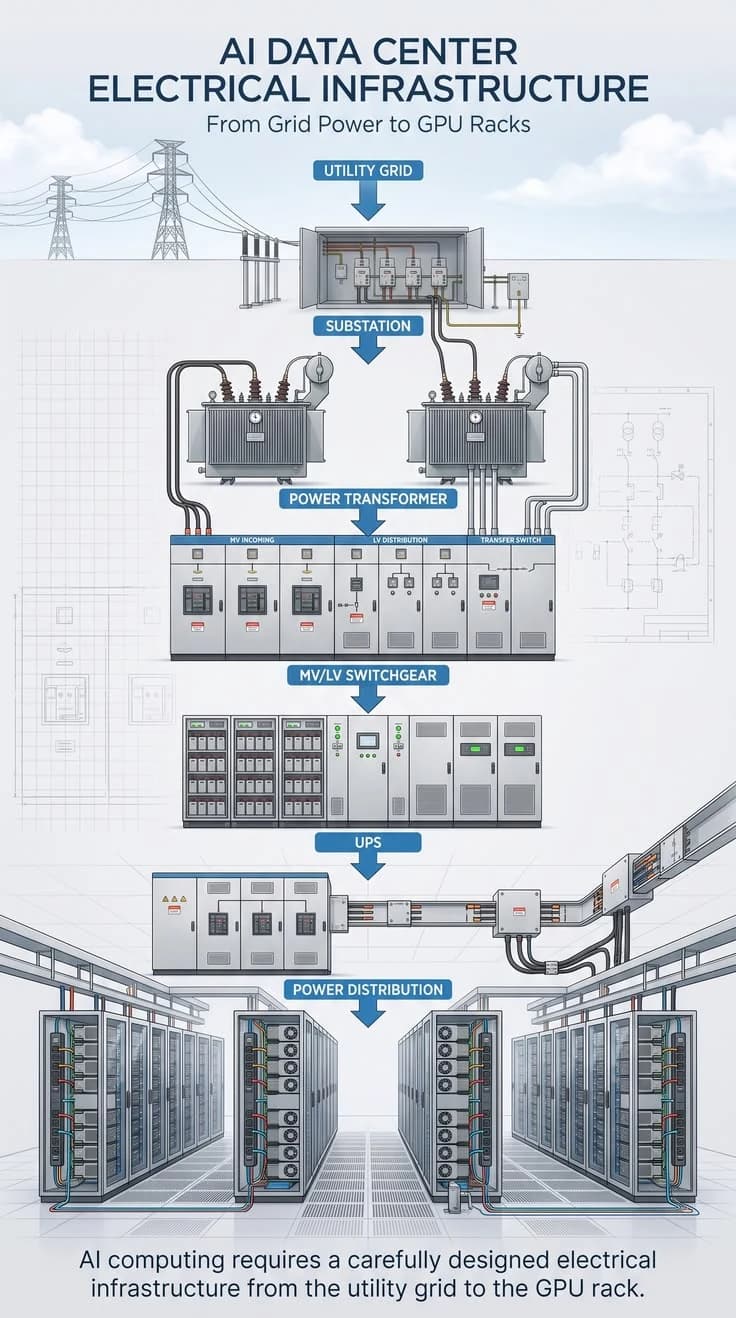
Every AI training run is an electricity bill. An AI rack draws many kilowatts, several times what an ordinary server rack needs, and the heat that comes out has to be fought with chillers and airflow that consume power themselves. Kenya's grid is remarkable by world standards (about a gigawatt of geothermal, one of the greenest electricity mixes anywhere), but total national peak demand is around 2,439MW, which is why a single large AI campus can strain a national conversation about power. Our guide to Kenya's power infrastructure and the data centre constraint covers that squeeze in detail. The practical takeaway for buyers: when you evaluate any AI-ready claim, ask for the kilowatts per rack the facility can actually deliver today.
What Kenya would do with local GPUs
The point of all this infrastructure is not prestige; it is the work. Three families of use cases come up again and again in the Kenyan market, and our deeper piece on AI model training use cases in Kenya profiles them properly.
- ✔ Finance: credit scoring models trained on Kenyan mobile money patterns. They understand the local reality of irregular incomes better than models trained on Western banking data.
- ✔ Agriculture: computer vision (AI that looks at images) checking crops for disease using photos of Kenyan fields, deployed at the edge close to the farms.
- ✔ Language: models that speak Kiswahili, Sheng and Kenya's local languages, trained on local text so digital services stop being foreign by default.
Each of these runs on Kenyan data. And under the rules above, each one wants Kenyan compute.
A practical starting path
For a Kenyan organisation reading this with a real project in mind, the path is simpler than the hype suggests. If you are experimenting and your data is not sensitive, a global cloud GPU by the hour is fine for learning, if you can pay for it. The moment real Kenyan personal data enters the project, bring it home: talk to the AI-ready facilities about reserved or dedicated capacity, size your need in kilowatts and GPUs honestly, and let the legal requirement do part of your negotiating. Between those two poles, hybrid setups (development abroad, data-bearing training at home) are common and sensible.
Kenya spent two decades exporting its digital problems: data abroad, models built elsewhere, value added elsewhere. GPU cloud infrastructure is how that reverses. The chips are arriving, the law is pulling, and the buildings, finally, are standing.
Frequently asked questions
What is GPU cloud infrastructure?
GPU cloud infrastructure is computing capacity built around GPUs (graphics processing units, chips designed to run thousands of small calculations at once) instead of ordinary processors. AI workloads, like training a model to recognise crop diseases or answer in Swahili, are mostly thousands of small maths problems happening together, which is exactly what GPUs are good at. GPU cloud infrastructure means renting that kind of computing power from facilities that can power and cool these machines.
Why does Kenya need local GPU hosting?
Three reasons. Legally, Kenyan data protection rules expect personal data to be processed inside Kenya or to keep a serving copy in Kenya, which pushes AI work on Kenyan personal data toward local facilities. Technically, a GPU server in Nairobi answers Kenyan users faster than one in Europe because the round trip is shorter. Practically, paying in shillings and building on local infrastructure keeps skills, jobs and value in the country instead of exporting them with every training run.
Does Kenyan law require data to stay in Kenya?
Kenya's Data Protection Act, in force since 25 November 2019, is the primary law, and the regulator's own handbook states that organisations can meet localisation requirements by processing personal data through a data centre located in Kenya, or by storing a serving copy of the data in Kenya. Every data controller and processor must also register with the Office of the Data Protection Commissioner before processing personal data. The exact duty depends on your sector and data type, so get legal advice for your case, but the direction is clear: Kenyan personal data is expected to have a Kenyan home.
Can I rent GPUs by the hour in Kenya today?
The by-the-hour model familiar from global clouds is still mostly abroad. Inside Kenya, AI compute today comes mainly through AI-ready facilities: iXAfrica's NBOX1 campus in Nairobi is explicitly built and marketed for high-density GPU hosting with a 22.5MW design capacity, and since November 2025 the campus hosts a GPU-powered AI infrastructure service unveiled by Atlancis Technologies, Everse Technology and iXAfrica, built on NVIDIA GPUs. Similar capacity is emerging as new facilities launch. For most Kenyan teams that means engaging a local provider for dedicated or reserved capacity rather than swiping a card for one hour of training. Global clouds remain the option for small experiments, if you have the payment method and accept the data leaving the country.
What makes a data centre AI-ready?
Three upgrades over a normal facility. Power density: AI racks draw many kilowatts each, several times an ordinary server rack, so floors, breakers and cooling must be engineered for the heat. Networking: training clusters pass enormous amounts of data between machines, so the cabling between racks matters as much as the internet connection. Space and weight: GPU machines are heavier and deeper than standard servers. A facility advertising AI-ready today, like iXAfrica's Nairobi campus, is claiming all three.