A new market analysis has put Africa's data-centre opportunity into one uncomfortable number: 3 percent.
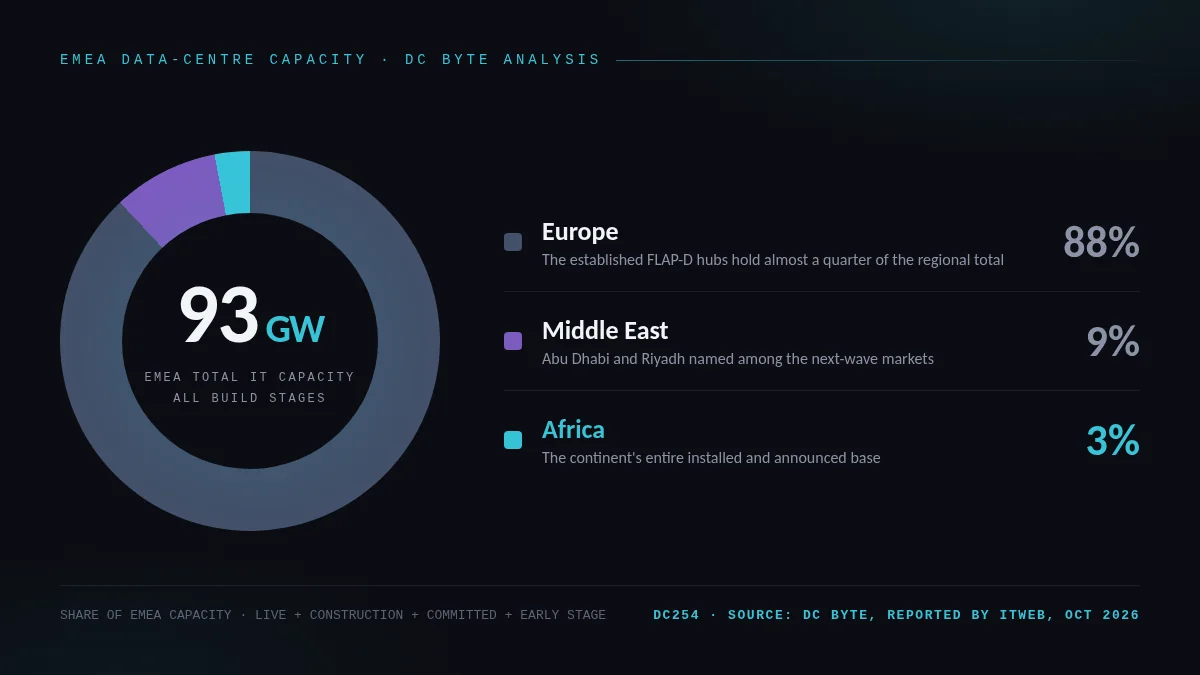
DC Byte's latest EMEA analysis, reported by ITWeb, estimates the region's total data-centre capacity at 93 GW once live facilities, construction, committed projects and early-stage developments are counted together. Europe accounts for 88 percent of that total. The Middle East accounts for 9 percent. Africa accounts for just 3 percent.
That is a small share of a large market. It is also the reason the continent keeps attracting attention.
The question for Kenya is not whether Africa has room to grow. It clearly does. The more useful question is whether Kenya can turn its advantages, from renewable generation and subsea cable access to established interconnection and a growing digital economy, into capacity that is actually powered, connected and operational.
What the 3 percent means. The figure is Africa's share of EMEA data-centre capacity, not Africa's share of global capacity, and not a forecast that Africa automatically captures the next wave. It is a regional comparison across a dataset that spans live capacity and multiple development stages. That distinction is kept unavoidable throughout this article.
The 3 percent is an opportunity, not a forecast
The first point needs to be stated precisely, because the number is already travelling without its context. The 3 percent figure is Africa's share of EMEA data-centre capacity, measured across a broad DC Byte dataset that includes operational capacity and multiple stages of development. It should not be read as a verdict on the continent or as a promise about its future.
The number does, however, show how unevenly digital infrastructure is distributed. Europe's established hubs still dominate. Frankfurt, London, Amsterdam, Paris and Dublin, often grouped as FLAP-D, account for almost a quarter of EMEA's total capacity. Those markets are now running into the constraints that decide where new capacity can actually be delivered: available land, grid access, planning timelines and the ability to serve large power-intensive campuses.
That is why DC Byte's analysis points to South Africa as the African market most clearly positioned for the next wave. Land availability is one reason. Power delivery remains the condition. The analysis is explicit that a site is not attractive simply because land is available: operators still have to secure sufficient power, and assess how quickly that power can be delivered, before any site becomes a data centre.
That distinction matters for every African market, including Kenya.
Kenya's counter-pitch is not one number
Kenya's current proposition rests on several assets that only work when they are counted separately.
The country has a verified data-centre directory of 27 Kenyan facilities, of which 20 are operational. The State of Kenyan Data Centres 2026 separates 10.5 MW of published live IT load from 42.9 MW of built capacity at operational sites. Behind that operating base sits a tracked pipeline of 230 MW. Those numbers must remain separated, because they measure different things.
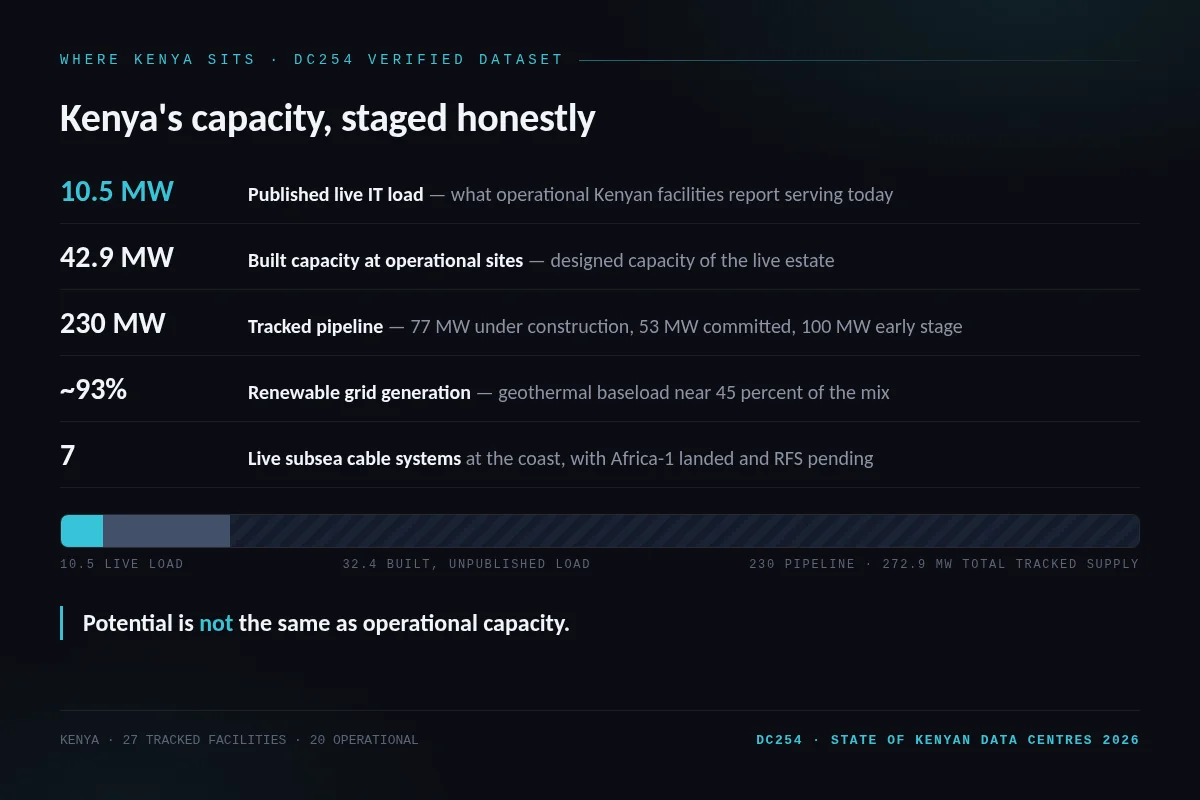
The 230 MW pipeline is not operating capacity. It combines 77 MW under construction, 53 MW committed and 100 MW at an early stage. Projects at different stages face different tests. Under-construction projects are physically underway. Committed projects have land and funding signals but are not yet built. Early-stage projects may still require approvals, financing, firm tenants or power-delivery commitments.
This is exactly the discipline African markets need as the global conversation shifts toward AI and hyperscale demand. A pipeline is evidence of intent. It is not evidence that the grid connection, the building, the cooling plant and the network are already serving customers.
Kenya's power advantage is real, but it has a ceiling
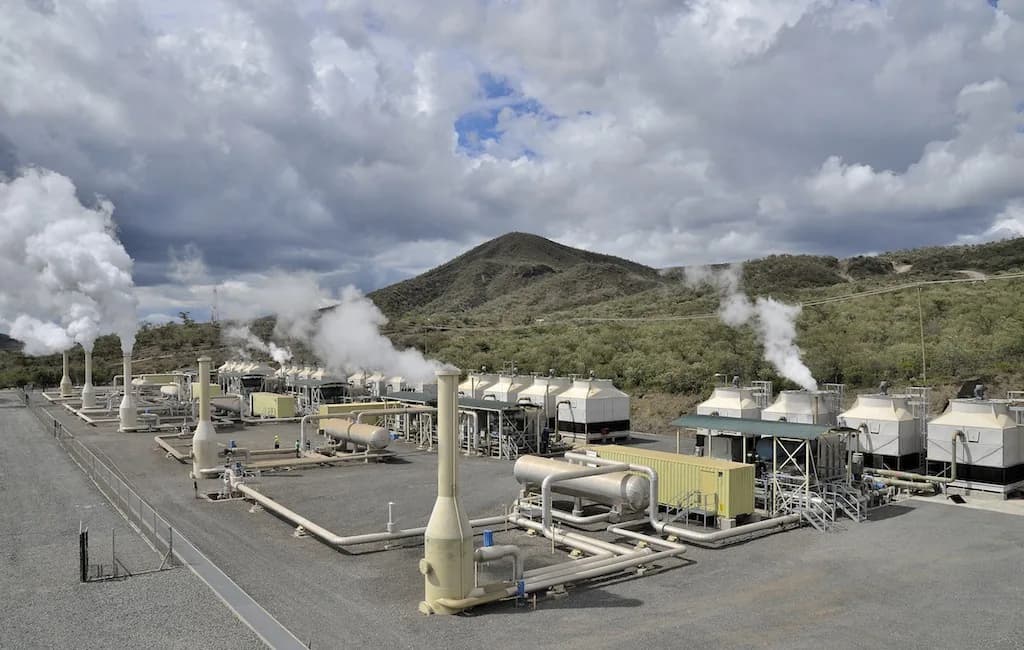
Kenya's strongest counter-pitch is the quality of its generation mix. About 93 percent of the electricity generated on the national grid comes from geothermal, hydro, wind and solar, according to KenInvest commentary published in The Star. Geothermal alone supplies roughly 45 percent of generation and gives Kenya something solar-only propositions cannot provide without storage: renewable baseload power. Our renewable energy coverage explains why that baseload quality matters more to data centres than the headline share.
The strategic weight of that mix is growing as AI reshapes demand. The next facility is not always a conventional colocation building with incremental load. It may be a large campus that needs substantial power at one location, along with a credible path to expand. A workload hosted on a grid with Kenya's renewable share carries a different carbon story from one hosted in a coal-heavy system that must assemble its clean-power position through contracts and certificates.
But renewable generation is not the same thing as firm, site-specific data-centre power. A grid can have enough capacity in aggregate while a particular site still faces connection, transmission, substation or delivery constraints. Kenya's own record makes the point: the 100 MW Microsoft and G42 project, the single largest early-stage record in the country's tracked pipeline, has stalled on grid power constraints. Delivering 100 MW or more to one site is a different engineering and commercial problem from serving a growing city.
Kenya has a high-renewable generation base, but it now needs to prove that clean power can be delivered reliably, at scale and on the timelines large digital-infrastructure customers require.
Connectivity gives Kenya a second advantage
Power is only one part of the location decision. Kenya also has a credible connectivity foundation, and unlike the pipeline, most of it already exists.
Seven live subsea cable systems connect to the Kenyan coast: TEAMS, SEACOM, EASSy, LION2, DARE1, PEACE and 2Africa. Africa-1 has come ashore but remains pending a confirmed ready-for-service date. Daraja is announced, and LuLu is planned. The cable tracker keeps those categories separate rather than counting every announced route as live, which is the same staging discipline the capacity numbers follow.
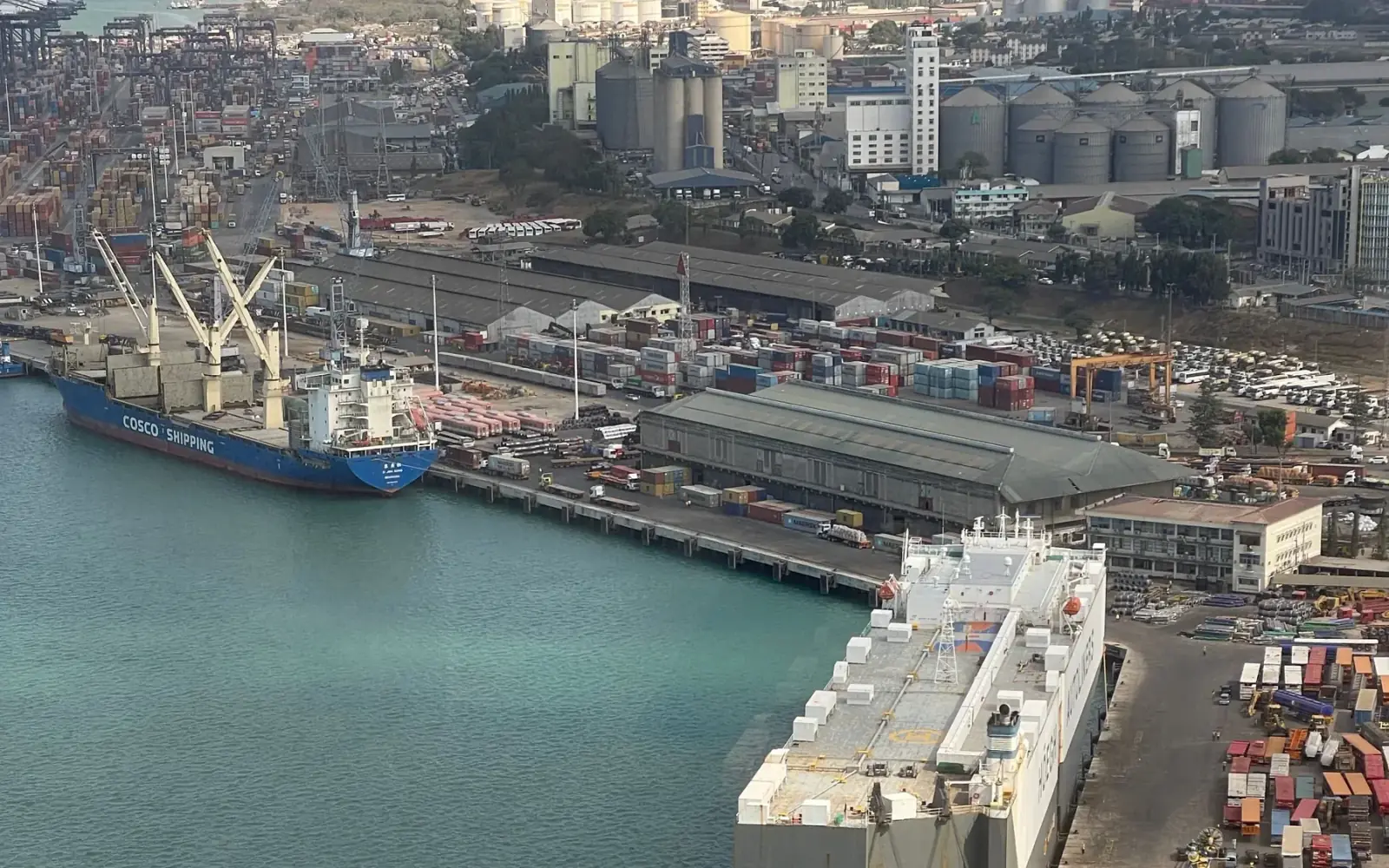
That coastline matters because Kenya's digital infrastructure plays out across two connected roles. Mombasa is the international gateway, where cable systems land and international routes enter the country. Nairobi is the infrastructure cluster, concentrating data centres, enterprise demand, operators, networks and interconnection. The national opportunity lies in the chain between the two: landing stations, terrestrial fibre, Nairobi facilities, internet exchanges and the businesses consuming digital services at both ends.
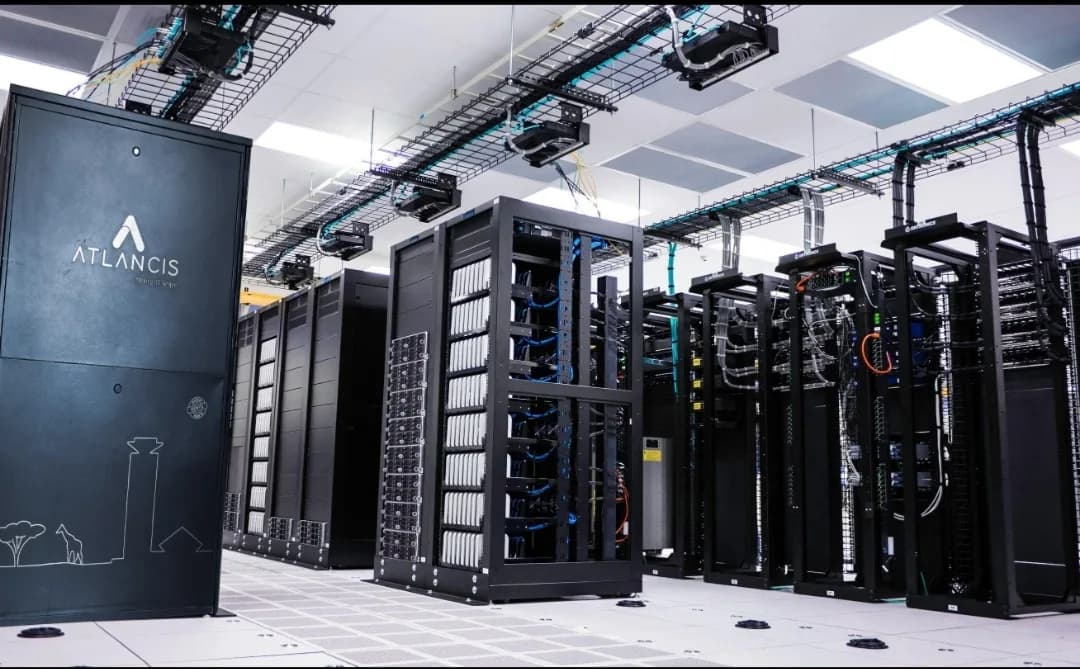
The interconnection data shows where that depth is already accumulating. In the latest PeeringDB cross-check, the market numbers record Africa Data Centres Nairobi 1 leading with 122 networks and four internet exchanges on site. iColo Mombasa One follows with 94 networks and three exchanges, a function of its proximity to the landing stations, while iColo Nairobi One carries 62 networks and four exchanges. These are public registration signals rather than a complete measure of facility quality, but they show a real interconnection layer forming, not an aspiration.
The real competition is deliverability
Africa does not need more generic claims about being the next data-centre frontier. It needs to demonstrate delivery, and the analysts saying this loudest are the ones selling the market data.
DC Byte's analysis identifies power availability and delivery timelines as the test that matters, and it warns that early-stage pipelines can exaggerate the capacity that ever becomes operational. Milan is the cautionary example: almost 70 percent of that market's total IT capacity remains at an early development stage, which is exactly how headline pipeline figures outrun reality. Announcements should not automatically be treated as completed facilities.
Kenya's own figures make the same argument from the inside. The country has 230 MW of tracked announced pipeline, but only 10.5 MW of published live IT load and 42.9 MW of built operational capacity. That is not a weakness in the data. It is the point of staging the data honestly.
For Kenya to move from a credible emerging market to a preferred destination for the next wave, four conversions matter:
- Pipeline to operational capacity: projects must be completed and commissioned, not re-announced.
- Generation to firm delivery: renewable electricity must reach large sites with the required reliability and redundancy.
- Connectivity to customer value: cable access must translate into networks, cloud on-ramps, exchange fabric and low-latency services.
- Announcements to evidence: every major claim needs a source, a status and a verification date.
Where Kenya sits in the African race
Kenya is not South Africa. It does not have the same depth of installed capacity, operator footprint or established hyperscale market, and it should not compete by pretending otherwise.
In the same analysis, DC Byte identifies South Africa as the African market to watch and names Nigeria, Kenya, Egypt and Morocco among the continent's key data-centre markets, noting that Nigeria and Kenya are moving towards wholesale facilities capable of accommodating hyperscale demand. International operators are voting with deployments too: Continent 8 Technologies is entering Africa through Johannesburg, with its first African facility live in Q4 2026, close to one of the world's most intensive regulated betting markets.
Kenya's distinctive combination is still real, and it looks like this:
- A renewable-heavy generation mix with geothermal baseload near 45 percent of supply
- Seven live subsea cable systems, with more landed or announced
- A growing Nairobi interconnection cluster anchored by 122-network facilities
- A mature mobile, fintech and enterprise demand base
- 27 tracked facilities, with 20 operational
- A 230 MW pipeline that is large enough to matter but still has to be converted
- A location from which operators can serve East Africa and connect to wider regional markets
The honest proposition is therefore not a slogan about becoming the next Johannesburg.
Kenya can offer clean generation, international connectivity and a growing digital market, but its next competitive advantage will be the ability to deliver reliable power and commissioned capacity faster than its pipeline suggests.
The question for 2027
The next phase of Kenya's market will be decided less by the size of the announcement pipeline than by what becomes operational.
The current dataset puts specific names on the test. The watchlist includes the completion of iXAfrica NBOX1.2, Africa Data Centres Nairobi 2 and Nxtra by Airtel's Tatu City campus, with commissioning targeted for 2027, alongside iXAfrica NBOX2 at Tilisi moving from committed to built. It also includes the decision path around the Microsoft and G42 project and the interconnection ramp of iColo Nairobi Two, Digital Realty's freshly launched NBO2. Each of those projects answers one of the operational questions the analysis says will decide the next wave.
Africa's 3 percent share of EMEA capacity is not a verdict. It is a starting position. The continent has room, demand and increasingly visible connectivity. But the next wave will go to the markets that can answer the operational questions: Is the power available? Can it be delivered to the site? How quickly can the facility be built? Is the route diversity real? Are the networks and customers already present? What portion of the pipeline is genuinely committed?
Kenya has a credible answer to several of those questions already. The country's opportunity is to make the remaining answers measurable.
That is where the race begins.
Explore the evidence
- DC254 State of Kenyan Data Centres 2026
- DC254 Infrastructure Map
- Kenya Data Centre Directory
- DC254 Energy & Power coverage
- Kenya Subsea Cable Tracker
Sources used in this article
Primary
- ITWeb, Land availability gives SA edge in data centre race (5 October 2026): DC Byte EMEA analysis, 93 GW total, Europe 88 percent, Middle East 9 percent, Africa 3 percent, FLAP-D 24 percent, Milan early-stage caveat
- DC254, State of Kenyan Data Centres 2026 (27 facilities, 20 operational, 10.5 MW published live IT load, 42.9 MW built, 230 MW announced pipeline)
- DC254, Kenya Subsea Cable Tracker (7 in service, Africa-1 landed with RFS pending, Daraja announced, LuLu planned)
Supporting
- The Star, KenInvest commentary (5 October 2026): about 93 percent of grid-generated electricity comes from geothermal, hydro, wind and solar
- DC254, Kenya's Renewable Energy Meets Data Centre Demand (geothermal near 45 percent of generation)
- Developing Telecoms, Continent 8 enters African market with Joburg data centre (5 October 2026)
- Continent 8, launch announcement for South Africa
- Data Center Dynamics, Continent 8 Technologies launches data center in Johannesburg
Dataset checked: 7 October 2026.