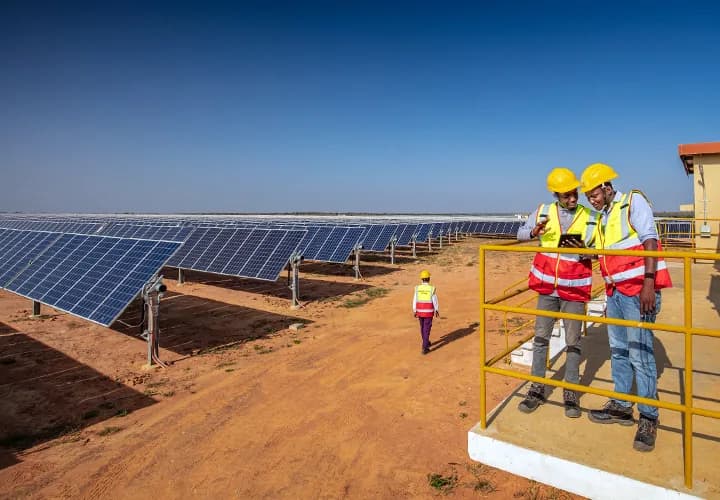
Kenya sits on the equator, receives more direct sunlight than most countries on Earth, and generates over 90% of its electricity from renewable sources. For an industry that consumes as much power as a small town, this should be a dream combination. Yet the question of whether Kenya's data centres can meaningfully harness solar power is more nuanced than simply pointing photovoltaic panels at the sky. The answer involves grid economics, battery storage costs, land availability, and the practical reality that data centres cannot afford even a second of downtime.
The short answer: solar alone cannot power a Kenyan data centre, but grid-tied solar is already cheaper than grid power for operators who can install it, and it is becoming a meaningful layer of Kenya's data centre energy stack rather than its foundation.
Solar power for data centres is not a new idea. Google, Amazon, and Microsoft have all built massive solar farms to power their data centres in the United States and Europe. What makes Kenya different is that the country's grid is already predominantly renewable, powered by geothermal energy from the Rift Valley, hydroelectric dams, and growing wind and solar installations. A Kenyan data centre running on grid power already has a lower carbon footprint than almost any competitor in Africa or the Middle East. The question, then, is not whether solar can make data centres greener, but whether it can make them cheaper, and whether the economics work at the scale that Kenyan operators are building.
Kenya's Solar Resource
Kenya's position astride the equator gives it a solar resource that ranks among the best in the world for utility-scale photovoltaic generation. The country receives an average of 4 to 6 kilowatt-hours of solar energy per square metre per day (kWh/m²/day), with the highest irradiance found in northern and eastern Kenya, the arid and semi-arid lands (ASALs) that cover roughly 80% of the country's land area. Even Nairobi, which sits at 1,795 metres above sea level and experiences occasional cloud cover, receives approximately 5 kWh/m²/day on average, which is comparable to solar leaders like Spain, California, and Northern India.
The equatorial location provides another advantage that is often overlooked: seasonal consistency. Unlike higher latitudes, where solar output can vary by 50% or more between summer and winter, Kenya's solar resource is relatively stable year-round. Day length varies by only a few minutes between the longest and shortest days of the year. This consistency makes it easier to size solar systems accurately and to predict energy output, reducing the risk of over-investment or under-performance that plagues solar projects in more variable climates.
Why Solar for Data Centres Makes Economic Sense
The economic case for solar in Kenyan data centres rests on the gap between the cost of grid power and the levelised cost of solar energy. Kenya Power charges industrial and commercial customers between KES 12 and KES 18 per kilowatt-hour (approximately $0.08–$0.12), depending on the tariff category, time of use, and demand charges. The levelised cost of solar PV in Kenya, based on current panel prices, inverter costs, and installation labour, is approximately KES 6–8 per kWh ($0.04–$0.06) over a 25-year system life. This means solar can produce electricity at roughly half the cost of grid power, a compelling saving for an industry where power is the single largest operating expense.
To put this in concrete terms: a 1 megawatt data centre operating at a power usage effectiveness (PUE) of 1.5 consumes approximately 1.5 megawatts of total facility power, or about 13,140 megawatt-hours per year. At KES 15/kWh from the grid, this costs approximately KES 197 million ($1.3 million) annually. A solar system sized to offset 30% of this consumption (approximately 450kW of solar PV capacity) would generate about 810 MWh per year, saving roughly KES 12 million ($80,000) annually. With an installation cost of approximately KES 50–70 million for a 450kW system, the payback period would be 4–6 years, well within the 25-year design life of the solar panels.
Grid-Tied Hybrid: The Practical Configuration
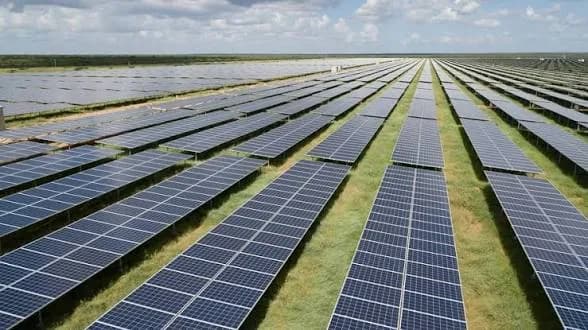
The most practical and economically viable configuration for a Kenyan data centre is a grid-tied hybrid system. In this setup, solar panels generate DC electricity during daylight hours, which is converted to AC by inverters and fed directly into the data centre's power distribution system. When solar output exceeds the data centre's demand, the excess can be exported to the grid (where net metering is available) or curtailed. When solar output is insufficient (at night, during heavy cloud cover, or during peak demand periods) the grid seamlessly supplies the balance.
This hybrid approach eliminates the need for large battery banks, which are currently the most expensive component of off-grid solar systems. Battery storage costs have fallen dramatically (lithium-ion battery packs now cost approximately $120–$150 per kilowatt-hour, down from over $1,000 a decade ago) but they still represent a significant capital investment and add complexity in terms of maintenance, thermal management, and replacement cycles.
The key design decision in a grid-tied hybrid system is how much solar capacity to install relative to the data centre's load. This is not a simple ratio calculation, because data centres run 24 hours a day, but solar only generates during daylight hours (approximately 6:00 AM to 6:30 PM at the equator). Oversizing the solar array means more energy is exported to the grid (at potentially unfavourable rates) rather than used directly by the data centre. Undersizing means leaving money on the table.
The optimal sizing typically targets a solar offset of 20–40% of total energy consumption. This range maximises the use of solar generation during peak daylight hours without excessive curtailment or grid export. For a facility with a 1.5MW total load, this translates to approximately 300–600kW of solar PV capacity.
Battery Storage: When It Makes Sense
While grid-tied systems without batteries are the most cost-effective configuration for most Kenyan data centres today, there are scenarios where adding battery storage makes economic sense. The primary case is for facilities that want to participate in demand response programmes or reduce their peak demand charges.
Kenya Power's industrial tariffs include a demand charge component based on the maximum power draw recorded during the billing period. A data centre that occasionally draws more power during peak hours (for example, when workloads spike or when cooling systems work harder during hot afternoons) pays higher demand charges for the entire billing period. A battery system can smooth out these peaks by drawing power from the grid (or solar) during low-demand periods and discharging during high-demand periods, reducing the recorded maximum demand and therefore the demand charge.
A secondary case for batteries is as a short-term backup during grid outages. While data centres already have UPS systems and diesel generators for this purpose, batteries can bridge the gap between a grid failure and generator start-up more cleanly and with lower emissions than flywheel UPS systems. Lithium-ion batteries can also reduce diesel fuel consumption during extended outages by handling the first 15–30 minutes before generators take over, and by managing load transitions during generator testing.
The Geothermal vs. Solar Question
Kenya's unique position in the global renewable energy landscape raises a question that does not arise in most data centre markets: if the grid is already 90% renewable (primarily geothermal), does on-site solar provide meaningful additional environmental benefit? The baseload that anchors this question comes from Kenya's geothermal energy, with the Olkaria corridor its clearest expression.
The answer depends on the data centre operator's goals. From a pure carbon perspective, a Kenyan data centre running on grid power already has an exceptionally low carbon intensity. Kenya Power's generation mix produces approximately 50–100 grams of CO2 per kilowatt-hour, compared to 400–500 g/kWh for the European grid average and 800+ g/kWh for coal-heavy grids in South Africa and India. Adding solar panels on-site might reduce this to 20–50 g/kWh for the portion of consumption offset by solar, which is a meaningful improvement but not a transformative one.

However, the economic argument for solar remains strong regardless of the grid's greenness. Solar is cheaper than grid power in Kenya. Period. Any data centre operator who can install solar at $0.04–$0.06/kWh instead of buying grid power at $0.08–$0.12/kWh is saving money. And for international companies with corporate renewable energy targets (companies that have committed to 100% renewable energy or net-zero carbon) on-site solar provides verifiable, attributable renewable energy that is easier to report and certify than purchased grid renewables.
Case Studies from Other African Markets
While Kenya has not yet seen a large-scale solar-powered data centre, other African markets provide instructive examples. In South Africa, several data centres have installed rooftop and ground-mounted solar arrays, driven primarily by the country's load shedding crisis and high grid costs. Teraco, Africa's largest colocation provider, has installed solar at multiple facilities and has signed power purchase agreements (PPAs) with independent solar producers. In Ghana, a pilot project at the Ghana-India Kofi Annan Centre of Excellence in ICT demonstrated a 100kW solar installation supporting a small data centre, achieving 25–30% solar offset with a grid-tied configuration.
These examples confirm that the technology works in African conditions and that the economics are viable. Kenya's advantage over both South Africa and Ghana is its more reliable grid, which makes grid-tied systems more practical (there is less need for battery backup to compensate for load shedding) and lower grid costs (which means the savings from solar, while real, are a smaller percentage of total costs than in markets with very expensive grid power).
Land Requirements and Site Selection
One of the practical constraints on solar for data centres is land. A 1MW solar PV array in Kenya, using modern monocrystalline panels with approximately 20–22% efficiency, requires approximately 2–3 hectares (5–7 acres) of land when accounting for panel spacing, access paths for maintenance, inverter pads, and perimeter security. A 5MW array (enough to offset a significant portion of a large data centre's consumption) needs 10–15 hectares.
This land requirement has implications for data centre site selection. Facilities in Nairobi's congested industrial areas (along Mombasa Road, in Enterprise Road, or in South B) typically sit on 1–2 acre plots and have no room for meaningful solar installations. Newer facilities being built on larger sites (like iXAfrica's campus, which has room for expansion, or potential sites in Konza Technopolis) are better positioned to incorporate solar from the design stage.
The Path Forward
Solar power for Kenyan data centres is not a question of if, but of when and how fast. The economics are already favourable, the solar resource is excellent, and the regulatory framework (net metering, renewable energy targets) is supportive. The primary barriers are land availability at existing sites, the capital investment required, and the fact that grid power is already relatively clean and reasonably priced, which reduces the urgency compared to markets with dirty or unreliable grids.
The most likely trajectory is that new data centre projects (those not yet built or in early planning stages) will incorporate solar from the design phase, allocating land and electrical infrastructure for 20–30% solar offset. Existing facilities will add solar incrementally, starting with carport installations (solar panels above parking areas, which require no additional land) and rooftop arrays where structural capacity allows. Within five years, it is reasonable to expect that most new Kenyan data centres will have some form of on-site solar generation, and that solar offset will be a standard feature in colocation marketing materials.
For Kenya, solar-powered data centres represent an opportunity to reinforce its positioning as Africa's greenest digital infrastructure hub. In a world where environmental, social, and governance (ESG) considerations are increasingly influencing investment decisions, the combination of geothermal grid power and on-site solar could make Kenyan data centres some of the most environmentally attractive in the world, a genuine competitive advantage in the global market for digital infrastructure investment.