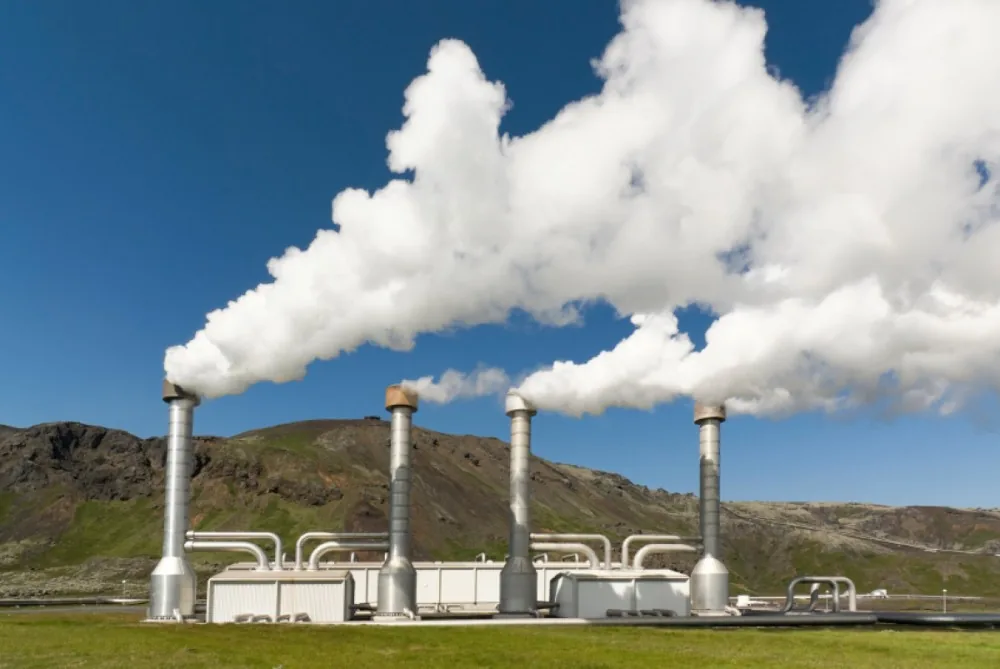
Kenya has a power problem and a power surplus at the same time, and both point to the same place on the map. The country's grid carries roughly 3,000 megawatts of installed capacity, and the largest single slice of its electricity comes from steam fields at Olkaria, about 120 kilometres northwest of Nairobi. Yet the biggest data centre project ever announced in East Africa stalled in 2026 largely because of power, not money, not permits, and not demand. The idea now pulling investors and government officials alike is the geothermal corridor: putting compute close to the wells instead of stretching the grid thin to reach it.
This article explains what the corridor actually is, what happened to the Microsoft and G42 project that put Olkaria on the data centre map, and the honest engineering trade-offs (fibre, latency, workforce) that will decide whether the Rift Valley ever hosts server halls at scale.
The $1 Billion Project That Ran Into the Grid
The project that defined the conversation was announced in May 2024, during President William Ruto's state visit to Washington. Microsoft and the UAE's G42 committed around $1 billion to a data centre intended to serve government and business customers on Azure, planned for a site roughly 100 kilometres northwest of Nairobi, in the direction of Naivasha and the Olkaria steam fields. Geothermal power was the headline: the facility was meant to run on the same renewable baseload that powers roughly 45 percent of Kenya's electricity generation.
It never broke ground. Semafor reported on 6 May 2026 that President Ruto, speaking in Nairobi, said the project was reconsidered after it became clear it would require about a third of the country's roughly 3,000 megawatts of installed capacity. "To switch on that one data center, we would need to shut off power for half the country," he said. The project as announced was a data centre campus in the region of 100 megawatts of IT load, per the entry in our Kenya data centre directory, but the president's arithmetic described the generation and grid build-out a campus of that ambition was expected to pull with it. Either way, the numbers describe a load Kenya's grid could not absorb at a single site in 2026.
The paperwork trail matters as much as the quotes. Government officials told Semafor the technology ministry developed a project concept note and took it to the National Treasury, which never approved the funding. A meeting between Kenyan officials and Microsoft executives in August 2025 made clear the facility would miss its original May 2026 online target. Semafor also reported the context around the announcement: the deal had been framed as a symbol of strengthening Kenya-US relations, and MoUs signed at bilateral summits often move faster than feasibility studies. G42 declined to comment; Microsoft did not respond to a request for comment.
What Kenya's Grid Can and Cannot Carry
Kenya's power system is genuinely strong by regional standards, and genuinely finite. Installed capacity sits at roughly 3,000 megawatts, geothermal contributes approximately 950 megawatts of it, and demand from homes, industry and the Mombasa Road data centre corridor is growing at the same time. The national grid picture is the binding constraint on every hyperscale conversation: Kenya Power cannot today deliver the kind of single-site load a flagship AI campus wants, which is precisely why the Microsoft and G42 project stalled and why our directory marks it early stage rather than pipeline.
Two government numbers frame how the corridor idea fits in. The first is the target: President Ruto has argued Kenya must raise energy capacity to 10,000 megawatts by 2030 for projects of this class to work, part of a broader push to fund roughly $38 billion in energy infrastructure through asset sales and private capital. The second is the resource: Kenya's geothermal potential is estimated at 7,000 to 10,000 megawatts, of which only about 950 megawatts has been developed, almost all of it at Olkaria. The constraint is not the heat under the Rift Valley. It is the pace at which wells, plants and transmission lines can be financed and built.
Why Move Compute Next to the Steam?
The economics of siting compute near the wellhead are straightforward. Power bought close to generation avoids transmission losses and some distribution charges, and analysis in our geothermal explainer puts the saving for a Rift Valley site at 30 to 40 percent below Nairobi levels. Olkaria also sits at roughly 2,000 metres altitude, where cooler air helps free-cooling economics. Geothermal is baseload: it runs through the night and does not depend on rainfall, which matters for the high utilisation rates that make data centre capital efficient.
There is evidence the corridor is forming rather than just being discussed. Coverage of the ITW and Datacloud Africa 2026 summit in Nairobi (The Star, 14 September 2026) reported that Kenya's live data centre capacity is growing "with more under construction in Olkaria and Konza", a notable line because it puts an active Rift Valley site alongside the government-backed smart city. Konza Technopolis runs its own campus power model, as our Konza deep dive explains, and the same logic (build the power plan first, the halls second) is what a direct geothermal integration at Olkaria would formalise.
The Fibre and Latency Reality
Every honest corridor conversation has to clear the latency question, and the physics are friendlier than most people assume. Over the roughly 120 kilometres between Olkaria and Nairobi, a signal travelling on fibre needs about 1 to 2 milliseconds for a round trip even before equipment overheads (a rough estimate from the speed of light in glass, not a measured route figure). That is a rounding error compared with the delay of routing traffic to Europe or South Africa and back. Latency will not kill a Rift Valley data centre.
The real connectivity questions are route diversity and interconnection density. Nairobi has the metro fibre, the internet exchange points and the carrier community; a greenfield site at Olkaria needs high-capacity fibre built or extended to it, ideally over more than one physical path, before any carrier treats it as a credible colocation market. AI training workloads tolerate this trade-off well, because they move huge datasets between a handful of locations on schedule. Transactional workloads that serve M-Pesa and banking customers want the densest possible interconnection, which for now keeps them in Nairobi. The sensible reading of the corridor is a split market: training and batch compute near the steam, customer-facing compute in the metro.
What Would Make the Corridor Real
Three things have to line up. First, generation: more wells and plants at Olkaria, Menengai and Suswa, developed by KenGen and the Geothermal Development Company, on the path to the government's ~1,600 megawatt geothermal target for 2030. Second, transmission: high-voltage lines (KETRACO's portfolio) sized for dedicated industrial loads, or a formal direct-integration framework that lets a large campus contract power at the generator gate. Third, commercial structure: the kind of purpose-built licensing clarity the Communications Authority is currently consulting on, and the investment incentives covered in our tax piece.
The prize explains the persistence. Kenya is projected to account for more than three-quarters of fresh data centre capacity across East African markets by 2030, according to an African Union report cited by Semafor, and the Kenya market is projected to roughly triple to $805 million by 2031 (a 2026 market report cited by Semafor; market estimates vary, as we explain here). A country that solves the power-at-scale question first will collect a disproportionate share of that build-out. The compute hub plan the ICT ministry published in September 2026 makes exactly this argument: cables are done, compute is next, and power is the gate.
Three Models Now Compete for the Same Load
The corridor does not develop in a vacuum. As of late September 2026, three competing power models are on the table for Kenya's compute build-out, and each needs to be read on its own terms. The first is this article's model: compute-to-the-wells, siting campuses at or near geothermal generation so the load lives where the baseload is. The second is regional hydro imports: Ethiopian Electric Power plans to raise exports to Kenya from 200 to 400 megawatts from December 2026, subject to grid testing, which we track in our Ethiopia power exports analysis. The third arrived on 26 September 2026, when Aliko Dangote announced that his proposed Lamu refinery would include an LNG-fired power plant of about 1,000 megawatts, with roughly 500 megawatts potentially offered to the Kenyan government, covered in our Dangote Lamu analysis. That announcement is attached to a refinery that has not broken ground, with no power purchase agreement public.
The discipline in reading all three is keeping their numbers apart. Olkaria's roughly 950 megawatts of installed geothermal is operating capacity on today's grid. Ethiopia's 400 megawatts is a planned trade volume entering the bulk system, not a private feed. Dangote's 500 megawatts is an announcement, the same status our directory gives the Microsoft and G42 campus's 100 megawatts. None of the three is reserved for data centres, and adding them together produces a number that describes nothing, because the figures sit at different stages of certainty and different points on the grid. What decides Kenya's compute future is which model turns its promise into contracted, transmitted, dispatchable supply first, and for the corridor that means wells, plants and a direct-integration framework, not a headline.
What to Watch
- Treasury action on energy infrastructure: the $38 billion funding push is the single biggest variable between the 3,000 MW grid of 2026 and the 10,000 MW ambition of 2030.
- Named projects at Olkaria: the ITW 2026 coverage points to construction under way, but no operator, size or timeline is public yet. We will add it to the directory the moment it is confirmed.
- Whether the Microsoft and G42 concept returns in any form: the directory entry stays early stage, and the lesson from the stall (match the load to the generation plan first) is now shaping every new proposal.
- Direct-integration policy: how the government lets large campuses contract power at or near generation, which decides whether the corridor is a metaphor or an engineering programme.
Sources: Semafor (6 May 2026, Ruto statements, Treasury concept note, market projections); The Star (14 September 2026, ITW and Datacloud Africa 2026, Olkaria and Konza construction); Business Daily (15 September 2026, regional connectivity context). Grid and geothermal figures (950 MW installed geothermal, Olkaria complex roughly 800 MW, 45 percent generation share, 120 km distance, 30 to 40 percent cost advantage, 7,000 to 10,000 MW potential) verified against our geothermal explainer, first published with dated sources. Facts verified 16 September 2026; updated 26 September 2026 to add the three-model competitive framing (Olkaria compute-to-the-wells, Ethiopian hydro imports, announced Lamu coastal LNG) following the Dangote announcement, with figures for each model kept separate.