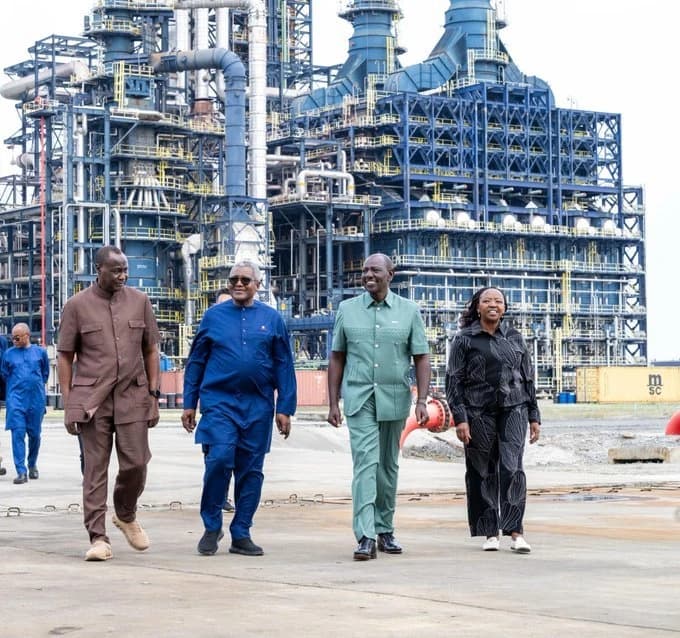
Africa's richest man has offered Kenya half of a very large power plant. Announcing details during President William Ruto's late-September 2026 visit to his Lekki refinery in Nigeria, Aliko Dangote said the proposed Lamu refinery complex would generate about 1,000 megawatts of electricity and sell roughly 500 megawatts to the Kenyan government, as reported by Kenyans.co.ke on 26 September 2026. "We are going to produce about 1,000 megawatts in Lamu and have 500 megawatts to sell to the Kenyan government," Dangote said. For a country whose largest announced data centre project stalled largely on grid constraints, half a gigawatt of new generation is the kind of number that demands attention, and scrutiny.
This article was published on 26 September 2026, days after the announcement. It is a developing story: the refinery has not broken ground, financing is not closed, and no power purchase agreement is public. Every figure below is staged the way DC254 stages everything, as an announcement with a named source, not as infrastructure that exists.
What Was Actually Announced
The facts as reported are straightforward. Dangote framed electricity generation as part of the refinery investment, an "entry point" for further businesses. "What this investment will do to Kenya's economy is not only the refinery. The refinery is actually the gate. Once you open the refinery, you will be shocked at how many people will come to invest in Kenya," he said during the visit. President Ruto backed the project, said his administration had already secured land for its development, and described it as an industrial-scale-up opportunity rather than a refinery alone.
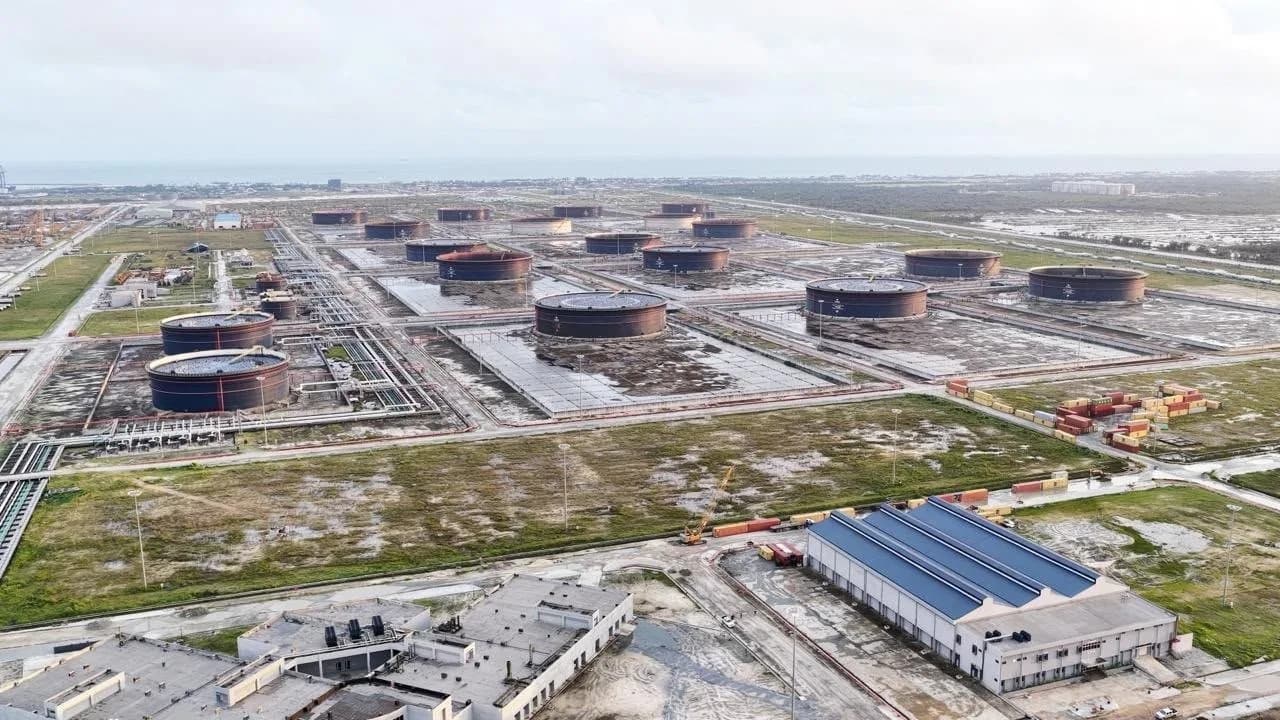
The project's reported shape, assembled from coverage across Kenyans.co.ke, The Star and international outlets, includes a refinery complex backed by the Africa Finance Corporation, an investment value reported in the range of Ksh 1.94 trillion to Ksh 2.20 trillion (roughly $15 billion to $17 billion), and processing capacity reported between about 220,000 and 700,000 barrels per day depending on the outlet, a discrepancy worth flagging rather than smoothing over. The project was initially earmarked for Tanga in Tanzania before shifting to Lamu, citing infrastructure, logistics and market considerations. Reports in late September suggested a launch or groundbreaking window at the end of September 2026, which, if it happens, will be the first hard evidence that the project is moving.
The Detail That Matters: It Is an LNG Plant
One technical detail from the earlier reporting changes how this story should be read. The Africa Report, writing on 3 September 2026, described Dangote Industries planning to double the capacity of an LNG-fired power plant at the proposed Lamu refinery from 500 megawatts to 1,000 megawatts, with an eye on Tanzanian gas supply. That means the 1,000 megawatts now being discussed is not renewable baseload. It is fossil generation, and its fuel would be imported or regionally sourced natural gas.
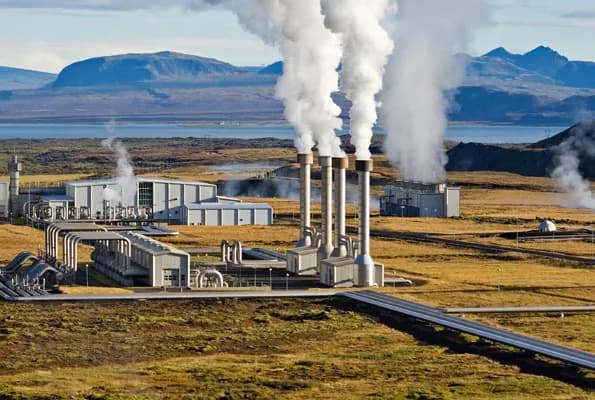
That detail matters because Kenya's electricity story, and by extension its data centre story, has been built on the opposite proposition. Kenya's grid is roughly 90 percent renewable, anchored by Rift Valley geothermal that supplies roughly 45 percent of generation, with hydro and wind carrying most of the rest. That green grid is a genuine commercial edge in a market where hyperscalers and enterprises face mounting scrutiny over the carbon cost of compute. Half a gigawatt of LNG baseload would not end that edge, but it would dilute the grid-level mix that the edge rests on.
The Scale, in the Context That Counts
Put the announced numbers against the grid DC254 tracks. Kenya's installed generation capacity is roughly 3,000 megawatts. The Microsoft and G42 campus, announced in 2024 at around $1 billion and roughly 100 megawatts of IT load, stalled in 2026 after President Ruto himself said the project would have needed about a third of the country's installed capacity, and the National Treasury never approved its funding concept note. Against that arithmetic, 500 megawatts of new supply is material: about one-sixth of today's installed capacity, from a single project.
For data centres specifically, the comparison is starker still. DC254's directory currently tracks 27 verified Kenyan facilities with 42.9 megawatts of built capacity at operational sites and 10.5 megawatts of published in-service IT load, inside a 230 megawatt announced pipeline. The half of Dangote's plant destined for the grid is roughly twelve times the built capacity of every operational Kenyan data centre combined. That is the scale gap between the compute Kenya actually runs and the generation now being promised to support what comes next.
Two caveats keep the excitement honest. First, generation is not capacity: megawatts produced at Lamu only matter to a data centre if they reach it, which requires a contracted power purchase agreement, transmission investment and dispatch priority, none of which is public. Second, an announcement tied to an unbuilt refinery inherits every schedule risk the refinery carries, and African infrastructure history is full of refinery-scale projects that stayed announcements. Our Kenya data centre directory keeps live and announced capacity strictly separated for exactly this reason.
Why a Data Centre Site Is Covering a Refinery
Because the constraint this announcement speaks to is the one that decides Kenya's data centre decade. Power, not demand, not land, and not capital, is the binding constraint in the directory's own records: the Microsoft-G42 stall was a power story, and operator build-outs across Nairobi are sized by what the grid can supply. If 500 megawatts of firm capacity actually entered the system, it would change what projects are financeable, starting with the stalled gigawatt-scale ambitions.
There is also a geographic angle. Lamu sits on Kenya's coast, near but not adjacent to the infrastructure that anchors Kenya's digital economy. Kenya's submarine cables land at Mombasa, the landing stations and fibre routes that carry traffic run through Mombasa and Nairobi, and the market's interconnection, skills and customers are concentrated inland. Our analysis of why data centres cluster in Nairobi and Mombasa explains why cheap power alone has never moved the market: a refinery-town power surplus, however large, needs wires and fibre to become compute.
The third angle is competitive. Ethiopia is exporting regional hydro power to Kenya across a 2,000 MW interconnector and plans to double those exports, a story we track in our Ethiopia power exports analysis. Olkaria's geothermal corridor idea pulls compute to the steam fields instead of stretching the grid. Dangote's LNG plant adds a third model: big coastal fossil baseload beside an industrial anchor tenant. Kenya's data centre power future may end up being all three, and the mix will shape both cost and carbon claims.
The Deal Structure and the Open Questions
The commercial architecture around the project is still forming. Reporting in August 2026 indicated Dangote offered Kenya a 10 percent stake worth about $500 million, with a combined 30 percent offered to East African countries, and that Kenya was considering financing its contribution through a local facility. Dangote has said the project would be financed through debt and shareholder funds, with support from the Africa Finance Corporation. Whether any government stake, offtake agreement or power purchase arrangement is concluded, and on what terms, will say more about the project's credibility than any announcement event.
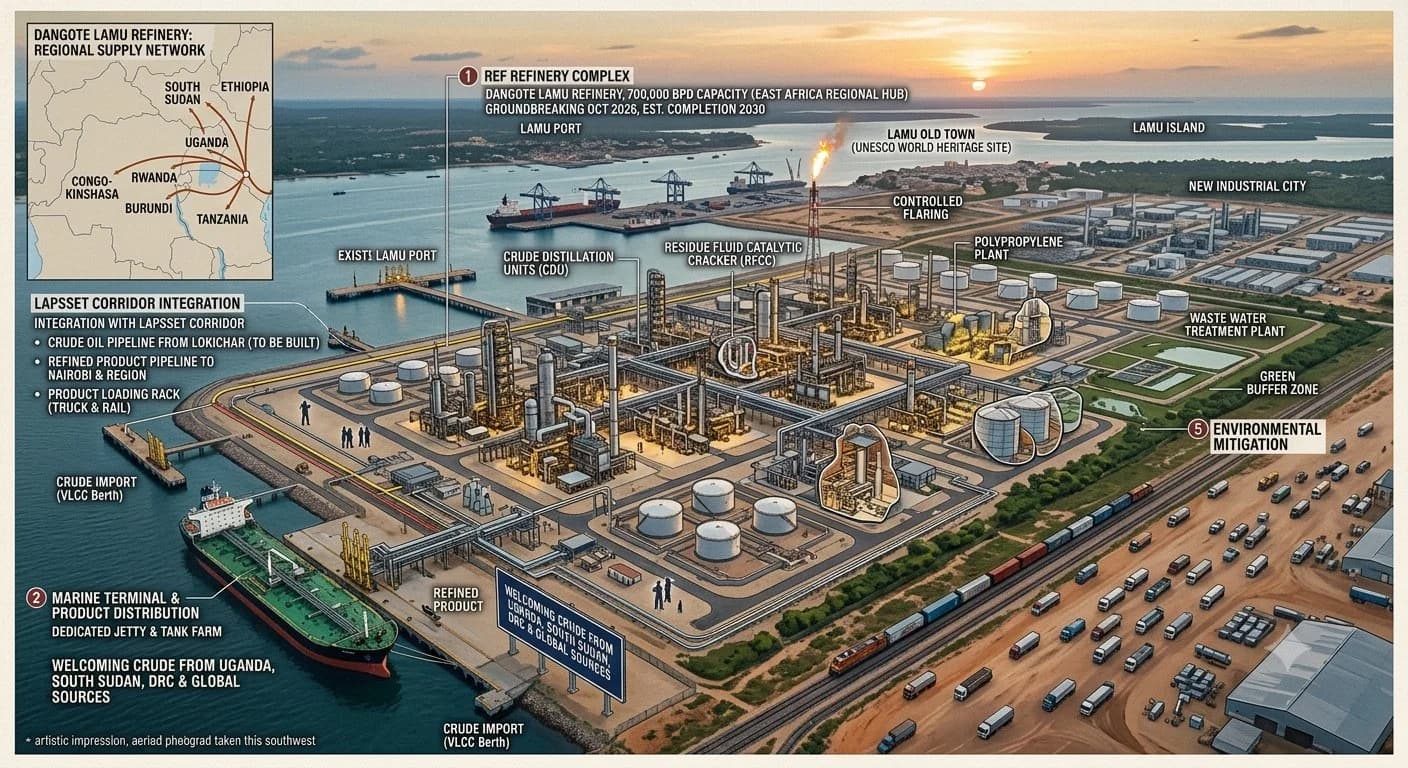
The environmental and heritage questions are equally part of the record. Lamu is a UNESCO World Heritage site, and the area carries the history of the 1,050 MW Amu Power coal plant, cancelled after the National Environment Tribunal revoked its licence in 2019. LNG is a different proposition from coal on emissions, but the permitting history means any large thermal plant at Lamu should be expected to face organised opposition and litigation. Investors, including data centre operators who might one day contract that power, price that risk.
What to Watch Next
Four markers will tell you whether this becomes infrastructure. Watch for a signed power purchase agreement naming the offtaker and the tariff, the single most verifiable signal that the 500 megawatts are real. Watch for financing close, not a launch ceremony, since debt and shareholder commitments are the difference between a groundbreaking photo and a construction site. Watch for the transmission plan that moves Lamu power to demand centres. And watch the fuel chain, because an LNG plant is only firm capacity if the gas supply contracts behind it are firm. Until those land, treat the 1,000 megawatts the way our methodology treats every announced number: as intent, dated and sourced, not as capacity.