African data centres have moved from regional story to geopolitical one. In a Fox News Digital report published on 13 September 2026, analysts and US officials framed the continent as the next major frontier for AI infrastructure, precisely because the US and Europe are hitting limits of their own: power scarcity, grid congestion, permitting fights and environmental rules are slowing new data centre construction in mature markets. The US State Department put its position plainly, telling Fox News Digital that it is "committed to ensuring that American AI, including enabling infrastructure like data centers, continues to be the gold standard worldwide."
The report matters for Kenya for a simple reason: the country is on the shortlist that accompanies the narrative. Arizton Advisory & Intelligence consultant Abhishek Goyal named South Africa, Kenya, Nigeria, Morocco and Egypt as the African markets attracting large-scale AI projects. But frontier stories attract pledges the way floodlights attract moths, so this article does what DC254 always does: separate what is signed from what is sited, and what is sited from what is switched on.
What the Frontier Narrative Actually Says
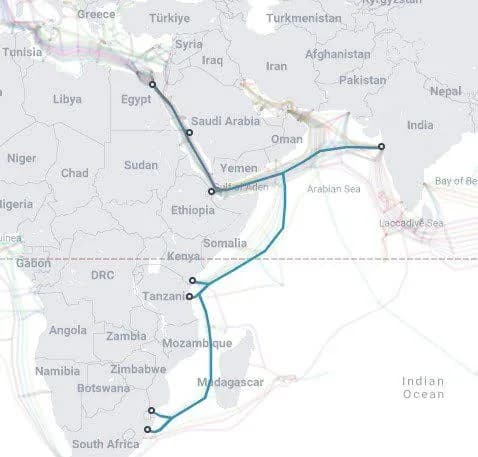
The argument from the US side has three parts. First, demand is real: governments, banks and large companies across Africa increasingly want local cloud and AI services, and they want sensitive data stored inside their own borders, which regulators and procurement rules are starting to require anyway. Second, supply is constrained elsewhere: as Goyal put it, "many mature markets face increasing environmental and power constraints," while Africa's gaps in infrastructure present "an opportunity rather than a disadvantage." Third, the US government is actively promoting American vendors: a State Department spokesperson described the goal of keeping American AI the "gold standard" and the US the "partner of choice" for governments upgrading telecoms networks and AI capabilities, and pointed to new undersea cable construction across the Atlantic as evidence that connectivity is improving faster than compute.
That third part is the genuinely new element. African data centre demand has been discussed for a decade as a commercial story. What the Fox report captures is its emergence as an arena of state-backed competition, with US embassies brokering deals that explicitly displace rival bids. The State Department framing ("partner of choice") and the competition references in the deal flow below are not our words; they are the words of the people doing the deals.
The Deals Behind the Headlines
Three US-linked packages carry the story in 2026, and each is at a different stage of verification.
Lesotho, $6.2 billion. American company Convalt Energy won a package covering a data centre and a pumped-hydro power project (the Kobong scheme) with the government of Lesotho, in a deal the report says was facilitated with US government assistance. It is the largest single number in the narrative, and the structure is the interesting part: the data centre and the generation are bundled, because one cannot work without the other.
Gabon, $600 million in 2025 plus $100 million in 2026. The US Embassy in Libreville helped American companies win $600 million of business in 2025, and this year assisted in securing a $100 million contract to supply two data centres and a gas-to-power plant, reportedly against strong competition from China. Two data centres plus dedicated generation in one package is the same pattern as Lesotho at a tenth of the headline size.
Ivory Coast, $170 million. The US Embassy in Abidjan helped facilitate a $170 million contract for US company Cybastion with the government of Ivory Coast, which includes a data centre. The report carried images from a construction site visit, which puts this deal further along the verification path than most: renderings are promises, construction photos are evidence.
The pattern across all three is worth naming. None of these is a hyperscaler buying land and waiting for a grid connection. Each bundle pairs compute with generation, because Africa's binding constraint is exactly what the analysts say it is: electricity.
The Sober Counterpoint
Arthur Goldstuck, CEO of World Wide Worx and author of "The Hitchhiker's Guide to AI: The African Edge," provided the reality check in the same report, and his quotes deserve as much attention as the deal values. "Africa is experiencing a data centre boom, but it begins from a very small base," he said, and "Africa will not replace either market as any kind of center of global computing." The attraction, in his framing, is serving a rapidly growing African cloud market and processing African data closer to the people and businesses that generate it.
He also named the operational difficulty that headline numbers skip: weak electricity grids make construction and operation harder, and Africa remains far behind the US and Europe in installed capacity. His most useful observation for operators is the one about energy economics: "In some countries, a data center can also become the guaranteed customer that makes a new renewable energy project financially viable." That inverts the usual risk story. The data centre is not the customer that power projects fear; it is the anchor tenant that makes them bankable.
Where Kenya Fits
Kenya's name on Arizton's list (Goyal's five) is not a forecast; it is a recognition of what already exists, and our own directory makes it checkable. DC254 tracks 27 facilities in Kenya, of which 20 are operational, concentrated in Nairobi and Mombasa. The AI-specific positioning is already marketed: iXAfrica bills its Nairobi campus as Kenya's first hyperscale AI-ready facility, and the government's digital infrastructure push is active on the regulatory front, with the Communications Authority consulting on a standalone data centre licence. On the input side, Kenya's geothermal fleet gives operators something most frontier markets lack: cheap, firm, low-carbon baseload power, which is why energy-hungry compute keeps appearing in Kenya-focused investment conversations.
The honest gaps are the ones Goldstuck names for the continent. Kenya's grid is more stable than most in the region but it is not unlimited, transmission into new industrial areas takes years, and the country's total installed data centre capacity is measured in dozens of megawatts, not the hundreds a single US campus can hold. That is why the Kenya angle in the frontier story is best read as a demand signal (US vendors and financiers are actively looking here) rather than a capacity claim.
How to Read Frontier Numbers
This site's standing advice applies with extra force to frontier narratives, because the numbers involved are pledges, and pledges compound enthusiasm. A $6.2 billion package is not $6.2 billion of installed capacity; it is a programme with a hydro project inside it, and pumped hydro takes the better part of a decade. An $80 million announcement is not an $80 million building until a groundbreak and a commissioning date exist. The discipline that works is the one this directory uses: track facilities, status and MW against dated sources, and re-verify when the story changes. For Kenya, that instrument already exists (our directory and its quarterly re-verification); for the rest of the frontier, the same habit is the difference between following the story and repeating it.
Sources: Fox News Digital, "Could Africa be the next AI frontier as US and Europe hit limits?" by Paul Tilsley (13 September 2026), including quotes from Abhishek Goyal (Arizton Advisory & Intelligence), a US State Department spokesperson, and Arthur Goldstuck (World Wide Worx). Deal figures as reported therein. Kenya capacity and status figures from the DC254 directory (September 2026 verification).