The continent has quietly standardised on a unit of infrastructure planning, and Kenya is one of its best case studies. PIDA, the Programme for Infrastructure Development in Africa, currently identifies 42 priority corridors; the African Development Bank has helped fund 25 of them and deployed more than $55 billion into African infrastructure over the last decade; and the Africa Center for Strategic Studies counts 79 ongoing and planned regional economic corridors across the continent. A spotlight published by the Africa Center, "Transforming Africa's Economic Corridors for a New Era", argues these corridors are misunderstood when they are treated as roads and railways. Done right, they are economic ecosystems: production centres, industrial clusters, energy, one-stop border posts and markets moving together. The line worth keeping: "Infrastructure becomes economically transformative when complementary investments, institutions, markets, financing, and governance operate as a single system."
Kenya's data centre conversation almost never uses the word corridor. It should, because the country's digital infrastructure is already corridor-shaped, and the corridor era now being planned will decide where the next layer of it lands.
Corridors as ecosystems, not concrete
The Africa Center's central warning is about the extract-and-export trap. A corridor that only digs up raw materials and ships them out, the historical pattern, generates transit revenue without transformation. The alternative reading, corridors as integrated economic systems, connects production centres to markets, builds industrial clusters for processing and manufacturing along the route, and deepens intra-continental trade, with AfCFTA (in force since 2019) and the AU's Agenda 2063 providing the continental frame. The financing numbers the spotlight assembles explain why governance matters as much as concrete: Africa needs roughly $130-170 billion a year for infrastructure but generates only about $68 billion domestically; over 40% of active infrastructure commitments are already financed by African governments themselves; and debt distress has made sovereign borrowing expensive, pushing the playbook toward pooled African financing, multilateral lenders and PPPs. The AfDB's 2024 structure for the Central Corridor Electric Railway, a $696 million credit guarantee releasing $3.9 billion, is the model the piece praises.
For our readers the translation is direct: the same financing realpolitik that shapes a railway shapes a data centre. Facilities are capital-intensive, long-lived, and only as good as the power and connectivity that reach the site. Corridor planning is where those inputs are decided.
Kenya is a corridor economy
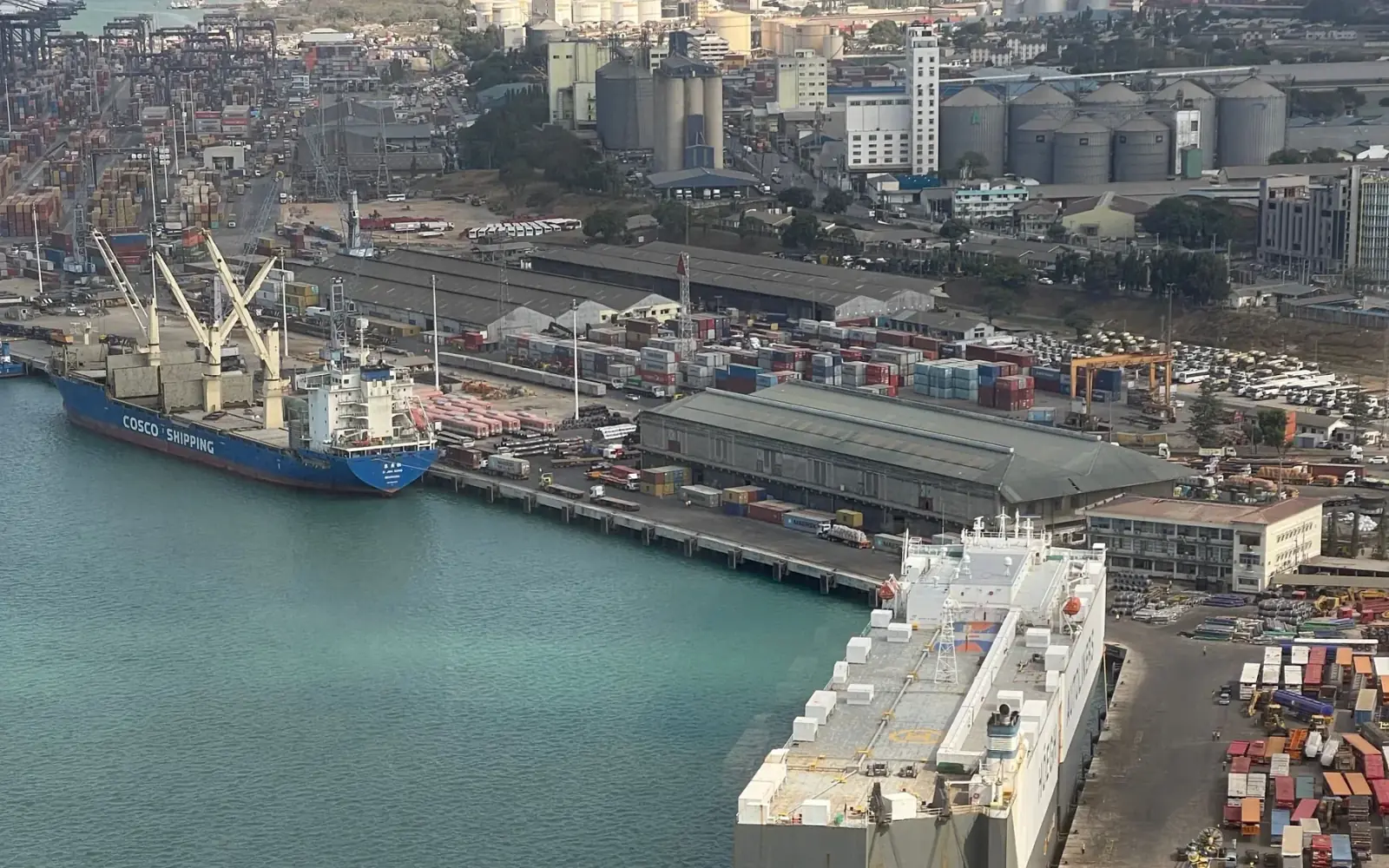
Look at Kenya through the Africa Center's lens and the country reads as a textbook corridor state. The Northern Corridor, anchored on the port of Mombasa, carries most of the freight for Kenya and its landlocked neighbours, and our own pull of Kenya's records from the African Infrastructure Database (AUDA-NEPAD's registry behind PIDA, fetched 8 September 2026) shows how much of the country's built infrastructure is corridor infrastructure: the $5 billion Mombasa-Nairobi SGR section sits in the registry's completed column alongside the Nairobi Southern Bypass, the Mombasa Port container terminal and the Malaba one-stop border post, while the wider Mombasa-Nairobi-Malaba-Kampala-Kigali standard-gauge programme is the registry's continental flagship at $19.2 billion.
The second corridor is LAPSSET, the Lamu Port-South Sudan-Ethiopia Transport corridor, Kenya's bet on a second gateway. Its registry entries are pipeline rather than concrete: a roughly $3 billion crude oil pipeline and a $13.5 billion railway, at preparation and structuring stages. And the Africa Center spotlight is refreshingly honest about the risks such projects carry: it notes the 2022 al Shabaab attacks targeting infrastructure and workers along the LAPSSET corridor in Kenya, a reminder that corridor security is infrastructure security, and it documents the counter-example of Kenya's own SGR, financed largely through Chinese loans with lower-than-expected freight volumes and revenue that raised concerns about returns and added fiscal burden. The lesson the spotlight draws is one worth quoting precisely: anchor investment to "phased, demand-driven development based on cargo flows, revenue potential, and secured financing." Corridors that outrun their demand become debts. That lesson transfers to the digital layer with almost no translation.
The digital layer was built on these corridors all along
Here is the part of the story Kenya's data centre coverage usually misses: every layer of the country's digital infrastructure sits on the physical corridors' bones.
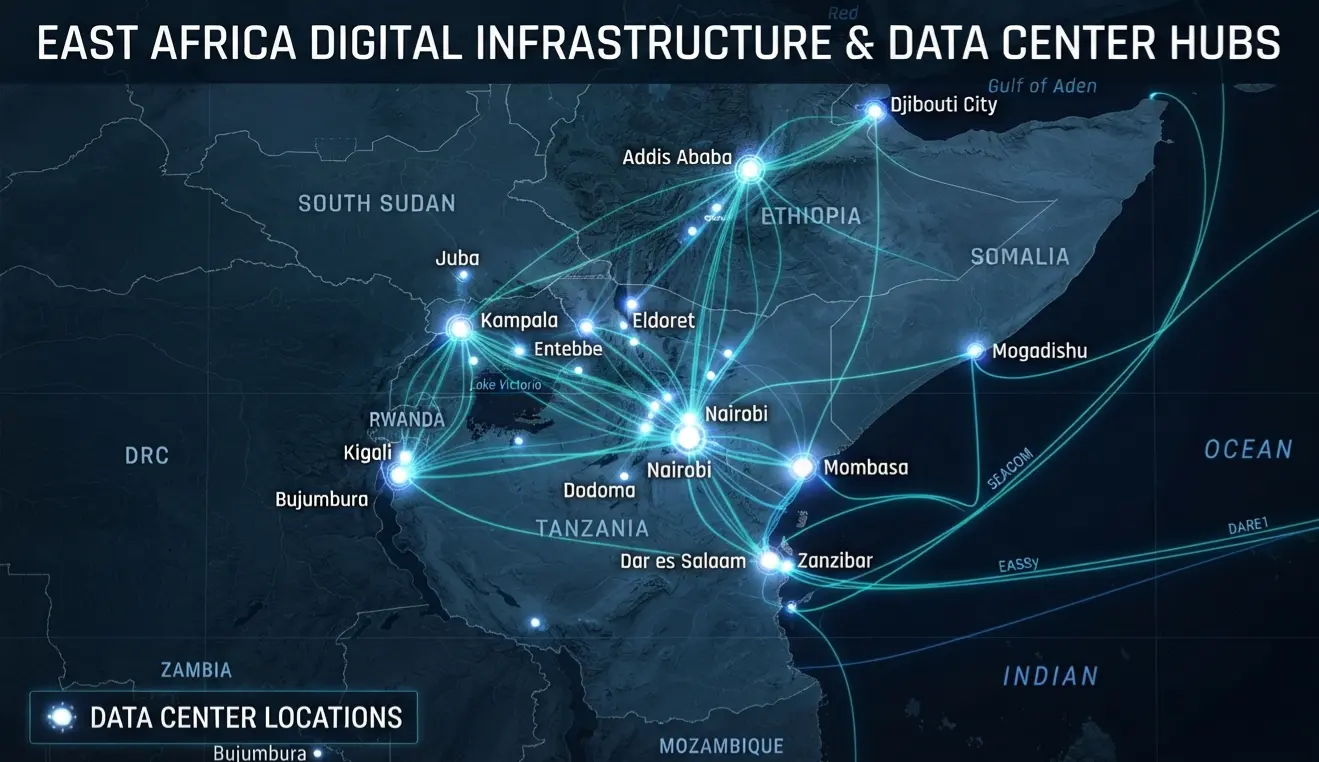
The cables landed where the port is. Mombasa's cable station geography exists because the port existed first, and seven live submarine cable systems now surface within reach of the freight gateway. Container ships and fibre pairs chose the same beach for the same reasons.
The fibre followed the freight. The national backbone runs along the Mombasa-Nairobi transport spine, and the SGR's civil works carried conduit the same way highway projects carry ducts. When we map why data centres cluster in Nairobi and Mombasa, the answer is corridor logic: power, fibre and demand concentrate along the route that freight built.
The nodes are corridor nodes. Nairobi sits at the hinge where the Northern Corridor splits toward Uganda, Rwanda and South Sudan, and the country's largest data centre cluster, IXP and cloud on-ramps sit exactly there. Konza, Kenya's smart-city play, is positioned on the same Mombasa-Nairobi axis. The registry's flagship ICT entry, the $395 million regional smart hub with data centre capacity at Mombasa (PIDA I.02.30.05, being advanced as a PPP under PIDA PAP 2 for six countries), is the corridor idea applied to digital infrastructure explicitly: stack regional demand onto the node where cables, port and border already meet. Meanwhile the $45 million Juba-Nairobi fibre link, whose Kenyan segment is operational, is best understood as corridor plumbing for landlocked demand: every kilometre completed turns South Sudanese traffic into Kenyan colocation and transit revenue.

What is missing is intentionality. Edge computing in East Africa is still waiting for its corridor moment: the one-stop border posts that transformed cargo transit, Malaba, Busia, Namanga, are the natural hosts for the region's next layer of edge sites, caching and content closer to cross-border trade. No one-stop data post exists yet. The corridor era is the window in which that changes, if digital infrastructure is written into the corridor plans from the start rather than bolted on after the ribbon cuttings.
The financing question reaches the digital layer too
The Africa Center's governance recommendations read as if they were written for Kenya's digital build-out. Diversify financing so no single partner holds the infrastructure hostage. Agree priorities, financing responsibilities and measurable outcomes up front, the registry is full of projects that failed this test. And think beyond the extract-and-export model: for a century Kenya's corridors exported tea and coffee; the value-addition frontier is exporting computation, turning geothermal steam, human capital and cable landing rights into AI services processed locally rather than raw capacity sold cheaply abroad. That is the economic logic behind the national compute hub ambition, and it is also why the corridor framing matters: compute hubs are industrial clusters, and industrial clusters are what corridors are supposed to produce.
Two honest caveats before anyone invests on the strength of a registry entry. First, registry records are project preparations, not built facilities, and "Active" means in the pipeline, a discipline we explain in our PIDA registry read-through, which is why our infrastructure map keeps the PIDA layer visually and numerically separate from the verified DC Directory. Second, registry numbers are the registrant's own, published as registered and never independently verified, so we carry them dated and attributed, and you should read them the same way.
What to watch
Three things will tell you whether Kenya's digital infrastructure actually joins the corridor era. Watch the Northern Corridor Transit and Transport Coordination Authority and whether digital infrastructure, fibre ducts, border data rooms, edge siting, starts appearing in its planning documents the way one-stop border posts did a decade ago. Watch the financing structures for the Mombasa regional smart hub, the $395 million PPP: if it reaches financial close with pooled African and multilateral capital behind it, the corridor financing playbook has officially crossed from railways into data centres. And watch the PIDA layer on our own infrastructure map, which we refresh from the African Infrastructure Database's public API with each quarterly directory pass, because the gap between registry ambition and verified reality is exactly the information this platform exists to publish.
The corridor era is not coming to Kenya. It already built the country's digital backbone, cable stations at the port, fibre along the freight spine, data centres at the hinge. What the next decade decides is whether the digital layer gets a seat at the corridor planning table while the concrete is still wet, or keeps discovering its geography by accident after the fact.