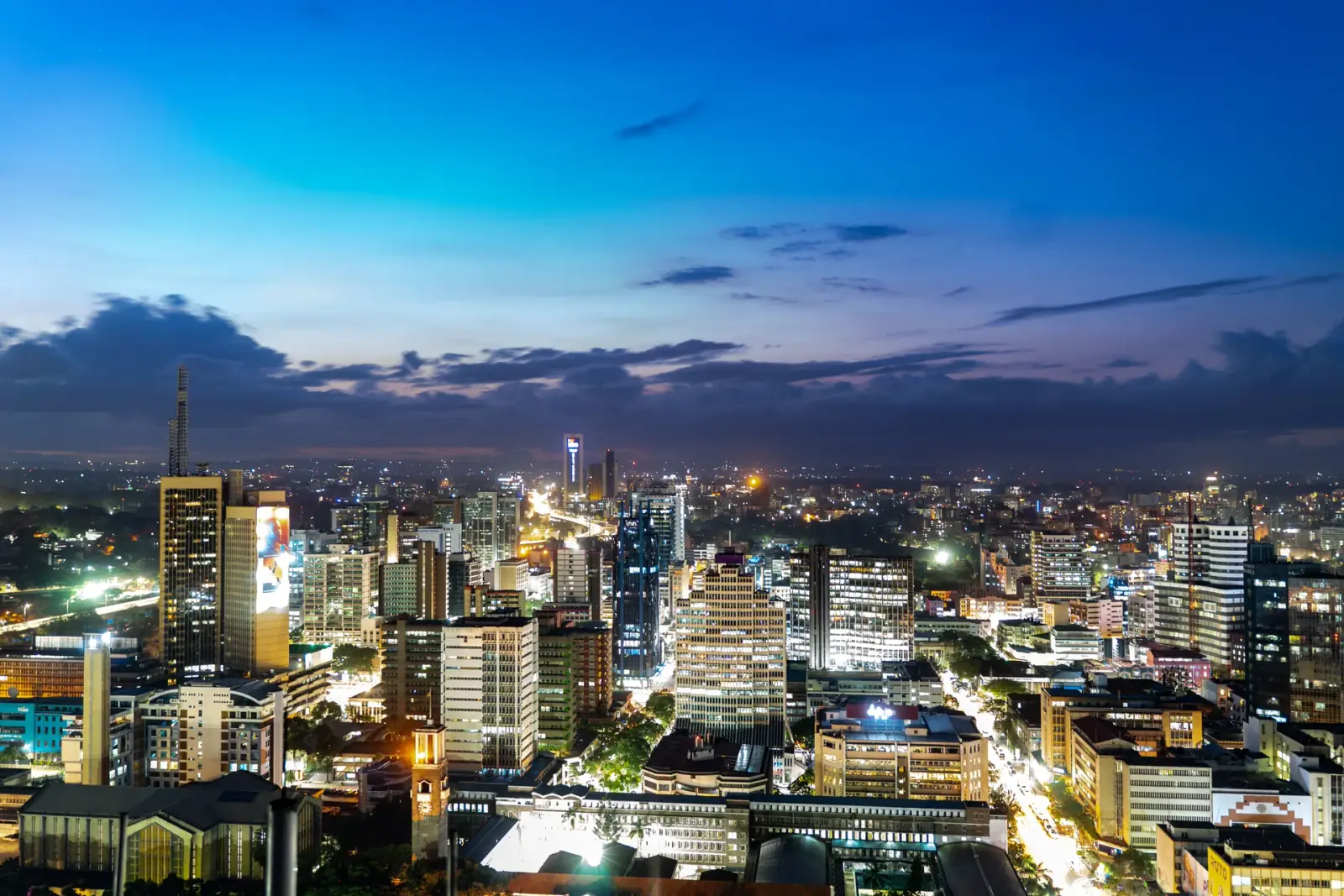
The Macro Picture: Why Kenya's Data Centre Market Is Accelerating
Kenya's data centre industry is entering a phase of structural growth driven not by a single sector but by a convergence of macroeconomic forces. From mobile money volumes that rival some European nations to a government digitisation agenda touching every public service, the demand for colocation and cloud infrastructure in Kenya is compounding year on year. Understanding these demand drivers is essential for investors, operators, and enterprises making infrastructure decisions.
Kenya's GDP grew at approximately 5.0% in 2024 and is projected to maintain 5-6% growth through 2030, according to the World Bank and IMF. Crucially, the digital economy's share of GDP has risen from under 3% a decade ago to an estimated 7.5-8% today. This shift is not abstract, it translates directly into servers, racks, and megawatts of data centre demand.
Government Digitisation: The Public Sector Engine
The Kenya Digital Masterplan 2022-2032
The Kenya Digital Masterplan 2022-2032, developed by the Ministry of Information, Communications and the Digital Economy, represents the most comprehensive government technology strategy in East Africa. Its ambitions are substantial: connecting all 47 counties with high-speed broadband, digitising 80% of government services, establishing national data centres, and building a workforce of 1.5 million digitally skilled Kenyans.
For data centre operators, the masterplan signals sustained public-sector demand. Government systems, including e-Citizen (which processed over 20 million service applications in the 2023/2024 financial year), iTax (the Kenya Revenue Authority's digital tax platform handling millions of filings), and the Huduma Namba digital identity programme, all require local server infrastructure. The World Bank's Digital Economy Diagnostic for Kenya identified digital government infrastructure as a critical gap that, when filled, will generate significant data centre demand.
Education Digital Content
The Ministry of Education's push for digital learning content, including the Digital Literacy Programme and the Competency-Based Curriculum (CBC) digital resources, requires content delivery networks and local hosting infrastructure. With over 10 million students in primary and secondary schools, the storage and delivery of educational content at scale demands data centre capacity, particularly edge nodes closer to schools in underserved areas.
Mobile Money: The Backbone of Data Demand
M-Pesa and Transaction Processing
M-Pesa remains the single most significant driver of backend infrastructure demand in Kenya. According to the Communications Authority of Kenya, mobile money transactions exceeded KES 7.8 trillion (approximately USD 52 billion) in the year ending June 2024. With daily transaction volumes of 15-20 million, the M-Pesa platform requires:
- Real-time transaction processing with sub-second latency for each payment
- Database infrastructure capable of handling millions of concurrent read/write operations
- Compliance logging and audit trail storage that grows terabytes per month
- Disaster recovery facilities with real-time replication
Safaricom operates multiple data centre facilities in Nairobi to support M-Pesa and its broader mobile network. As M-Pesa evolves from a simple person-to-person transfer tool into a full financial services platform, incorporating savings (M-Shwari, KCB M-Pesa), credit (Fuliza), international remittances, and merchant payments, the computational demands intensify.
Other Mobile Money Platforms
While M-Pesa dominates, Airtel Money and Equity Bank's Equitel also contribute to transaction processing demand. The competitive dynamics among these platforms drive continuous infrastructure investment as each provider seeks performance and reliability advantages.
Fintech: Beyond Mobile Money
The Fintech Boom
Kenya is widely recognised as Africa's leading fintech hub alongside Nigeria and South Africa. The ecosystem includes:
- Flutterwave, which established a significant East African presence in Nairobi, processing cross-border payments for businesses across the continent
- Cellulant, a Kenyan-born payments platform operating in over 35 African countries, requiring robust infrastructure to serve its pan-African network
- The Fintech Consortium of Kenya, an industry body representing dozens of fintech companies collectively demanding infrastructure, interoperability, and regulatory clarity
- Interswitch, PesaPal, Jenga API, and dozens of other payment and lending platforms
Each of these companies runs production workloads that require data centre infrastructure. The fintech sector's preference for local infrastructure over distant cloud regions is driven by latency requirements (payment processing demands sub-100ms response times), regulatory compliance, and cost optimisation.
Lending and Credit Infrastructure
Digital lending platforms (including Tala, Branch, and the bank-affiliated mobile lending services) process millions of loan applications using automated credit scoring models. These require real-time API access to credit reference bureaus, mobile money transaction histories, and other data sources. The infrastructure chain from loan application to disbursement involves multiple systems, all hosted in or connected through Kenyan data centres.

E-Commerce and Digital Retail
Growing Online Commerce
Kenya's e-commerce market has grown steadily, accelerated by the COVID-19 pandemic and the increasing digitisation of consumer behaviour. Key players include:
- Jumia Kenya, the pan-African e-commerce platform, requiring warehousing management systems, payment processing, and customer-facing web infrastructure
- Copia Global, which serves peri-urban and rural consumers through a network of agents, relying on logistics optimisation and inventory management systems
- Wasoko (formerly Sokowatch), the B2B e-commerce platform serving informal retailers across East Africa, requiring real-time inventory, pricing, and delivery management systems
- Jiji, the classifieds marketplace processing millions of listings and user interactions
E-commerce platforms generate demand across the full data centre spectrum: web and application servers, database clusters, analytics and business intelligence systems, and content delivery for product images and media.
The Startup Ecosystem: Silicon Savannah
Nairobi as Africa's Tech Capital
Nairobi has earned the nickname "Silicon Savannah" for good reason. The city hosts:
- Over 200 active tech startups across fintech, agritech, healthtech, edtech, and logistics
- Venture capital inflows exceeding USD 400 million annually in recent years, with 2024 seeing renewed investor interest after a global funding slowdown
- Incubators and accelerators including iHub, Nairobi Garage, Nailab, and Antler
- Global technology company offices including Microsoft ADC, Google, Amazon Web Services, Oracle, and IBM
Each startup that scales beyond its initial cloud credits eventually faces infrastructure decisions. Those handling sensitive data (healthtech, fintech) or requiring low latency gravitate toward Kenyan colocation facilities. The market outlook to 2030 suggests this cohort will be a significant demand driver.
5G Rollout and Edge Computing Demand
Safaricom and Airtel 5G Expansion
Safaricom launched commercial 5G services in October 2023, initially covering parts of Nairobi, Mombasa, and Kisumu. Airtel Kenya has deployed its own 5G network. By 2026, 5G coverage is expected to extend to most major Kenyan towns.
5G fundamentally changes the data centre demand landscape in several ways:
- Edge computing nodes are needed near 5G base stations to process data locally and reduce round-trip latency for applications like autonomous vehicles, industrial IoT, and augmented reality
- Multi-Access Edge Computing (MEC) requires small-form-factor data centre infrastructure distributed across urban areas
- Network function virtualisation (NFV) means telco network functions that once ran on proprietary hardware now run on standard servers in data centres
This creates a new category of data centre demand, not just large centralised facilities in Nairobi, but distributed edge infrastructure across Kenya's urban geography.
Internet Penetration and the Connected Population
The Numbers
Kenya's internet ecosystem has reached impressive scale:
- 43 million+ internet users as of 2024, representing approximately 82% of the population
- Over 66 million mobile subscriptions, reflecting multi-SIM usage and M2M connections
- Average mobile data consumption exceeding 3 GB per month per user and growing
- Broadband subscriptions (fixed and wireless) growing at 15-20% annually
More users, more data consumption, and more online services all translate into more traffic flowing through Kenyan data centres. Every website hosted locally, every streaming service caching content in Nairobi, and every SaaS application serving Kenyan users benefits from local data centre presence.
Supply vs Demand: The Growing Gap
Current Capacity
Kenya's total operational data centre capacity stands at approximately 30 MW spread across facilities in Nairobi (the vast majority) and Mombasa. Key facilities include:
- Africa Data Centres (formerly CDN / Internet Solutions facilities) in Nairobi
- PAIX (Pan-African Internet Exchange) data centres
- Safaricom's owned facilities supporting mobile network and M-Pesa
- Banking sector facilities operated by KCB, Equity, NCBA, and others
- Government data centres including the Kenya Information Communications Technology Authority (KICTA) facilities
Projected Demand
Based on the demand drivers outlined above, Kenya's data centre requirements are projected to reach 80-120 MW by 2030. This implies a need for 50-90 MW of new capacity, roughly 2-4 times current supply. The gap is particularly acute in:
- Tier III+ colocation for enterprise customers seeking carrier-neutral facilities
- GPU-ready capacity for AI and machine learning workloads
- Edge facilities for 5G MEC and content delivery

Konza Technopolis: The Long-Term Supply Answer
The Konza Technopolis development, located in Machakos County approximately 60 km from Nairobi's central business district, remains the most ambitious planned addition to Kenya's data centre supply. Conceived under Vision 2030's ICT pillar, Konza is designed as a 5,000-acre technology city with:
- Dedicated power substation with planned capacity sufficient for data centre operations
- Fibre optic connectivity via multiple routes connecting to both Nairobi and the Mombasa submarine cable landing stations
- Zoned land allocations specifically for data centre development, with environmental and planning approvals streamlined
- Planned co-location with technology companies, universities, and research institutions creating a natural demand ecosystem
While Konza's development timeline has extended beyond original projections (the Phase 1 smart city core is now expected to be substantially operational by 2027-2028) the infrastructure investments already made (roads, water, power) reduce the barrier for data centre operators considering greenfield development.
Connecting the Dots: From Policy to Racks
Every demand driver discussed, government digitisation, mobile money growth, fintech expansion, e-commerce, startup scaling, 5G rollout, and rising internet penetration, ultimately converges on a single requirement: more data centre capacity in Kenya, built to higher standards, and distributed more widely across the country.
The policy environment is increasingly supportive. The Kenya Data Centre Licensing Framework under the Communications Authority provides regulatory clarity. The Kenya Digital Masterplan explicitly calls for data centre development. The Data Protection Act 2019 incentivises local processing. And the macroeconomic fundamentals (GDP growth, rising middle class, digital-native demographics) provide the demand foundation.
The data centre industry in Kenya is not a speculative bet. It is an infrastructure category whose demand is being written into law, driven by consumer behaviour, and underpinned by the strongest economic growth story in East Africa.
Frequently Asked Questions
How much data centre capacity does Kenya currently have?
Kenya's total operational data centre capacity is estimated at approximately 30 MW across all facilities in Nairobi and Mombasa. This includes carrier-neutral colocation facilities like Africa Data Centres (ADC), PAIX (part of the Liquid Intelligent Technologies group), and several enterprise-owned facilities operated by banks, telcos, and government agencies. By comparison, South Africa has approximately 150-200 MW of capacity, and Lagos has roughly 40-60 MW. Kenya's capacity is expected to grow to 80-120 MW by 2030 based on current demand trajectories and announced investments.
What is the Kenya Digital Masterplan 2022-2032 and how does it affect data centres?
The Kenya Digital Masterplan 2022-2032 is the government's comprehensive blueprint for transforming Kenya into a digital economy. It encompasses initiatives in digital infrastructure, digital government, digital skills, and digital innovation. For data centres, the masterplan specifically calls for the establishment of government data centres at national and county levels, the development of Konza Technopolis as a technology city with data centre capacity, and the expansion of broadband infrastructure (including 100,000 km of fibre optic network). Each of these initiatives directly or indirectly drives data centre demand, whether through government workloads migrating to local facilities, increased enterprise digital adoption, or the need for edge computing nodes to support the expanded network.
How does M-Pesa drive data centre demand?
M-Pesa processes an average of 15-20 million transactions per day, with peak volumes during salary payment periods and holidays exceeding 30 million daily transactions. Each transaction requires real-time processing, database lookups, logging, and settlement, all running on servers housed in Kenyan data centres. Safaricom operates multiple data centre facilities in Nairobi to support M-Pesa and its broader mobile network. As M-Pesa expands into new services (savings, credit, international remittances, merchant payments), the computational and storage requirements grow correspondingly. The migration of M-Pesa platform components to cloud-native architectures also increases demand for hybrid cloud and colocation infrastructure.
What role does 5G play in data centre demand?
5G networks require significantly more edge computing infrastructure than 4G. Safaricom launched 5G commercially in 2023, and Airtel Kenya has followed with its own rollout. 5G base stations generate enormous volumes of data that benefit from local processing to reduce latency, this drives demand for edge data centres and micro data centres distributed across urban areas. Multi-Access Edge Computing (MEC) nodes, typically colocated with or near 5G base stations, require their own rack-space, power, and cooling. As 5G coverage expands beyond Nairobi to Mombasa, Kisumu, Nakuru, and other towns, the geographic distribution of data centre demand will widen significantly.
Is Konza Technopolis actually going to host data centres?
Konza Technopolis, located approximately 60 km south of Nairobi in Machakos County, has been planned as Kenya's flagship technology city since its conception under Vision 2030. The masterplan includes designated zones for data centre development, with plans for dedicated high-capacity power feeds and diverse fibre connectivity. While progress has been slower than originally envisioned (a common challenge for megaprojects) key infrastructure components including road access, water supply, and power substation capacity have been completed. The Konza Technopolis Development Authority (KoTDA) has actively marketed the site to data centre operators and technology companies. The strategic logic is sound: Konza offers land at a fraction of Nairobi industrial zone costs, planned power capacity, and proximity to the fibre corridors running between Nairobi and Mombasa.