Two years ago, Kenya looked set to land the biggest technology investment in its history. On 22 May 2024, during the season of President Ruto's Washington state visit, Microsoft and the Abu Dhabi AI company G42 announced a $1 billion digital initiative for Kenya (Microsoft News, 22 May 2024). The headline item was a data centre: a geothermal-powered campus developed with local operator EcoCloud, pitched at 100 megawatts in its first phase and expandable towards 1 gigawatt (Data Center Dynamics, 22 May 2024). The quieter item was arguably bigger: a new East Africa cloud region for Azure, Microsoft's first on this side of the continent.
By May 2026, the project had stalled so completely that Kenya formally suspended the plan (ThinkGeoEnergy, 8 May 2026). This article walks through what was actually promised, why the arithmetic failed, and what the wreckage teaches every data centre project now on the table, from EcoCloud's own build at Olkaria to the $1.5 billion off-grid Amaco proposal in Mombasa.
The deal, piece by piece
The $1 billion was never one building. Read the original announcement carefully and it is an ecosystem play with three connected parts (Microsoft News, 22 May 2024).
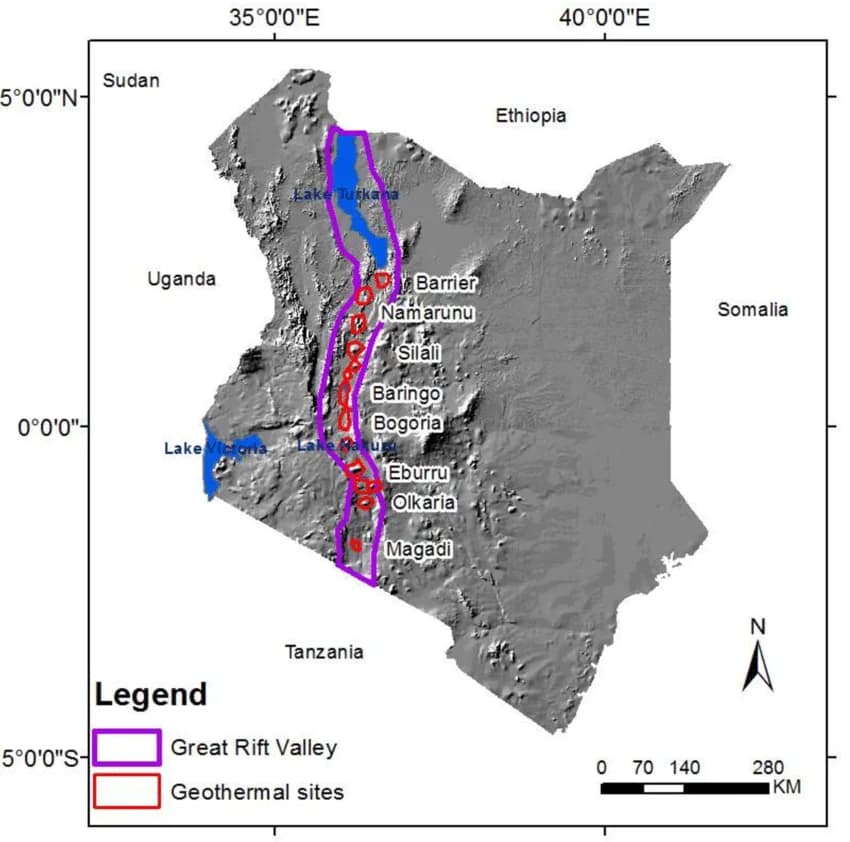
Part one: the campus. G42 and EcoCloud would build a data centre campus running on geothermal power, in the direction of Naivasha and the Olkaria steam fields, about 100 kilometres northwest of Nairobi. The scale was serious: 100 megawatts of first-phase capacity, expandable to 1 gigawatt, with phase one reportedly carrying 24 megawatts of IT load across eight 3-megawatt data halls, each holding 300 to 500 racks (Data Center Dynamics, 22 May 2024). At announcement, the first phase was expected to reach operational status in about two years, which put the target around mid-2026 (Data Center Knowledge, May 2024).
Part two: the cloud region. Microsoft and G42 would design and operate a new East Africa cloud region for Azure together with the Kenyan government, inside what the announcement called a "trusted data zone". The point of that framing was sovereignty: government workloads and regulated data would stay onshore, under Kenyan law, with governance arrangements both parties could defend. Today, a Kenyan enterprise using Azure writes its traffic to Europe or South Africa. A local region changes latency, cost and compliance at a stroke.
Part three: demand. The Kenyan government committed to move more of its services onto the cloud (Gulf News, 22 May 2024). That is the piece hyperscalers insist on: a cloud region without anchor tenants is an empty building. The government was to be that anchor.
How the partnership came together
The Kenya announcement did not appear in isolation. On 16 April 2024, Microsoft had invested $1.5 billion in G42 itself, taking a minority stake in the Abu Dhabi company and putting Microsoft President Brad Smith on its board (Microsoft News, 16 April 2024). The investment was widely read as part of a technology diplomacy balancing act between Washington and the Gulf, and it made G42 Microsoft's vehicle for expansion in regions where Microsoft wanted a local partner with government relationships. Kenya was the first big test of that model.
On the ground, the local pieces were already moving. EcoCloud, a Kenyan developer, had broken ground in 2023 on its own Project Eagle data centre at the KenGen Green Energy Park in Olkaria, inside Africa's largest geothermal complex. When the Microsoft and G42 initiative landed, EcoCloud became the local partner for the flagship campus, with Sudlows Consulting and X2X Group named as lead consultants (Data Center Dynamics, 22 May 2024). For a moment, Kenya had the full stack: a hyperscaler, a Gulf AI champion, a local developer, geothermal power and a government willing to commit demand.
What went wrong: power and payments
The stall came into public view in a single week of May 2026, and it had two strands.
The power arithmetic. Speaking in Nairobi, President Ruto said the project as designed would have needed about a third of Kenya's roughly 3,000 megawatts of installed generating capacity. "To switch on that one data center, we would need to shut off power for half the country," he said (Semafor, 6 May 2026). The campus itself was a 100 megawatt IT load; the president's arithmetic described the generation and transmission build-out that a campus of that ambition would pull with it. Kenya's grid is genuinely strong by regional standards, but it cannot hand one site the load of a mid-sized city in 2026.
The paperwork trail. Government officials told Semafor that the technology ministry developed a project concept note and took it to the National Treasury, which never approved the funding. A meeting between Kenyan officials and Microsoft executives in August 2025 had already made clear the original May 2026 online date would be missed (Semafor, 6 May 2026). By 8 May 2026, reports confirmed Kenya had suspended the planned $1 billion data centre (ThinkGeoEnergy, 8 May 2026).
The payment demand. Days later, Bloomberg and Reuters added the commercial strand: the project had been delayed by disagreements between Microsoft's side and the Kenyan government over guaranteed payments the investors sought, and over the structure of the power arrangements, with a possible scale-back of the project under discussion (Bloomberg, 11 May 2026; Reuters, 10 May 2026). In plain terms: the investors wanted the state to underwrite a baseline of revenue and power, and the state, already strained, would not commit on those terms.
What survives, and what replaced it
The story does not end at the suspension, because the ingredients it tried to combine are still real.
EcoCloud's own Project Eagle at Olkaria continues its development path, and The Star reported in September 2026 that construction activity at Olkaria and Konza is moving, even without the Microsoft flag on it (The Star, 14 September 2026). Kenya's cloud demand has not shrunk; if anything, AI workloads have raised the stakes. And the single most important lesson has already been absorbed by the next project in the queue: Amaco's proposed $1.5 billion HERCULES AI campus in Mombasa is designed to generate its own electricity from an LNG-fired power barge precisely because the national grid cannot carry a hyperscale load at one site. Whether or not that project is ever built, its power design is a direct answer to the exact problem that stalled Microsoft and G42.
What it means for Kenya's data centre market
Three things are worth holding onto.
The demand case was always real. The project did not fail because Kenya lacks customers for cloud and AI compute. It failed because the power and financing structures did not close. That distinction matters when you read the next announcement: ask where the megawatts come from and who guarantees what, before asking how many racks it has.
A local Azure region remains the prize. Until the East Africa cloud region lands in some form, Kenyan enterprises keep writing traffic to Europe and paying the latency and foreign-exchange cost of doing so. If the initiative returns at smaller scale, the cloud region is the piece Kenya should want first, because it is the part that changes the economics of every other part.
Match the load to the generation, or generate your own. That is now the defining rule of Kenyan hyperscale projects. The Olkaria corridor still holds the resource; the 7,000 to 10,000 megawatts of geothermal potential have not moved. What has changed is the discipline: proposals that arrive with their own power plan, like Amaco's barge or smaller phased campuses that grow with the grid, are the ones that can actually clear the bar the Microsoft project could not.
We track the project in our Kenya data centre directory as early stage with no confirmed site, and we will update that entry the moment anything changes. The physics has not changed, the resource has not changed, and the demand has not changed. Only the timetable has.