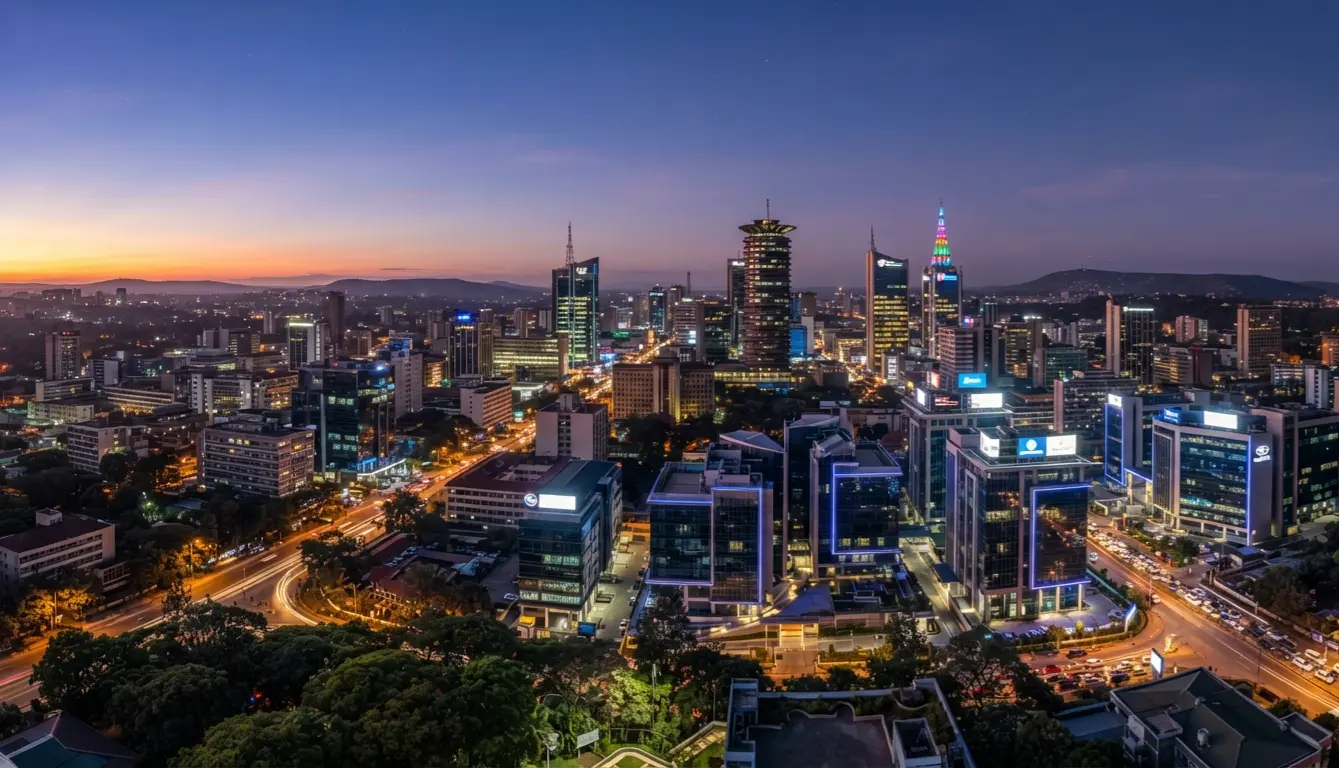
Ask most people what 5G is and the answer stops at "faster internet." That is true but incomplete, and the incomplete version hides both why 5G took decades to arrive and why Kenya's data centre industry watches every spectrum announcement so closely. 5G is the fifth generation of mobile network technology (the radio system that connects your phone to a mast instead of a cable) and it is the first generation designed to do three jobs at once: move data very fast, respond almost instantly, and connect enormous numbers of devices in the same place. This guide walks through what each of those words actually means, how we got here through four earlier generations, what 5G has already changed in Kenya since Safaricom switched on the region's first commercial network in October 2022, and what the promised sixth generation will realistically deliver.
What the "G" Actually Means
The "G" stands for generation, and the numbering is more than marketing, it tracks formal technical standards. Every generation corresponds to a set of specifications published by international standards bodies, principally 3GPP (the partnership of regional telecom standards organisations) and the ITU (the UN's International Telecommunication Union), which sets the formal requirements under names like IMT-2000 for 3G, IMT-Advanced for 4G, and IMT-2020 for 5G. When a network operator says a phone is "on 4G," it means the phone and the mast are speaking a protocol that descends from those published specifications.
Two things follow from this that surprise people. First, a "generation" is not a single technology but a family of them, 4G includes LTE and LTE-Advanced, and 5G includes both the low-band coverage layer and the millimetre-wave speed layer. Second, generations overlap for years: Kenya's 2G networks still carry SMS and M-Pesa sessions today, alongside 4G and 5G on the same masts. Each generation adds a layer; very few get switched off.
1G: The Analogue Beginning (1980s–1990s)
The first generation was analogue radio for voice calls, and it began when NTT launched a commercial cellular network in Tokyo in 1979, followed by the Nordic NMT system in 1981 and AMPS in the United States in 1983. 1G had three defining limitations: calls were not encrypted (anyone with a scanner could listen), the handsets were bricks costing the equivalent of thousands of dollars, and there was no data at all, a 1G phone could not send so much as a text message, because texts did not exist yet.
Kenya entered the cellular era during the analogue decades, when the state monopoly Kenya Posts & Telecommunications Corporation operated the country's early mobile service in the 1990s. Ownership was a badge of status, connections were dropped the way landline calls were, and the idea that mobile networks would one day carry a country's payments system would have sounded like science fiction. What 1G proved (and this is the through-line for everything after) is that people will pay a premium to communicate without a wire.
2G: Digital Voice, SMS, and the Technology M-Pesa Was Built On (1990s–2000s)
The second generation switched from analogue to digital, and the change did far more than sharpen call quality. GSM (the standard that came to define 2G globally, first deployed in Finland in 1991) encrypted calls, introduced the SIM card that made phones portable between networks, and carried two quiet features that would define the next thirty years: SMS text messaging and circuit-switched data at dial-up-like speeds, later boosted by GPRS and EDGE add-ons.
Kenya's modern mobile story starts here. Safaricom launched its GSM network in October 2000, and mobile ownership began its long collapse from luxury to necessity. The generation's Kenyan masterpiece arrived in March 2007, when Safaricom launched M-Pesa, a money transfer system that ran on 2G's SMS and USSD channels, deliberately requiring neither a smartphone nor mobile internet, because in 2007 almost nobody had either. It is worth sitting with that: Kenya's most celebrated digital innovation, now studied worldwide, rode the second generation of mobile technology. Data centres had nothing to do with it, 2G's genius was being clever with almost no bandwidth.
3G: The Mobile Internet Arrives (2000s–2010s)
The third generation, standardised under the ITU's IMT-2000 umbrella, finally made the internet a mobile experience. NTT DoCoMo launched the world's first commercial 3G network in Japan in 2001, and speeds that started under half a megabit climbed past 40 Mbps as HSPA upgrades rolled through the late 2000s. For the first time, a phone could load a webpage, stream a video, or download an app over a cellular network at tolerable speed, which is precisely when the smartphone became conceivable.
Safaricom became the first Kenyan operator to launch a 3G platform in 2008, a fact the company's own launch materials for its 4G network would later list proudly in its lineage (mobile data first in 2003, 3G in 2008). The significance for Kenya was the app economy: 3G is the generation that made Android phones affordable and useful, moved Kenyans from feature phones to touchscreens through the early 2010s, and gradually turned M-Pesa from an SMS service into an app. It also created the first real demand for local hosting of content, because data (unlike voice and SMS) needed servers, and that traffic initially rode on submarine cables and overseas hosting.
4G: The Smartphone Broadband Era (2010s)
The fourth generation, certified under the ITU's IMT-Advanced programme, turned mobile data from something you tolerated into something you relied on. The first commercial LTE networks went live in Stockholm and Oslo in December 2009, and LTE's all-IP architecture (carrying everything, including voice, as data) is the reason a modern call between two 4G phones is really a data session. Speeds in the tens and hundreds of megabytes made video streaming, video calls, cloud backups, and app-heavy smartphones a mass-market reality.
Kenya's 4G moment came on 4 December 2014, when Safaricom launched the country's first 4G network, Reuters reported it as Kenya's first fourth-generation service, and Safaricom billed it as the most advanced network in Africa at the time. The 4G era is when Kenya's digital economy visibly accelerated: video consumption, ride-hailing, e-commerce, mobile-money apps with full interfaces, and the first serious conversations about local data hosting because 4G traffic volumes had outgrown the habit of backhauling everything abroad. Every generation so far had made the network faster; 4G made it load-bearing for the economy, and exposed how much of the workload was landing in data centres, few of which were in Kenya.
5G: Three Promises at Once (2019–Present)
The fifth generation is different from every predecessor in one structural way: it was designed from the start for three distinct promises, not one. The industry shorthand is eMBB, URLLC, and mMTC. Enhanced mobile broadband (eMBB) is the speed story, hundreds of megabits to multi-gigabit connections. Ultra-reliable low-latency communication (URLLC) is the response-time story, networks designed for round trips of a few milliseconds, fast enough for factory robots and remote-controlled machinery. Massive machine-type communication (mMTC) is the density story, support for up to one million connected devices per square kilometre, for the sensor-heavy world the Internet of Things promises. 4G improved all three modestly; 5G was engineered to deliver all three simultaneously.
The first commercial 5G networks went live in South Korea and the United States in April 2019. Kenya's path ran through Safaricom's first trials in March 2021 (the first operator in Kenya to announce them) through a commercial commitment made in late 2021, to the commercial launch on 27 October 2022, which made Kenya the first market in East Africa with live consumer 5G. Airtel Kenya followed on 6 July 2023 as the country's second operator, launching with 372 sites. Rollout since then has been steady rather than spectacular (concentrated in Nairobi, Mombasa, Kisumu and progressively more counties) which is the normal shape of a 5G build, because mid-band 5G needs denser masts than 4G ever did.
The honest status report for Kenya: 5G is real, live, growing, and still a minority experience, most Kenyan phones and most Kenyan neighbourhoods are on 4G and will remain so for years. That is not a failure; it is how generations have always landed. 2G took roughly a decade to saturate; 4G is still not universal eighteen years after Stockholm. The question that matters is not "when will everyone have 5G" but "what does the network already make possible", which is where the importance comes in.
Why 5G Matters: Three Levels of Importance
For the individual user, the visible difference is speed and home internet. 5G fixed wireless access (a 5G router at home instead of a fibre line) is quietly one of the technology's most important Kenyan use cases, because it offers fibre-class speeds without waiting for a fibre trench to reach the gate. For phone users on a good 5G connection, large downloads, HD video calls, and cloud-heavy apps stop feeling constrained. Those gains are real but incremental: most things a person does online in 2026 work fine on 4G.
For the economy, the important capabilities are the two 5G features most users never see. Low latency makes real-time control possible, factory automation, precision agriculture, remote diagnostics, and the logistics systems that depend on machines talking to machines without human-perceptible delay. Device density makes sensor networks viable at scale: soil probes, fleet trackers, smart meters, and security cameras in numbers that 4G towers were never dimensioned for. These applications, not faster video streaming, are where 5G's economic case actually lives, and Kenya's agriculture, health, and logistics sectors are the natural early markets.
For the data centre industry (the reason this site watches 5G so closely) the effect is architectural. 5G's latency promises physically cannot be kept by sending every packet to a distant server: light itself needs about 5 milliseconds to travel 1,000 kilometres through fibre and back. Keeping response times in single milliseconds forces compute capacity out of a few large central facilities and into many small ones near the users, Multi-Access Edge Computing, or MEC. Each MEC node is, functionally, a small data centre with real power, cooling, and security requirements. 5G does not replace the big facilities either; every 5G mast still backhauls over fibre, and the traffic it generates ultimately pools in core data centres, internet exchanges, and the submarine cable landing stations around Mombasa. Our detailed analysis of how 5G drives data centre demand in Kenya puts numbers on that effect (hundreds of projected edge nodes nationwide) and it is the single strongest structural link between a telecom generation and Kenya's facility build-out.
Predicting 6G: What Is Known, What Is Speculation
Here is the verifiable part of the 6G story. The ITU (the same body that formally defined every previous generation) approved the 6G framework, Recommendation ITU-R M.2160 under the IMT-2030 name, in November 2023. Standards bodies including 3GPP have begun the multi-year specification work, following the pattern every generation has set: roughly a decade passes between a framework's approval and mature commercial networks. Putting that timeline on the wall gives a realistic window of around 2030 for the first commercial 6G services, with early deployments thin, expensive, and concentrated in wealthy markets first, exactly as 5G did in 2019.
What 6G might do is the speculative part, and it is worth separating the credible from the loud. The credible candidates, drawn from the IMT-2030 framework and the research agenda around it: networks that use artificial intelligence natively to route and heal themselves; "integrated sensing and communication," where the radio network doubles as a sensor layer detecting objects and motion; and the use of much higher frequency bands to push peak data rates further still. The loud versions (terabit-per-second to every phone, holographic calls, "the network will think for you") should be read as research directions, not roadmaps. Prediction is not commitment; the 6G that ships in 2030 will be narrower than the 6G in today's keynotes, just as 5G's launch was narrower than its 2015 hype cycle.
For Kenya, the practical reading is calibration, not urgency. The country is still mid-way through 5G adoption, and 6G's arrival date does not change any investment decision a Kenyan business should make this year. What it does change is the ceiling: if integrated sensing and AI-native networks materialise even partially, the data-centre implications multiply, sensing generates continuous data streams that need nearby processing, and AI-native networks need training and inference capacity that lives in facilities, not masts. The generation after next, like this one, will be won in buildings as much as on spectrum.
The Pattern Worth Remembering
Set the five generations side by side and a Kenyan pattern emerges that is easy to miss from inside any single decade. 2G gave Kenya M-Pesa because digital channels reached people who had no banks. 3G gave Kenya the app economy because the internet finally fit in a pocket. 4G gave Kenya a digital economy heavy enough that hosting it abroad became the expensive habit. 5G is handing Kenya two things at once: fixed-wireless internet that competes with fibre for homes, and an edge-computing blueprint that pulls data centre jobs onshore for the first time. Each generation has mattered less for its headline speed than for the barrier it removed, and the barriers 5G removes are distance and delay, which is precisely what a data centre economy is built on. If the 6G predictions hold, the generation after next will push that logic further; the honest posture is interest with verification, which is the posture this site takes to every generation.
Sources: Safaricom press releases (4G launch, 4 December 2014; 5G commercial launch, October 2022; trials first announced March 2021); Reuters (4 December 2014; 27 October 2022); Airtel Kenya (5G commercial launch, 6 July 2023); ITU Recommendation ITU-R M.2160 / IMT-2030 (November 2023). Timeline facts verified against multiple sources on 13 September 2026.