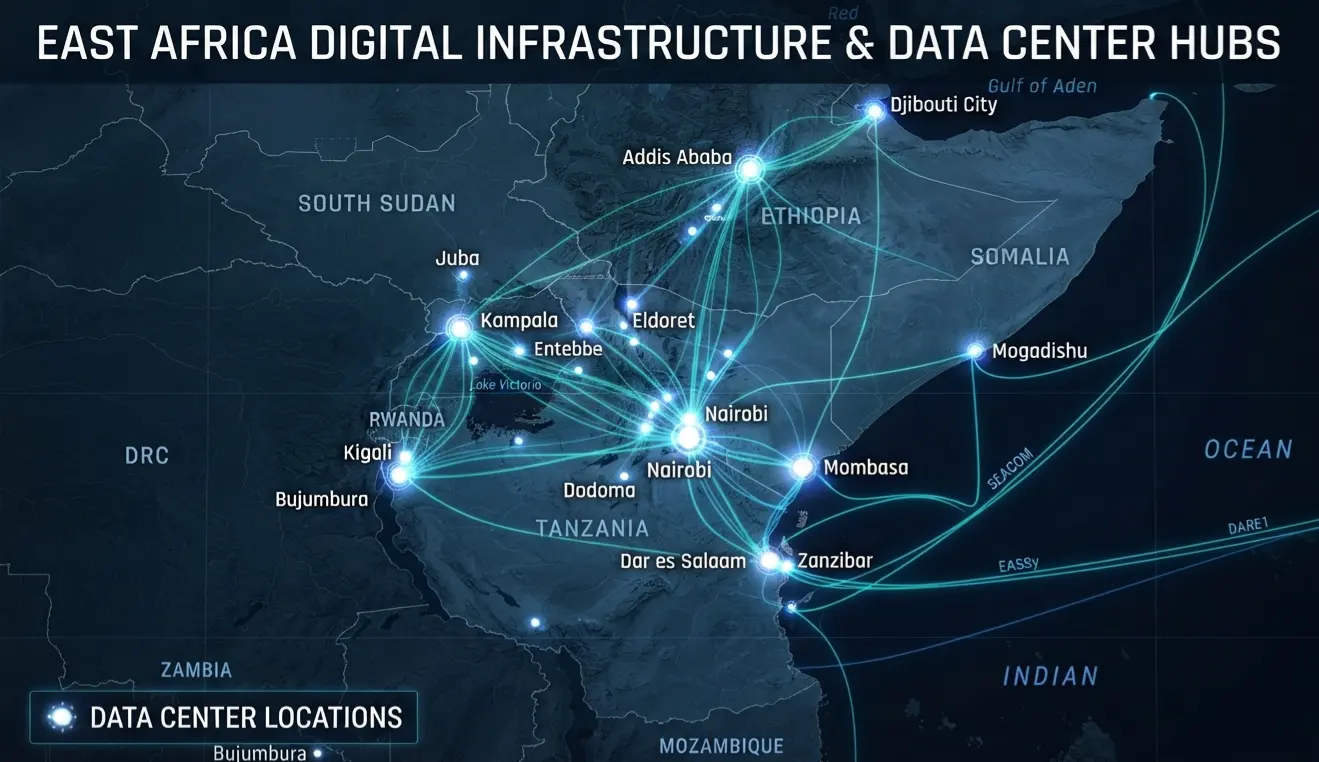
Ask where East Africa's internet actually lives and the answer is a map with one heavy dot. Kenya hosts the region's deepest data centre market, its cable landings and its biggest exchange point. But the story of 2026 is the other four capitals: Kampala, Dar es Salaam, Kigali and Addis Ababa, each getting their first carrier-neutral facilities, each deciding how much of their digital future to host at home versus transit through Nairobi.
This article compares the five East African markets on the things that decide where workloads land: facilities and operators, power, connectivity, policy and demand. It is the infrastructure-side companion to our regulation comparison, and it uses named, sourced facts rather than market-report averages.
Kenya: the hub with the receipts
Kenya's lead is structural, and it rests on three legs. First, connectivity: seven live submarine cable systems land on the Kenyan coast, with more in the pipeline, making Mombasa one of Africa's great cable towns and Nairobi the natural aggregation point for the region's traffic. Second, power: about 45 percent of Kenyan electricity is geothermal, renewable baseload that neither drought nor fuel prices interrupt, the resource that anchors every hyperscale conversation in the country. Third, ecosystem depth: the Kenya Internet Exchange Point, two decades of carrier competition, and an enterprise economy that actually buys cloud, colocation and managed services.
The facility landscape reflects that depth. Nairobi hosts Africa Data Centres' NBO1 and the newer NBO2 campus launched with Digital Realty, Raxio's Nairobi facility, Wingu's campus, ixafrica, carrier-owned capacity at Safaricom and Liquid, and a corridor of enterprise server rooms that anchor the market. Mombasa adds coastal capacity led by iColo's MBA1, sitting where the cables come ashore. Our Kenya directory tracks 27 facilities, the region's largest single-country list, and our market numbers article carries the detail.
The honest weaknesses: grid capacity is finite, as the suspended Microsoft and G42 project proved in public, and landlocked regional customers still route much of their traffic through Nairobi because their home markets cannot yet serve them.
Uganda: first mover among the neighbours
Kampala earned the region's first outside-Nairobi Tier III badge early. Raxio Data Centre Uganda launched in 2020 as the country's first certified, carrier-neutral Tier III facility, with room for up to 400 racks (Built in Africa). Wingu operates in Kampala as well, and the country's enterprise market, banks, telecoms, government systems, gives the facilities a real customer base rather than speculative demand.
Uganda's constraint is power economics. Hydro generation is cheap when the lakes are full and strained when they are not, and industrial tariffs and reliability sit below Kenya's geothermal baseload in investor conversations. Uganda's internet path also leans on Kenyan transit: the undersea capacity its traffic rides lands in Mombasa, which keeps Kampala's costs one hop removed from Kenya's ecosystem. For regional architects, Kampala is now a legitimate site for in-country hosting and DR, especially for regulated Ugandan workloads that prefer or require local residency.
Tanzania: the big market finally getting carrier-neutral capacity
Dar es Salaam has long been East Africa's second-biggest economy with the least independent data infrastructure, its traffic historically riding through Kenya or South Africa. That is changing on two fronts. Raxio Tanzania, a 6 megawatt facility in Dar es Salaam, is set to launch in 2026 as the country's first carrier-neutral Tier III data centre (Raxio Group), the kind of facility that lets Tanzanian banks and telcos interconnect without leaving the country. Wingu, which already runs a Dar facility as part of its regional network (Datacenters.com), adds competition and choice.
Tanzania's advantages: gas-fired generation gives its grid a fuel-based stability, its own submarine cable landings mean it is not dependent on Kenyan routes for international bandwidth, and a large domestic market with data localisation instincts. Its frictions: historically restrictive policy instincts and a slower enterprise cloud adoption curve. Watch the Raxio launch; carrier-neutral capacity is the catalyst that turned Nairobi's market competitive, and Dar is running the same playbook five years later.

Rwanda: small market, deliberate strategy
Kigali is the region's policy showcase. The government made digital infrastructure a national priority early, and Raxio Data Centre Rwanda, opened in late 2022 as the country's first carrier-neutral Tier III facility, gave the strategy a physical home. Rwanda's pitch is not market size, it is governance: predictable regulation, light corruption friction, and a government that buys locally, which together make it a credible site for regional and diplomatic workloads.
The physics remains stubborn. Rwanda is landlocked and land-powered: its international bandwidth transits neighbours, and its grid is modest, hydro-heavy and exposed to drought. Kigali will keep the workloads a proud capital and its policy environment attract, but regional scale flows to the coasts and the geothermal fields. Rwanda's role in the regional map is niche, high-trust hosting, and there is nothing wrong with that.
Ethiopia: the sleeping giant waking up
Addis Ababa is the market where the starting line is furthest back and the potential is largest. Ethiopia's state telecom monopoly kept enterprise infrastructure thin for decades; liberalisation and the arrival of Safaricom Ethiopia changed the incentive structure. Raxio's Addis Ababa facility, about 3 megawatts of capacity at roughly 21,500 square feet (ocolo), and Wingu's presence at the Ethio ICT Park (Datacenters.com) make the two pan-African operators the private-sector vanguard in the country.
Ethiopia's resources are real: hydro generation at enormous scale, a population above 120 million, and a government that wants data at home. Its constraints are equally real: currency and repatriation risk that gives foreign investors pause, internet controls that shape what workloads are welcome, and an enterprise IT culture still building cloud appetite. For regional planners, Addis is a market to enter carefully and early, precisely because the incumbency you build now is cheap.
The comparison in one table
| Market | Flagship facilities | Power story | Connectivity angle | Watch for |
|---|---|---|---|---|
| Kenya | ADC NBO1/NBO2, Raxio Nairobi, Wingu, ixafrica, iColo MBA1 (Mombasa) | About 45 percent geothermal baseload | 7 live cable systems, KIXP peering | Grid capacity limits shaping hyperscale deals |
| Uganda | Raxio Kampala (2020, first certified Tier III, up to 400 racks), Wingu Kampala | Hydro, seasonal exposure | Transit via Kenyan routes | In-country hosting mandates pulling workloads home |
| Tanzania | Raxio Dar (6 MW, launching 2026), Wingu Dar | Gas-fired stability | Own cable landings | Carrier-neutral launch as the market catalyst |
| Rwanda | Raxio Kigali (2022, first carrier-neutral Tier III) | Modest hydro grid | Landlocked, transits neighbours | High-trust niche and government workloads |
| Ethiopia | Raxio Addis (about 3 MW), Wingu at Ethio ICT Park | Massive hydro potential | Largest population, thinnest base | Liberalisation pace and currency risk |
What the comparison means
Three conclusions survive the detail. First, Kenya's hub position is not sentiment, it is cables, geothermal and ecosystem depth, and it will outlast any single project's delay. Second, the neighbours are not trying to beat Nairobi; they are trying to stop depending on it for workloads their regulators and latency requirements want at home, and carrier-neutral facilities in Kampala, Dar, Kigali and Addis are exactly that strategy in building form. Third, the region's growth is real and fast: Africa's data centre market is projected to nearly double by 2030 (Wingu guide, 17 December 2025), and the continent's active capacity, 360 megawatts with another 894 megawatts in construction or planned (ADCA, February 2026), will increasingly include East African megawatts.
For a Kenyan reader, the practical takeaway is opportunity, not threat. Regional operators build shared playbooks, shared talent and shared careers, and the engineers Kenya trains are the ones the region hires. The five markets are becoming one network, and Nairobi is its switching centre.