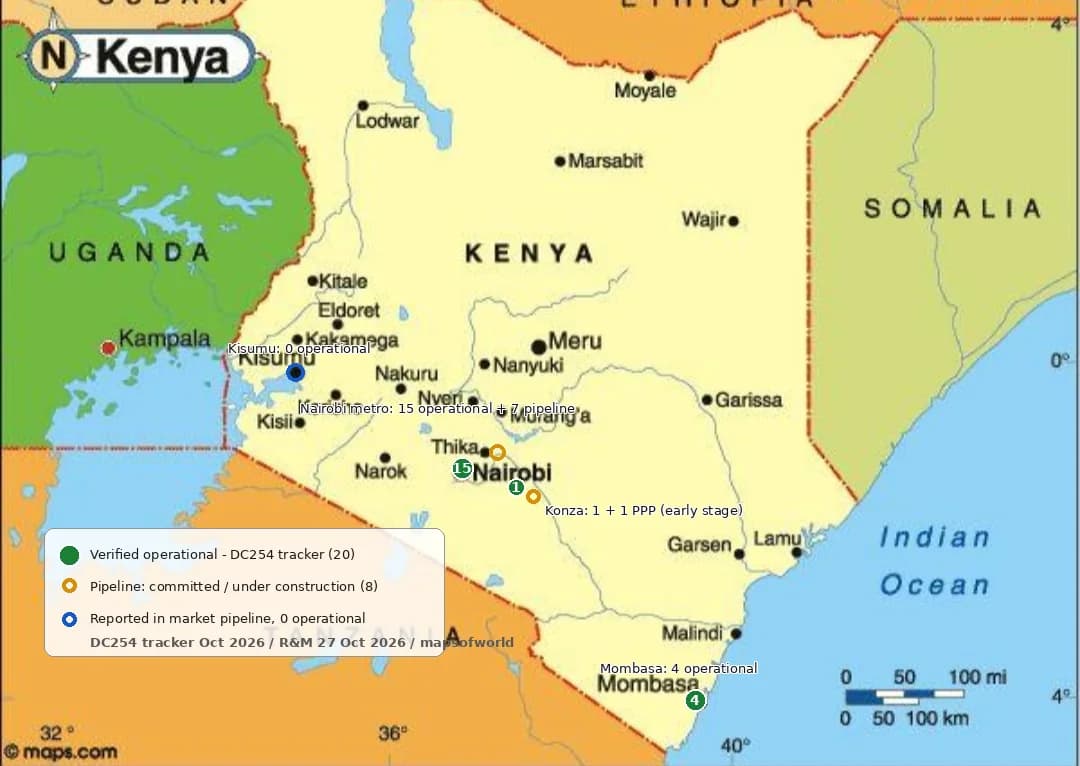
A ResearchAndMarkets database published on 27 October 2026 counts 13 existing Kenyan data centres, 10 upcoming developments and about 110 MW of planned capacity outside Nairobi, spread across Nairobi, Mombasa and Kisumu. Checked against the DC254 tracker of verified facilities, the report's headline points at something real but unfinished: Kenya's next wave of capacity is planning to leave the capital, and the region it names most prominently, Kisumu, currently has no operational data centre at all.
What the Report Claims, and What Kind of Claim It Is
The database behind the headline covers existing and upcoming colocation portfolios, white floor space, rack capacity, investment and colocation pricing for 2026-2031. Its Kenya announcement names Digital Realty, iXAfrica Data Centres and Safaricom among the leading operators by capacity, and frames the story as "10 projects and 110 MW beyond Nairobi."
Two properties of that figure matter before anything else. First, it is a pipeline number: ResearchAndMarkets' own description says the database spans announced, planned, under-construction and recently opened stages. Second, it sits in a paid database whose project-level breakdown is not public, so no outside reader can yet tell which projects contribute to the 110 MW, in what proportions, or whether the megawatts describe IT load or total facility power. Those are exactly the distinctions that make Kenya's market estimates disagree.
The View From the DC254 Tracker
Our tracker, which counts verified facilities with sources and last-verified dates, gives the ground truth the report's headline should be read against. Kenya currently holds 28 tracked facilities, of which 20 are operational.
| Location | Operational (DC254 tracker) | Pipeline (DC254 tracker) | Notes |
|---|---|---|---|
| Nairobi metro, incl. Thika and Limuru | 15 | 7 | The hub: carrier interconnection, cable termination, enterprise demand |
| Mombasa | 4 | 0 | Subsea cable landings; named in expansion narratives |
| Konza Technopolis | 1 | 1 (early-stage PPP) | The flagship smart-city build, funded for PPP preparation |
| Kisumu | 0 | 0 | Named in the report's upcoming portfolio; nothing operational or tracked |
The reconciliation cuts both ways. The tracker's 20 operational facilities outnumber the report's 13 existing ones, which is the coverage and definition problem in miniature: whether enterprise facilities count, what "existing" means for a recently opened site, and how a facility qualifies at all. On pipeline, the tracker shows 8 projects in development, concentrated in the Nairobi metro area, with Mombasa's expansion so far expressed through power-first proposals rather than committed builds. Neither dataset alone settles how much capacity is really coming outside Nairobi; together they show why numbers this market quotes need their methodology read.
Why Capacity Outside Nairobi Would Matter
Nairobi's advantages are structural. The metro area concentrates the internet exchange point where Kenyan networks meet, the terrestrial fibre that carries traffic from the Mombasa cable landings, and the enterprise and government demand that fills racks. That is why 15 of 20 operational facilities sit there.
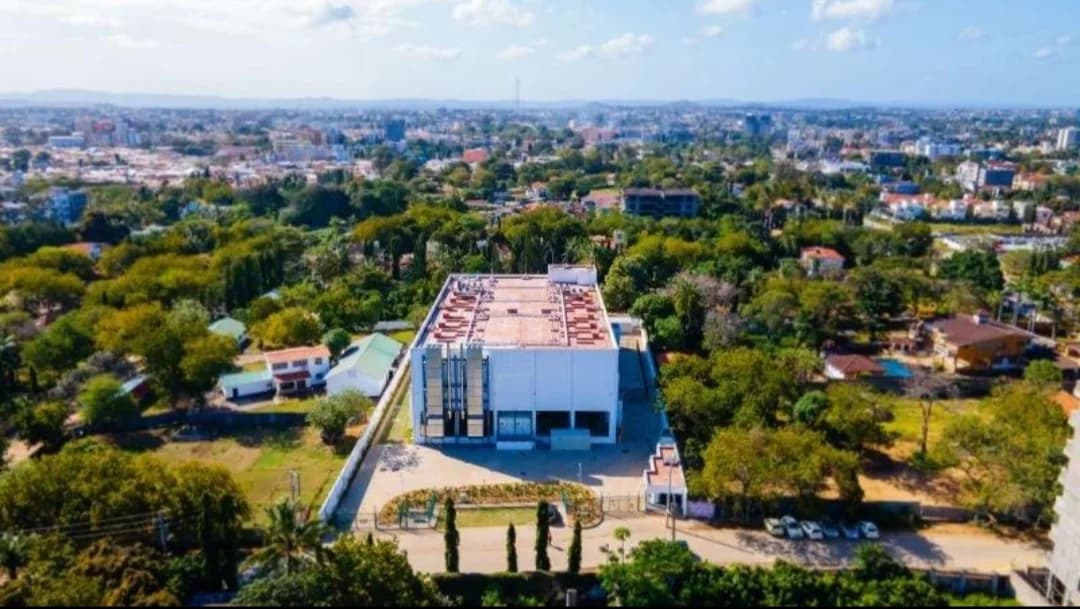
Mombasa's case rests on a different input: proximity to the subsea systems that land on the coast. Capacity there can serve latency-sensitive work for the port economy and the coastal region, and proposals like HERCULES argue generation can be built alongside it. Kisumu's case is the most open question of the three. The city anchors western Kenya's population and trade, sits near the Lake Victoria basin economies, and has no operational facility to build on. A facility there would be a bet on regional demand materialising, with connectivity, power reliability and an operating model all to be proven.
Each proposed regional project still has to clear the same hurdles as any Nairobi build: customers, metered power, fibre routes, cooling and a commercially viable price per kilowatt. Location is a thesis, not a business case.
How to Read a Pipeline Megawatt
The 110 MW headline will be quoted, so it is worth fixing what such a number can and cannot mean. It cannot mean available capacity, because none of it is operational. It cannot be verified project by project from the public announcement, because the breakdown sits behind the paywall. And it bundles stages: an announced concept and a building with switchgear installed contribute the same headline megawatts but carry completely different probabilities of ever delivering them.
For buyers and investors the practical read is narrower. Treat the figure as evidence that developers are looking outside Nairobi, then demand the three details that turn a claim into a fact for each project: the site, the capacity measure, and the stage. That is the standard we apply to operator disclosures, and it applies to research databases too.
What DC254 Will Track Next
- The project list. Which developments make up the 110 MW, and whether any operator has confirmed a regional site.
- Stage migration. Whether any Kisumu or Mombasa project moves from announced to committed or under construction in the tracker.
- The capacity measure. Whether quoted megawatts are IT load or facility power, per project.
- Mombasa's power story. Whether coastal expansion arrives with its own generation or waits for grid allocation.
- Kisumu demand. Whether western Kenya's public sector and enterprise demand produces an anchor tenant before a facility breaks ground.
The headline says Kenya's market may be spreading. The tracker says where it actually stands. Both belong in the same sentence, and only one of them is load-bearing.