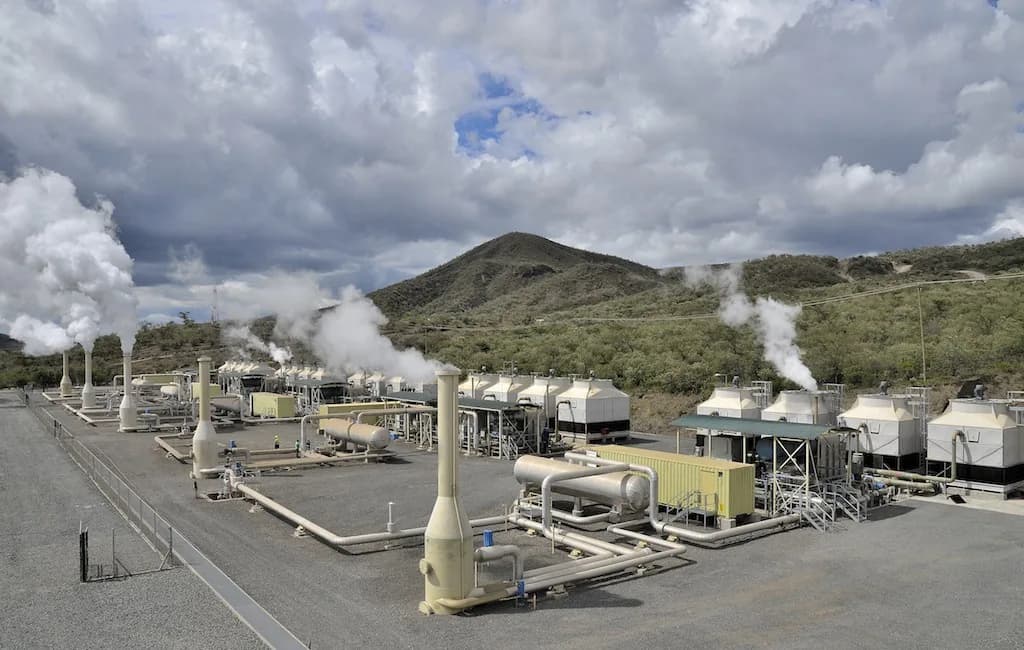
On 22 May 2024, Microsoft and Dubai-based G42 announced a $1 billion digital ecosystem package for Kenya. Its centrepiece was a data centre campus at Olkaria, in the Rift Valley, run entirely on geothermal power. The 100 MW first phase was not in the announcement text; that figure entered the public record through project reporting carried by Data Center Dynamics, and it is the number DC254's directory carries as the announced capacity. The site choice was the whole pitch: Olkaria sits on one of the world's most productive geothermal fields, and geothermal generates through the night, which is precisely what an AI compute floor needs.
Two years later, the campus is still an announcement. Semafor reported in May 2026 that the plan was being reconsidered, and quoted President William Ruto putting the facility's power appetite against the national system: "To switch on that one data center, we would need to shut off power for half the country. That's when I knew there was a problem." Semafor's account of that requirement puts it at a third of the country's total installed capacity of around 3,000 MW, roughly 1,000 MW. That is a different figure from the 100 MW first phase announced in 2024, and the distinction matters for everything that follows. In October 2026, Kenyan outlets reported that Microsoft plans to close parts of its Africa Development Centre in Nairobi, with roughly 400 jobs affected. The steam, meanwhile, keeps flowing.
The gap between those two facts is the most instructive case study in African digital infrastructure right now. It shows where Kenya's AI data-centre race actually stands, and the lesson has less to do with geology than most commentary assumes.
The terms, decoded
This story leans on a handful of power-market words. Short versions:
| Term | What it means |
|---|---|
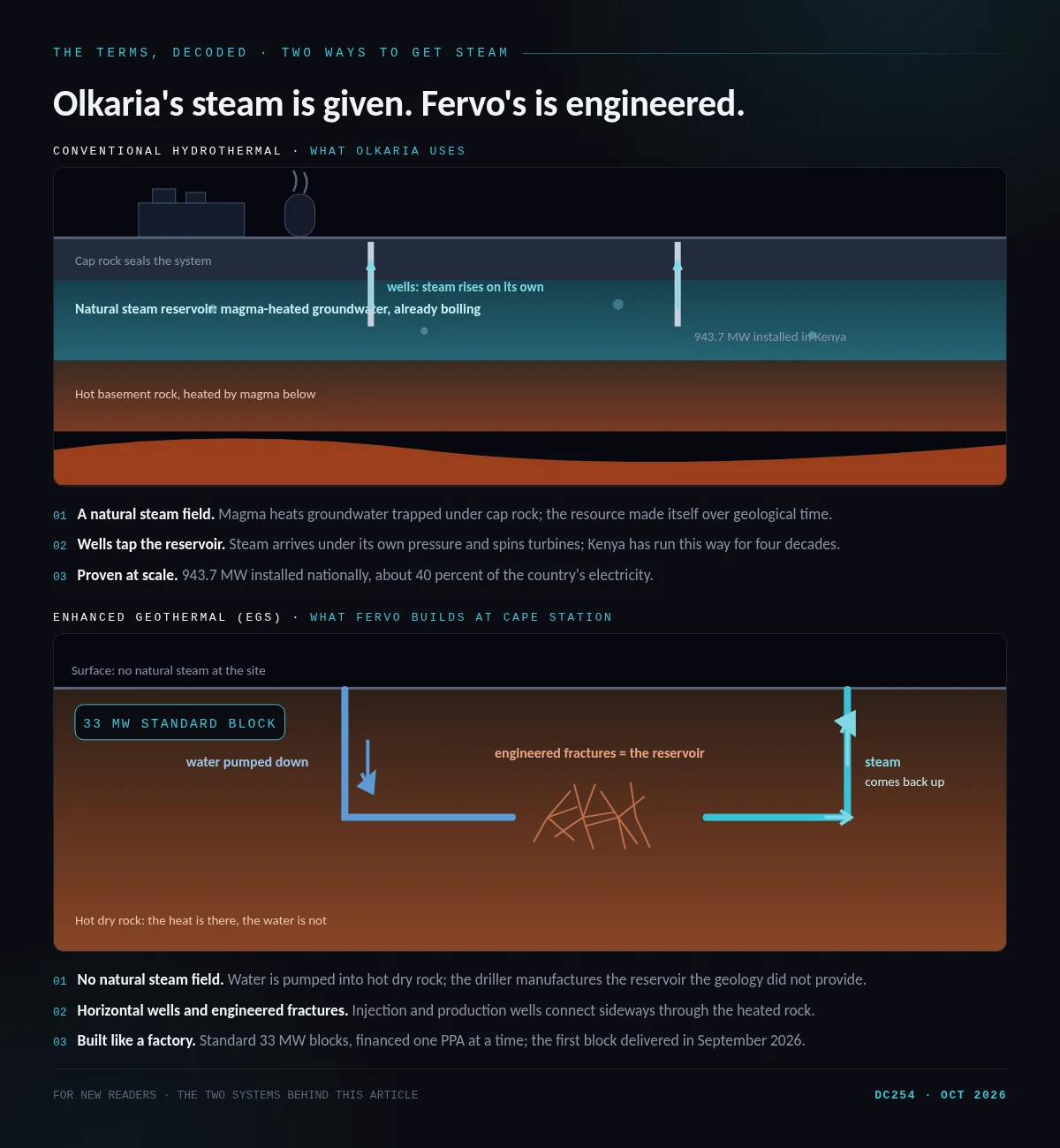
| Conventional geothermal | Hot rock heats natural groundwater into steam; wells bring it up. This is Olkaria's system, in service for four decades. |
| Enhanced geothermal (EGS) | No natural steam field. Wells drill sideways into hot dry rock, and water pumped through engineered fractures makes the reservoir. This is Fervo's system. |
| Fervo Energy | The US enhanced-geothermal company behind Cape Station in Utah. Its first commercial block, 33 MW, reached commercial operation in September 2026. |
| PPA (power purchase agreement) | A long-term contract to buy power at an agreed price. Lenders lend against signed PPAs. |
| Capacity payment | Payment for power capacity to be available whether or not it is used. The fight over who guarantees these payments is what stalled the Olkaria deal. |
| Single buyer | Kenya Power buys most of the country's generated electricity and resells it, so a large customer must work through or around that structure. |
| Behind the meter | A facility generates power on its own side of the meter, and grid contracting never enters the deal. |
| Live IT load vs designed capacity | What servers draw today versus what the halls were built to hold. DC254 tracks both, separately. |
What the verified tracker actually shows
DC254's directory tracks 31 facilities and projects across Kenya and the region. The verified numbers are small. Twenty Kenya facilities are operational, with a published in-service IT load of 10.5 MW. Designed capacity at those live sites totals 42.9 MW. A further 230 MW sits in the announced pipeline, of which 77 MW is genuinely under construction at three projects: iXAfrica's NBOX1.2 (18 MW), Africa Data Centres' Nairobi 2 (15 MW), and Nxtra by Airtel at Tatu City (44 MW).
Now hold the figures against each other, each with its own basis.
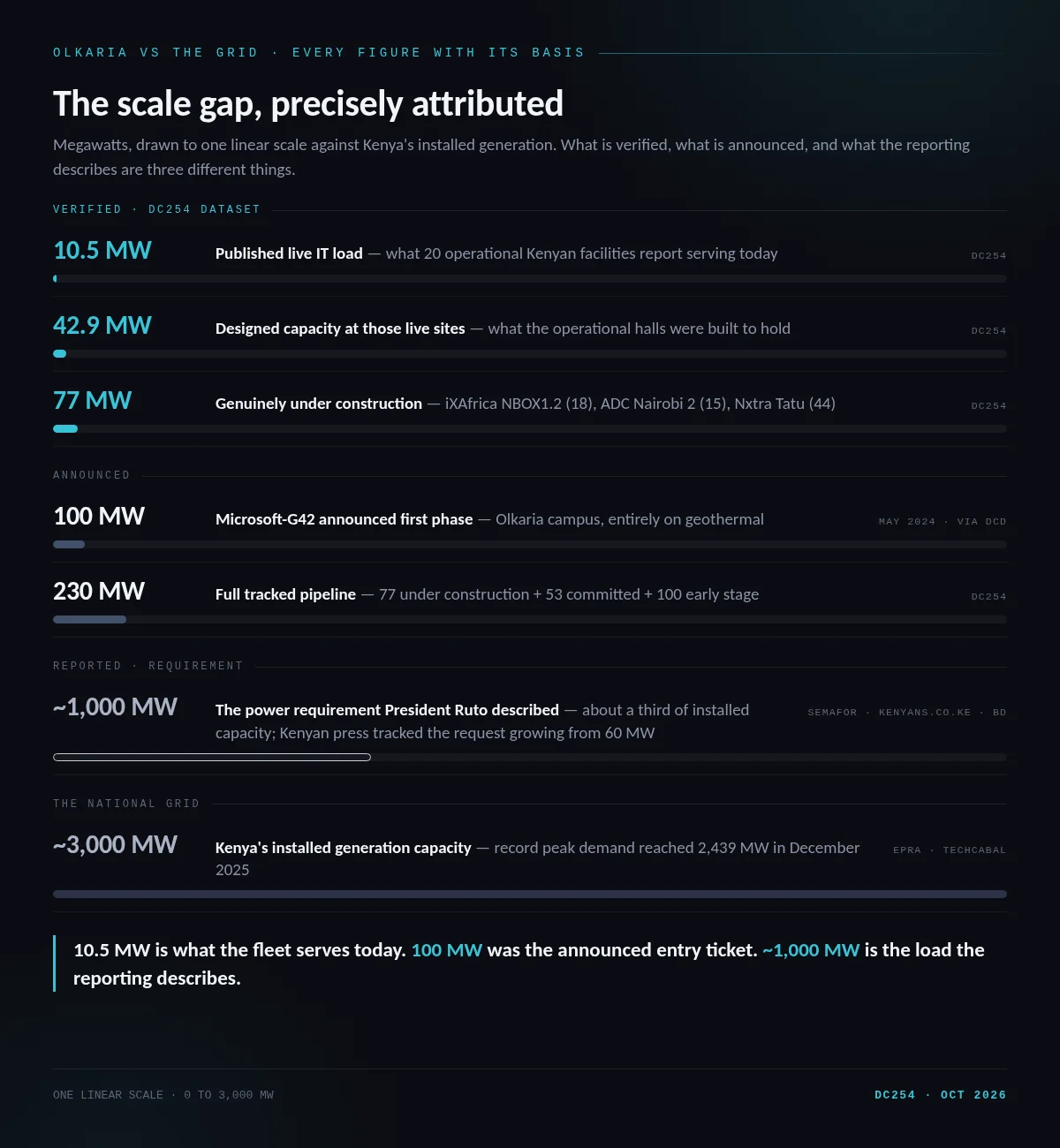
The announced first phase alone was 100 MW, close to ten times the country's entire verified live load. The requirement behind the scenes, as President Ruto described it, was nearer 1,000 MW. For reference, Kenya's record peak demand, reached in December 2025, was 2,439 MW (TechCabal, 20 August 2026). Either version of the campus would have been one of the largest individual loads the grid has ever been asked to carry, announced into a market whose whole operating fleet is a rounding error next to it.
That scale gap frames everything else in this story. Kenya's data centre market is real, growing, and verified down to the megawatt. It is a fleet of tens of megawatts, and the AI race is being contested in hundreds.
The steam was ready on day one
Kenya's geothermal credentials are among the strongest outside Iceland and the United States. The installed fleet stood at 943.7 MW at the end of 2023, according to the regulator EPRA, and geothermal supplied 39.51 percent of the country's electricity in the year to June 2025, the largest single source in the mix. Olkaria V alone contributes 172 MW. KenGen, the state generator, is completing Olkaria VII, an addition in the 80 MW class, and the Ministry of Energy's long-standing estimate puts the Rift Valley's total potential at about 10,000 MW.
None of that was ever in doubt. The resource could credibly support the campus. What Kenya could not put on the table in 2024 was a completed path from steam to a powered, contracted data hall, and that path runs through parts of the system the headlines rarely mention.
Where the deal actually stalled
Three kinds of evidence tell the stall story, and they say different things. The company announcement came first: on 22 May 2024, Microsoft and G42 put the initial investment at $1 billion and described a campus run entirely on renewable geothermal energy. Government statements came two years later: President Ruto, quoted by Semafor in May 2026, said the project was reconsidered once its power requirement became clear, at about a third of the country's installed capacity. Wire reporting filled in the mechanism. By May 2026, Reuters reporting carried by Bloomberg described talks stalled over the company's request for guaranteed annual capacity payments: Microsoft and G42 had asked the Kenyan government to commit to paying for a certain amount of capacity annually, and the talks broke down when the guarantees could not be provided at the level requested. The directory record for the project carries that attribution, with a caveat that the outlets share an upstream source, and holds Kenya's counter-position from the same wire: principal secretary John Tanui's line that the project "is not failed or withdrawn" and that "the scale of the data centre they wanted to do still requires some structuring."
The numbers behind that caution came into focus later. Kenyan business press tracked the requested power growing from 60 MW in early discussions to 1,000 MW by mid-2026 (Kenyans.co.ke, 22 August 2026; Business Daily, 10 September 2026), roughly a third of installed generation and the same magnitude President Ruto described. The announced 100 MW first phase and the reported 1,000 MW requirement describe the same project at different moments, and much of the public confusion around this deal comes from reading one for the other.
Put the evidence together and the shape of the problem is specific. Kenya can permit generation and drill steam. What it lacked was a bankable contract structure for a hyperscale customer, and grid headroom in the right place. A campus at Olkaria would also depend on transmission into Nairobi's metro network, where the country's connectivity concentrates: the KIXP peering point alone carries 144 member networks and 2,985 Gbps of connected port capacity, and the submarine systems that land in Mombasa ride terrestrial fibre to reach it.
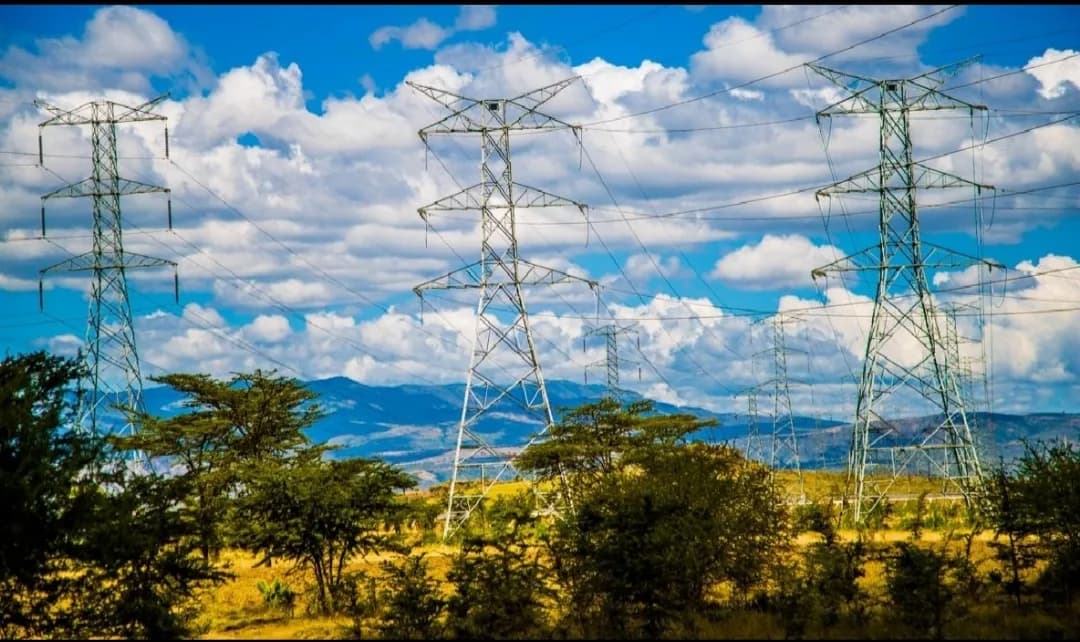
Power is one input in that stack. The Olkaria deal had to clear every input at once, and it had to do so as a single bespoke negotiation with a state utility in the middle.
What Utah did differently
The useful comparison sits outside Africa. Fervo Energy, a US company, drills horizontal wells into hot rock and engineers the reservoir it needs, an approach called enhanced geothermal. There is no natural steam field to tap: water goes down one well, heats as it moves through engineered fractures in the rock, and comes back up another as steam to spin turbines.
Fervo's first commercial project fed Google's data centres in Nevada. The climb since then reads like a financing ladder, and each rung has its own status. In June 2024, Fervo signed 15-year power purchase agreements totalling 320 MW with utility Southern California Edison for its Cape Station project in Utah. In 2025, Nevada regulators approved a 115 MW Clean Transition Tariff for the technology. In March 2026, the company closed $421 million in non-recourse project financing to fund Cape Station's first-phase construction. In September 2026, Google signed a 396 MW PPA with Fervo, the largest corporate geothermal deal on record. On 1 October 2026, Fervo announced that the first 33 MW GeoBlock at Cape Station had reached commercial operation, declared on 30 September, one day ahead of its contractual date, and already earning revenue under the PPA.
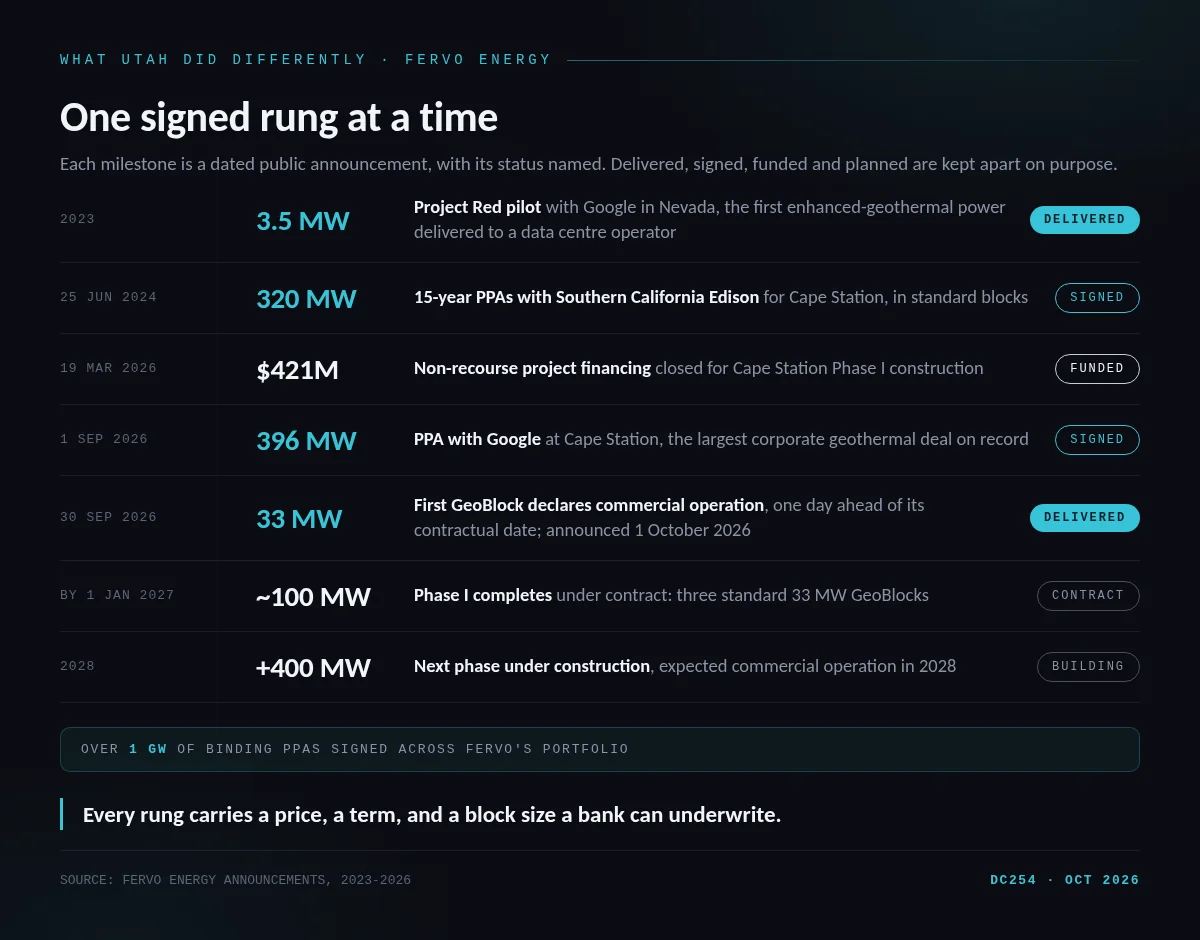
Two rungs are delivered, two are signed contracts, one is closed financing, one is a regulatory approval. The rest of Phase I, about 100 MW across three standard 33 MW blocks, is due on contract by 1 January 2027, and a further 400 MW phase is under construction for 2028. Across the portfolio, Fervo counts more than 1 GW of binding PPAs.
Look at what made that progression financeable, because it is all commercial. Google and SCE contracted directly with the generator, at fixed prices, over long terms, in block sizes a single PPA could carry. Standard blocks meant each financing closed on its own merits, and the drilling could be scheduled like a factory. Three years after a 3.5 MW pilot, the approach is delivering a 33 MW block and holding contracts for hundreds more.
So make the comparison honestly. Kenya has the more proven resource, and Fervo has the more repeatable commercial model. The Rift is a natural hydrothermal field that has carried Kenya's grid for four decades; Cape Station's reservoir had to be engineered out of hot dry rock, a harder geology problem, and Fervo solved it anyway to reach a commercial delivery. What Fervo proved sits in the commercial layer: standard block sizes, direct long-term PPAs, and project finance closed against signed contracts. That model is the transferable part. The steam was never the hard part in Kenya.
One more echo, and this one is DC254's read rather than an industry claim: Cape Station's entire first phase, about 100 MW being delivered as three standard blocks, is the size of the Olkaria campus's announced first phase. One company carried a 33 MW block on one contract, three times over, while the Kenya negotiation tried to land the same megawatts in a single bespoke state deal. The megawatts are similar. What differs is how many signatures each megawatt needs.
What would turn announcements into live load
Kenya's pipeline records share one honest gap: the tracker can show a megawatt figure and a status, and almost no project publishes where it stands on power procurement. Announced, contracted, under construction and commissioned are different stages with different risk, and the announced figure of 230 MW says nothing about how much of it has a signed path to power. That distinction is exactly what the tracker now stages explicitly, project by project.
Two moves would shift the market up that ladder. The first is modular procurement: 33 MW blocks that one contract can carry, rather than a 100 MW campus that needs the Treasury in the room. That first move is DC254's reading of the Fervo example, not a proven path for Kenya; the supporting sign is that the 77 MW under construction at three Nairobi projects shows Kenyan operators already build in that size range when the financing is standard. The second is a contract design Kenya is willing to defend. The capacity-payment dispute taught both sides where the other's limits sit, and the next attempt has to answer it, whether through direct corporate PPAs, behind-the-meter generation at the plant, or a reformed structure through the single buyer. The steam can carry any of those models. It has been carrying Kenya's grid for four decades.
What to watch
Three markers will tell you whether Kenya converts steam into compute. Watch the Olkaria campus record: if it moves from Early Stage to a signed structure, the contract question has an answer. Watch Olkaria VII's commissioning and the transmission work that accompanies it, because grid headroom is bought down wire by wire, not by press release. And watch the 77 MW under construction: if those three projects commission on schedule, Kenya's next negotiation starts from roughly a doubled live base, and the arithmetic that scared everyone in May 2026 looks different.
The Fervo clock is running in parallel. Cape Station's remaining Phase I blocks are due on contract by 1 January 2027, a further 400 MW is under construction for 2028, and the portfolio now holds more than 1 GW of binding PPAs. Kenya's next hyperscale negotiation will be judged by the same standard Fervo just met: a price, a term, and a block size a bank can underwrite.