
Every Kenyan data centre pitch deck quotes the same number first. Power usage effectiveness, PUE, the ratio of total facility energy to the energy that actually reaches the IT equipment, has been the industry's headline efficiency figure for so long that buyers stop asking what it does and does not measure. This week the argument against stopping there got a high-profile restatement: writing in Forbes on 19 October 2026, Jae-cheol Lyu, president and CEO of LG Electronics, made the case that PUE alone can no longer describe efficiency in the AI era, and that the industry needs to evaluate three things it has historically kept separate from the metric: hardware flexibility, heat movement, and site-specific resilience. He is writing about a global market. But the argument lands with particular force on a market like ours, where the climate is generous, the grid is unusually clean, and the next generation of AI racks is about to stress every assumption PUE was built on.
What PUE still does well
Nothing in this piece is an argument to retire the metric. As we set out in our PUE explainer, PUE is genuinely good at one thing: tracking a facility's own trajectory over time. A Nairobi operator who moves from 1.8 to 1.5 across a retrofit has a real, comparable story to tell, and PUE is the right way to tell it. Lyu's position, and ours, is that the trouble starts when PUE is read as a cross-site verdict rather than a self-history. Two facilities can post identical PUEs while one runs mild highland air through its coils and the other battles coastal humidity with chillers running flat out. The identical number hides different engineering, different water bills and different exposure when something breaks. That is the gap the AI era blows open, because AI workloads stress exactly the variables PUE was never designed to see.
The three questions that come after PUE
Lyu's framework is worth reading on its own terms, so let us restate it faithfully and then translate each part into Kenyan specifics.
First: how flexibly does the facility keep pace with the hardware? The numbers tell the story. Uptime Institute's latest survey, cited in the piece, found the share of operators running racks of 30 kW or more rose from 19% in 2025 to 24% in 2026, and roughly one in seven operators now runs racks of 50 kW or more. A facility designed around 6 kW cabinets cannot flex its way to an NVIDIA-class GPU hall; the power train, the floor loading, the airflow and the breakers all pre-date the demand. Kenyan operators are already meeting this: IXAfrica's Nairobi campus has built GPU-ready capacity at the density end of the local market, and every serious retrofit conversation in the city now starts with the same question, not "what is your PUE" but "what rack can you actually take tomorrow?" Flexibility is an efficiency property. A hall that cannot host next year's chips is inefficient by definition, no matter what its meter says, because its capital sits idle while the demand goes to another market.
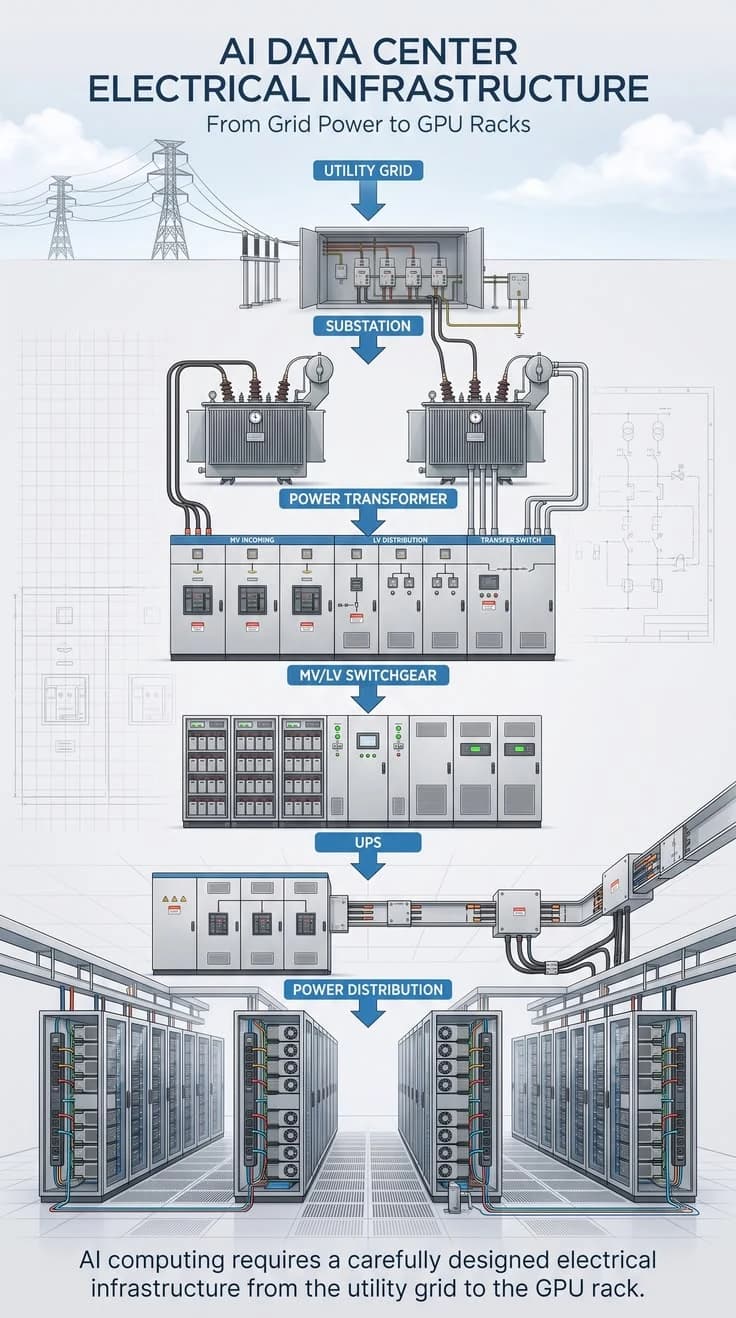
Second: how efficiently does heat move from the chip to beyond the facility? This is the axis where Kenya's advantage shows and also where its next capital bill hides. Nairobi's highland climate, mild days and cool nights, means free cooling still does real work for conventional racks, which is part of why local facilities post respectable PUEs without exotic mechanical plant. But the AI curve does not care about our weather. Once racks pass roughly 30 kW, air alone stops being a viable heat carrier: the heat has to move into liquid at the chip, through coolant distribution units, and out of the building, and the facility that cannot move heat at that rate simply cannot host the workload. Lyu's point is subtler than "buy liquid cooling", though. He argues IT, power and cooling should be designed as one coordinated system centred on computing performance, rather than three procurement lines optimised separately. In Kenyan terms: the chiller decision, the transformer sizing and the GPU order are the same decision, and the operator who lets a supplier optimise one line item in isolation will pay for it at the rack.
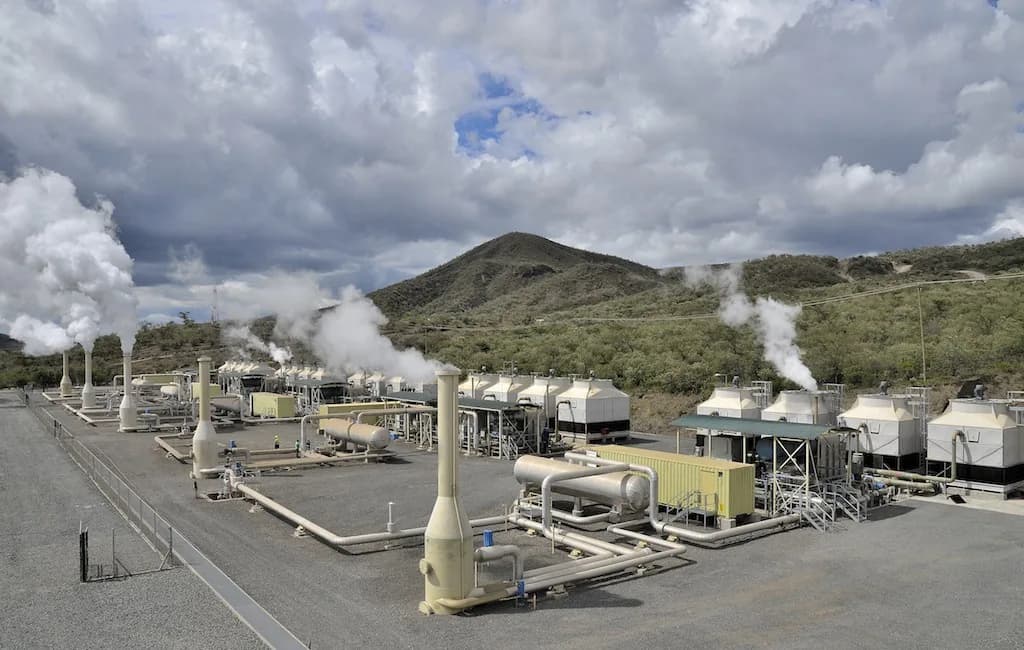
Third: how reliably does the site operate under local power, water and climate conditions? Here the piece quotes numbers that should make any operator pause. S&P Global, as cited by Lyu, reports that 43% of 9,055 surveyed data centres sit in regions of high water stress. Kenya knows this variable intimately: the drought cycles of the last decade are national memory, and a facility that quietly depends on county water or boreholes for its cooling tower make-up carries a climate risk that never appears in its PUE. The Kenyan counterweights are real, the binary units at Olkaria are air-cooled, the grid is roughly nine-tenths renewable, so the carbon arithmetic that dominates European siting debates matters less here, but the water arithmetic is moving the other way as Nairobi grows. Reliability also means the grid dimension: PUE says nothing about ride-through when the feeder dips, and Kenya's operators, running on a grid with a thin reserve margin, size UPS and diesel for exactly the hours PUE cannot see. Two facilities with identical PUE can have very different odds of keeping a load alive through a bad week.
The numbers behind the squeeze
The urgency in Lyu's piece comes from arithmetic. The International Energy Agency projects global data centre electricity consumption will more than double, from 415 terawatt-hours in 2024 to roughly 945 terawatt-hours by 2030. Efficiency, in other words, has stopped being a procurement nicety and become a strategic variable: utilities, regulators and neighbours now all have a view on how much power these buildings deserve. The public mood data cited in the piece is striking, a June 2026 Reuters/Ipsos report found 57% of Americans oppose a data centre being built in their area, and 77% worry AI growth could push electricity rates up.
Kenya runs the opposite experiment. We are not a market resisting data centres; we are a market courting them, with a national compute-hub ambition and tax incentives for the sector. That is precisely why the beyond-PUE argument matters here: in a country that wants the investment, the licence to operate will be kept by transparency, not by restraint. The operators who publish measured numbers, water drawn, diesel hours, real PUE, will be the ones who keep communities and regulators on side as the sector scales. We have argued this before in our disclosure piece, and the global mood shift Lyu documents is the best evidence yet that disclosure is a competitive asset rather than a compliance chore.
Five questions Kenyan buyers should ask instead of "what is your PUE"
The practical output of this argument is a better question list. When you are evaluating a Kenyan colocation provider, a landlord pitching you a shell, or a partner for a GPU deployment, ask:
- What rack density can you host today, and what is the roadmap? Ask for kW per cabinet actually deployed, not designed, and what changes (power, cooling, floor) to reach 30 kW and beyond.
- Is the quoted PUE measured or designed? Design PUE is a spreadsheet number. Ask for twelve months of metered data at the utility entry and UPS output.
- Where does cooling water come from, and what happens in a drought year? If the answer is county water, ask for the borehole and storage contingency, and for any water usage figures the operator tracks.
- What is the ride-through architecture? UPS minutes, generator hours, fuel contracts, and how many grid dips the site absorbed last year.
- What happens to the heat? For new AI halls, direct-to-chip loops are coming whether we plan for them or not; the operators thinking about heat reuse now are the ones worth shortlisting.
None of these questions has a PUE answer, which is the point.
The DC254 take
PUE will keep being quoted, and it should be, it is a clean, auditable measure of one real thing. The error to avoid is letting a single metric stand in for a conversation about flexibility, heat and local resilience that the AI era has made unavoidable. Kenya starts this conversation from an unusually strong position: a near-renewable grid, a climate that flatters conventional cooling, and a competitive market where the leading operators are already building for density. The facilities that will win the next three years of Kenyan demand are the ones that can answer the five questions above with numbers they are willing to publish, because in this market, trust is not a side effect of good engineering, it is the product.