The Middle East & Africa data centre colocation market was valued at USD 3.33 billion in 2025, and Arizton Advisory & Intelligence expects it to reach USD 12.88 billion by 2031, a compound annual growth rate of 25.32 percent that is hard to ignore from any vantage point on the continent. Behind the headline sits a familiar stack of drivers: enterprises accelerating cloud adoption, the first serious wave of AI deployments, smart city programmes across the Gulf and Africa, and governments treating digital infrastructure as economic policy rather than procurement. Colocation, in this story, is the pragmatic middle path, the way to get compute capacity quickly without writing a nine-figure cheque for a private facility.
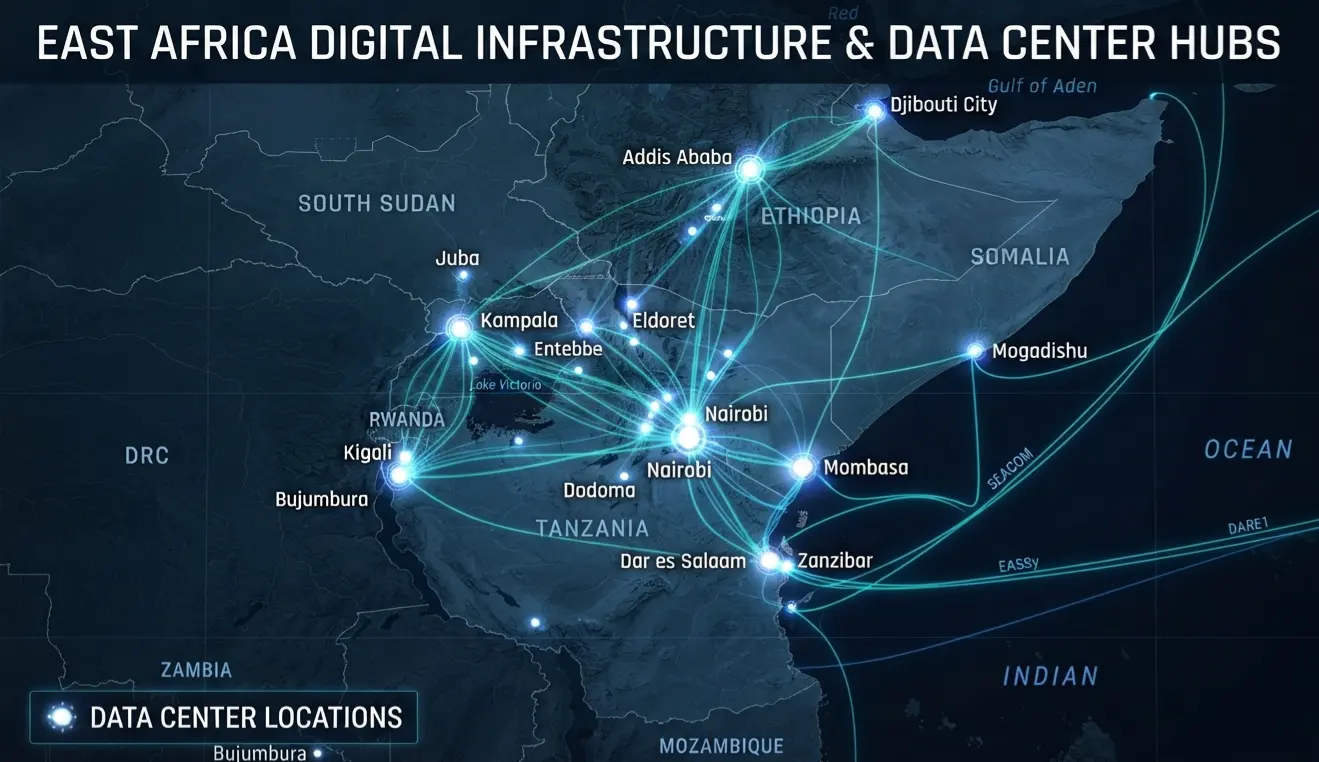
For Kenya's data centre community, the report is more than a regional cheerleading exercise. It quantifies the construction-cost pressures every operator in Nairobi already feels, ranks the markets Kenya competes against for mobile capital, and confirms something our facility directory has tracked for a while: Nairobi is East Africa's centre of gravity, with eight operational data centres and seven more in the pipeline as of December 2025.
This article unpacks the report's key numbers, maps where the investment is concentrating, and asks the question that matters for our readers: when the regional market nearly quadruples in six years, how much of that wave can Kenya realistically catch?
The Numbers Behind the 25.32% CAGR
Arizton's central finding is that colocation in MEA is growing because it solves the region's core infrastructure dilemma. Enterprises and governments want digital capacity now, but building private data centre facilities means confronting land scarcity, elevated labour costs, inflation, and power access, the report explicitly cites these as the reasons construction runs between USD 6 million and USD 12 million per megawatt depending on location. Colocation converts that hostile capex environment into a monthly operating expense, which is why demand keeps compounding even as headline interest rates stay uncomfortable.
The growth is underpinned by policy as much as by demand. Economic diversification strategies (Saudi Arabia's Vision 2030 being the loudest, but similar playbooks across the Gulf and in African capitals) treat data centre capacity as a sovereign capability. Rising internet traffic, expanding smart city projects, and favourable regulatory frameworks do the rest. The report also flags the counterweight honestly: geopolitical conflict and regional instability can delay projects through supply chain disruption, material shortages, and labour constraints. Paradoxically, the same instability pushes investment toward the region's more stable markets, which is precisely the bracket Kenya markets itself in.

One segment detail deserves attention from buyers. Despite the sustainability conversation, diesel generators remain the backbone of resilience across the region, Africa Data Centres' Lagos facility, for example, maintains 48 hours of diesel backup at full load. The report notes newer UPS chemistries such as Nickel-Zinc and Sodium-Ion batteries gaining traction on power density and safety, and confirms that the 42U rack remains the workhorse while 45U–48U cabinets appear in large environments. For anyone procuring colocation in Nairobi, those are the rack-level realities behind the brochure.
Where the Money Is Concentrating
The regional split inside "MEA" is stark, and Kenya needs to read it with clear eyes. The Middle East (led by large-scale developments in Saudi Arabia and the UAE) is expected to account for the significant majority of regional investment, propelled by government-backed digital transformation, smart city spending, and hyperscale cloud onshoring. Saudi Arabia's market is described as being in a high-growth, investment-heavy phase evolving into an AI-driven digital infrastructure hub; the UAE ranks among the most advanced markets in the region on the strength of connectivity and a well-defined regulatory framework.
Africa's pockets of scale are real but narrower. Nigeria hosts around 20 colocation data centres, the majority concentrated in Lagos, and the pipeline keeps deepening, with Open Access Data Centres announcing a USD 240 million, 24MW two-stage Lagos facility in March 2025, the first 12MW targeted for 2026. South Africa anchors the southern end of the continent with roughly 11 operational submarine cables as of November 2025, and drew a strategic marker in July 2025 when NVIDIA and Cassava Technologies signed a partnership to build AI-ready data centres across Egypt, Nigeria, Kenya, and Morocco with around USD 700 million attached. Egypt is flagged as a market where foreign operators are beginning to enter through local partnerships.
Even the Gulf's second-tier markets are moving. In August 2025, Ooredoo inaugurated a data centre and cable landing station in Salalah, Oman (starting with 125 racks and planning 500) explicitly designed to host the 2Africa subsea cable. That single project bundles three of the region's repeating patterns into one: colocation capacity, cable-driven connectivity, and state-adjacent capital.
Nairobi's Position in the Regional Map
Against that backdrop, Nairobi's numbers hold up well for an East African market. Arizton identifies Nairobi as the top data centre destination in Kenya, with eight existing and seven upcoming facilities as of December 2025. Our own tracking bears this out: the DC254 directory profiles the operators behind those facilities, from Africa Data Centres and Liquid Intelligent Technologies to iXAfrica, whose Nairobi campus markets itself as the region's first hyperscale AI-ready facility, and the comparison tool makes the capacity, power, and certification differences between them searchable.

What gives Nairobi a differentiated pitch in a 25-percent-growth region is the combination Kenya keeps underselling. The grid is over 90 percent renewable, anchored by geothermal baseload, a structural carbon story that Gulf competitors spending billions on solar and storage cannot yet replicate. The licensing framework is explicit, with NFP-Tier 1 and Tier 2 categories that operators can plan against. And the connectivity case keeps strengthening: submarine cables land in Mombasa, and terrestrial fibre routes the traffic up the Northern Corridor to Nairobi, a geography we examined in detail when explaining why data centres cluster in Nairobi and Mombasa.
The honest caveats sit in the report's cost line. At USD 6–12 million per megawatt region-wide, and with Kenya Power industrial tariffs representing the largest recurring operating cost, Nairobi cannot win on cheap construction or cheap power alone. It wins (when it wins) on stability, carbon, talent, and the depth of its interconnection ecosystem via KIXP.
What the Vendor Landscape Tells Kenyan Buyers
The report's vendor roll-call reads like the tenant list of any Nairobi facility's cross-connect room: Africa Data Centres, Equinix, Digital Realty, Vantage Data Centers, EdgeConneX, Raxio Group, Rack Centre, Orange Business, and carrier-neutral and regional names across the Gulf. New entrants (Agility Logistics Parks, DataVolt, Kasi Cloud, Mega DC, and more than a dozen others) signal that capital still believes there is room at the table.
Two data points matter most for East African readers. First, DataVolt's planned Neom development with around 1.5 GW of IT power capacity is a useful reminder of the scale gap: Kenya's entire operational market is a rounding error against single Gulf campuses being scoped today. Second, Sahayeb's two Riyadh and Dammam facilities (about 60 MW combined across 600,000 square feet) show what a mid-sized, state-aligned build looks like. Kenya's realistic strategy is not to out-build the Gulf but to capture the workloads that need Kenya specifically: East African latency, sovereign localisation under the Kenya Data Protection Act, and carbon-conscious capacity.
The Kenya Takeaway
A market growing at 25.32 percent a year does not guarantee any individual country a share of the growth, it guarantees competition for it. The report's own segmentation points to where Kenya should play. Colocation remains the on-ramp for enterprises digitalising without building, which favours Nairobi's established operators and the seven facilities still in the pipeline. AI is named as a demand driver, but the near-term African opportunity is inference and enterprise AI services rather than training campuses, a distinction we unpacked in our AI data centres in East Africa analysis. And the sustainability trend runs in Kenya's favour: the report highlights renewable procurement across the region, from Kenya's September 2025 clean energy policy targeting universal green power access by 2030 to Egypt's 12 GW renewable target for 2026, context that makes our earlier piece on Kenya's renewable advantage look conservative rather than promotional.
The watch items for the rest of 2026 are straightforward. Whether the seven upcoming Nairobi facilities hold their timelines against global equipment lead times. Whether Kenya's grid connection queues can keep pace with the pipeline, given that the report ranks power availability as the region's structural constraint. And whether the NVIDIA–Cassava programme materialises its Kenya commitments on the schedule its announcement implied. If those three break well, Nairobi's share of a $12.88 billion regional market will be bigger in 2031 than the pessimists assume today.